Kyrgyzstan
- works
- 23
- 17 books · 6 films
- period covered
- 1850–1998
- language of writing
- Kyrgyz
The Kyrgyz national poem runs to about five hundred thousand lines. The Manas, the narrative of the life of a hero and of his descendants, is twenty times longer than the Iliad and the Odyssey together, and it has never been fixed: each manaschi, a professional reciter, knows a version that he transmits and that he modifies. A German ethnographer who transcribed it for the first time in 1885 understood while listening to it that a singer retains a limited number of formulas and improvises the rest. That observation made in Kyrgyzstan founded the modern theory of orality, the one that made it possible, fifty years later, to read Homer differently.
Read moreShow less
That primacy of the voice has a material reason. The Kyrgyz were nomads of the high valleys of the Tian Shan, without cities or printing presses, and the language was written only in the twentieth century, in Arabic, then in Latin, then in Cyrillic. What existed of literature was held in the memory of the akyn, poet-singers who composed accompanying themselves on the komuz and who competed in public. Toktogul, one of them, was deported to Siberia by the tsarist regime and came back on foot, which in turn provided matter for a song.
The entry into the book happened all at once, and through a single man. Chinghiz Aitmatov published in 1958 a short narrative about a woman who leaves her husband, gone to the war, for a wounded man who sings, and the text caused a scandal and then went around the world. He wrote in Kyrgyz and in Russian, translated himself, and was the only author of Soviet Central Asia read everywhere. Cinema came with him, several of his narratives having been brought to the screen by Soviet directors, then with a Kyrgyz school that filmed the mountain villages.
What awaits the reader is a prose that keeps the rhythm of oral narrative, with its repetitions and its direct addresses. The narrative that opens this page tells of a love born during the war in a Kyrgyz village, and Louis Aragon's preface made its author known in the West.
A way to begin
Jamilia
Chinghiz Aitmatov · 1958
Jamilia, which Aragon hailed as the most beautiful love story in the world: the Central Asian text most read beyond the region.
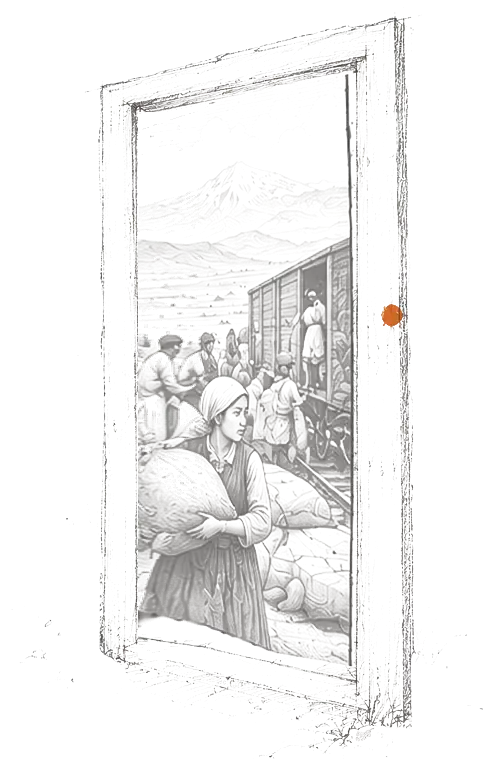
During the war, in a Kyrgyz village in the Talas valley, young Seit, fifteen, watches over Jamilia, the wife of his elder brother, who has gone to the front. With Daniyar, a demobilised soldier, lame and taciturn, they cart sacks of grain to the station every day. One evening, on the way back, Daniyar begins to sing, and both Jamilia and Seit discover another man in him.
Timeline
- 1500ManasThe longest epic in the world, recited from memory by the manaschi.
- 1850–1928AkynsToktogul, Togolok Moldo, Moldo Niyaz. Oral poetry moves to writing.
- 1928–1951Soviet periodTynystanov, Elebaev, Osmonov. The alphabet changes twice in twenty years.
- 1958JamilaAitmatov writes what Aragon will call the most beautiful love story in the world.
- 1965–1998The Kyrgyz miracleOkeev, Shepitko, Konchalovsky, then Aktan Arym Kubat.
Reading keys
- Names often end in -ov or -ova, a Russian inheritance, and many have taken up forms in -uulu, "son of", and -kyzy, "daughter of".
- Belonging to the clan and genealogy over seven generations organise alliances and political solidarities.
- Kinship terms distinguish the elder from the younger and the paternal from the maternal side, and one addresses strangers by a kinship term according to age.
- Respect for elders imposes an order of precedence in the yurt, where every place is assigned.
- The purges of the nineteen thirties wiped out the first generation of writers, including the linguist who had fixed the alphabet.
- The revolutions of 2005 and 2010 and the interethnic violence of the south, notably in 1990 and 2010, are sensitive subjects.
- Bride kidnapping, a practice still attested, is addressed head-on by part of the recent production.
- Restraint is valued, and one does not contradict an elder in public.
- Hanafi Sunni Islam is in the majority, having arrived late and long mixed with earlier beliefs.
- Tengrism, the cult of the sky and of the masters of places, survives in rites, formulas and the respect owed to springs and mountain passes.
- Umay, protectress of births, and the spirits of the ancestors, arbaki, are invoked in domestic rites.
- The mazars, tombs and sacred places high in the mountains, are visited to make vows, including by practising Muslims.
- Mourning includes a yurt set up to receive visitors, lamentations sung by the women, then commemorations on the seventh and the fortieth day and at one year.
- The white of the kalpak, the men's felt hat, and the patterns of kiyiz felt indicate status and region.
- Nowruz on 21 March is the main festival, with sumolok and the horseback games.
- The three-stringed komuz accompanies recitation, and instrumental playing itself recounts stories.
- The Manas, with its hero, his horse Akkula and his forty companions, is the absolute reference, and its recitation is listed as intangible heritage.
- The akyn and the aitysh, an improvised poetic contest, are a living practice that the texts assume is known.
- The transcription of the Manas published in 1885, in Kyrgyz and German on facing pages, is the founding document of studies on orality.
- The narratives about Tengri, Umay and the masters of places form the old religious stock.
- The Manas is not a fixed text: it exists only in versions, and looking for the original is a misreading.
- Kyrgyzstan is not Uzbekistan: a nomadic society against an old urban society, two distinct histories despite the shared border.
- Aitmatov wrote in two languages and translated himself, so that the question of the original does not arise as it does elsewhere.
- Bride kidnapping, often presented as a tradition, is an offence that recent literature speaks of as a social problem.
Tales and mythologies 1
- EpicManasМанасAnonymous · 1885The epic of the Kyrgyz, recited by inspired performers, from the hero Manas to his grandson.Literature
Available in English 1
The books from this country that can be read in English, in the original or in translation.
- Short storyJamiliaЖамийлаChinghiz Aitmatov · 1958A love born during the war on the roads of a Kyrgyz village, told by the heroine's young brother-in-law.Literature
A selection to begin with 10 / 23
- NarrativeАжарKasymaly Bayalinov · 1928not translated into EnglishA founding story of Kyrgyz letters: the fate of an orphan caught in the exodus of 1916.Literature
- PoetryАлтын кызDzhoomart Bokonbaev · 1933not translated into EnglishA Kyrgyz poem of the thirties, later brought to the stage as a musical drama.Literature
- NovelУзак жолMukai Elebaev · 1936not translated into EnglishThe book that opens the Kyrgyz novel, written from what its author had lived through as a child on the roads of the flight to China.Literature
- PoetryМахабатAlykul Osmonov · 1945not translated into EnglishKyrgyz love poems, published as the war ended.Literature
- CinemaHeatЗнойLarisa Shepitko · 1963The graduation film of a woman director from Ukraine, shot in Kirghizia from a story by Aitmatov.Cinema
- CinemaБелые горыMelis Ubukeev · 1964A film about an episode that Soviet textbooks passed over in silence, made by the first generation of filmmakers trained in the republic.Cinema
- CinemaThe First TeacherПервый учительAndrei Konchalovsky · 1965A mountain village where the school arrives with a soldier, and where an orphan girl is sold to the local master.Cinema
- CinemaНебо нашего детстваTolomush Okeev · 1966An old horse breeder and his sons who have left for the city, in the high Kyrgyz mountains.Cinema
- CinemaThe White ShipБелый пароходBolotbek Shamshiev · 1976Kirghizfilm's adaptation of a great novel by Aitmatov, about childhood, legends and the nature of the Kyrgyz mountains.Cinema
- CinemaБешкемпирAktan Arym Kubat · 1998The childhood of a village boy and the secret of his birth.Cinema