Uzbekistan
- works
- 37
- 26 books · 11 films
- period covered
- 1484–1998
- language of writing
- Uzbek
At the end of the fifteenth century, a vizier of Herat wrote a book to prove that his language was worth as much as that of the scholars. Alisher Navoi, a poet and high official of the Timurids, observed that everyone composed in Persian and that Turkic passed for rough, so he drew up a comparative judgement of the two languages, listed the words that Turkic possesses and that Persian has to paraphrase, and demonstrated that learned poetry could be written in it. Then he did so, over thousands of lines. The demonstration founded a literature, and modern Uzbek still holds Navoi to be its father, to the point that its language bears his name in the textbooks.
Read moreShow less
That quarrel has a geography. Samarkand, Bukhara, Khiva and Herat were for centuries cities where Persian served as the language of culture, Turkic as the language of the court and of the people, Arabic as the language of religion, and where people wrote in all three. Babur, a descendant of Tamerlane driven from his kingdom, founded the Mughal empire in India and left a journal in Chagatai Turkic of unusual frankness, in which he notes his defeats, his drinking bouts and his regrets.
The rupture came from outside. The Soviet authorities made Uzbek a standardised literary language, wrote it in Latin and then in Cyrillic, and eliminated the generation that had modernised it: Abdulla Qodiriy, author of the first Uzbek novel in 1922, Fitrat, Cho'lpon, all shot in 1938. Soviet Uzbek cinema then produced tolerated works, including a great film of 1968 about a child driven by the famine of the twenties from Russia to Tashkent, the city of bread. Today the language is written in Latin again, and the old collections are republished and put online in full.
What awaits the reader is a very written literature, inherited from a learned tradition, in which the poem counts for more than the narrative. The book that opens this page is made of the memoirs of a prince of Ferghana who founded the Mughal Empire, written in Chagatai Turkic, and it is regarded as the first great example of autobiography.
A way to begin
The Baburnama
Zahiriddin Muhammad Babur · 1530
The memoirs of the prince of Ferghana who founded the Mughal Empire, free of rights: regarded as the first great example of autobiography.
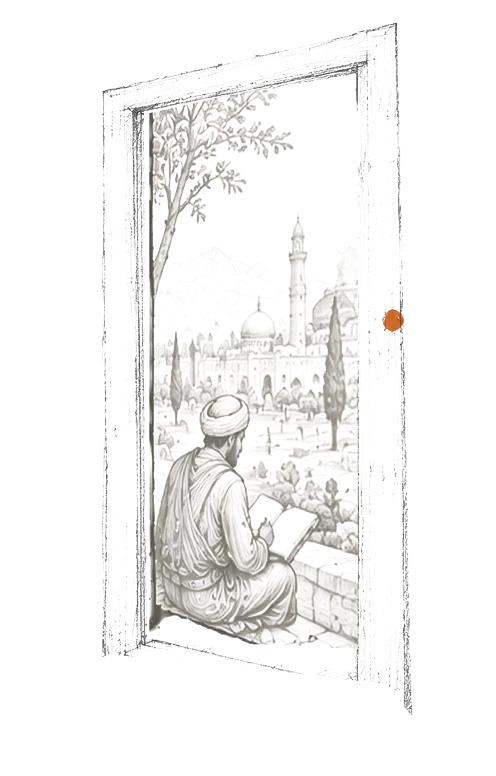
Babur follows his life from 1494, the year he became king of Ferghana at twelve: Samarkand taken and lost twice, exile, the conquest of Kabul, then the campaigns towards India. Between battles he describes, with a naturalist's curiosity, the towns, peoples, plants and animals of the lands he crosses, and notes poetry, music and festivities.
Timeline
- 1484–1530ChagataiNavoi makes Turkic a literary language; Babur writes his memoirs.
- 1700–1872Khiva and KokandMashrab, Nodira, Ogahiy. The khanate courts keep verse alive.
- 1911–1938JadidsBehbudiy, Fitrat, Qodiriy, Cholpon. To reform, then to be shot.
- 1946–1972Tashkent studioGaniyev, Khamraev, Ishmukhamedov. A Soviet Uzbek cinema.
- 1980–1998The end of the USSR and afterMahmudov, Togay Murod, then Razykov's films.
Reading keys
- Names often end in -ov or -ova, a Russian inheritance, and many have taken up forms in -zoda or -o'g'li since 1991.
- The name may indicate the town of origin, Samarqandiy, Xorazmiy, Farg'oniy, and that origin remains socially legible.
- The extended family and the neighbourhood, the mahalla, form the social unit of reference, with its elders and its obligations of mutual aid.
- Respect for elders imposes forms of address, and one does not sit down before an elder.
- The purges of 1937 and 1938, which wiped out almost all the modernist writers, are a subject officially recognised since 1991.
- The Soviet period produced an official literature and forbidden works, some of which appeared only after 1990.
- Criticism of the authorities remains risky, and several writers were imprisoned in the nineteen nineties and two thousands.
- Restraint and formal politeness organise speech, and a direct request is impolite.
- Hanafi Sunni Islam is in the majority, with a long scholarly tradition: Bukhara trained jurists and theologians for the whole Muslim world.
- Sufism, with the Naqshbandi brotherhood born here, structures a popular religiosity made of visits to tombs.
- Sogdiana and Khwarezm were Zoroastrian centres, and the figure of Siyavush is still attached to Bukhara.
- The jinn, the devs and the peris belong to the common Turkic and Persian stock, and rites of protection are commonplace.
- Muslim mourning is brief, with burial on the same day and condolences extended to the twentieth and the fortieth day.
- The doppi, an embroidered skullcap, and the chapan, a quilted coat, indicate the region and the occasion.
- Nowruz on 21 March is the main festival, with sumalak prepared collectively by the women of the neighbourhood.
- Pilaf, cooked in large quantities for ceremonies, is a social rite as much as a dish, and being responsible for it is a charge.
- Alpomish, an epic recited by the bakhshi, is the great national heroic narrative, placed on the same level as the Manas or the Kalevala.
- The Go'ro'g'li cycle, in four volumes, is the Uzbek version of the Koroglu that circulates from Azerbaijan to Tajikistan.
- The Uzbek tales, available online in full, form a considerable corpus with its devs and its peris.
- Navoi and Babur are two learned references that every Uzbek knows by name.
- Uzbek is a Turkic and not an Iranian language, despite centuries of shared Persian culture.
- Bukhara and Samarkand are today in Uzbekistan but were centres of Persian culture, and Tajik is still spoken there.
- The borders of Central Asia were drawn in the nineteen twenties and thirties, so that literary belongings overflow them.
- The written tradition is old and learned: reducing Uzbekistan to a nomadic oral culture is an error, the region having been urban for two thousand years.
Tales and mythologies 1
- EpicAlpomishAnonymous · 1928The oases of Uzbekistan and the steppe, where bakhshi sing these epics to the accompaniment of a lute and pass on their art from school to school.Literature
Available in English 4
The books from this country that can be read in English, in the original or in translation.
- NarrativeThe BaburnamaBoburnomaZahiriddin Muhammad Babur · 1530Ferghana, Kabul and India between 1494 and 1529, travelled by a prince who twice loses everything he has and ends up an emperor.Literature
- NovelDays Gone ByOʻtkan kunlarAbdulla Qodiriy · 1922The khanate of Kokand in the nineteenth century, some twenty years before the Russian conquest, seen from the Soviet Tashkent of the early twenties.Literature
- NovelNight and DayKecha va kunduzCho'lpon · 1936Russian Turkestan at the beginning of the twentieth century, where a native district chief holds his power from the colonial administration and his household from custom.LiteraturePublic domain
- NarrativeThe Mischievous BoyShum bolaGʻafur Gʻulom · 1936The pranks of a Tashkent street urchin, on the run across pre-revolutionary Turkestan.Literature
A selection to begin with 10 / 37
- PoetryLayli va MajnunAlisher Navoiy · 1484not translated into EnglishHerat at the end of the fifteenth century, where learned poetry is written in Persian and where a vizier sets out to prove that Turkish can say everything.LiteraturePublic domain
- NovelDays Gone ByOʻtkan kunlarAbdulla Qodiriy · 1922The khanate of Kokand in the nineteenth century, some twenty years before the Russian conquest, seen from the Soviet Tashkent of the early twenties.Literature
- NovelNight and DayKecha va kunduzCho'lpon · 1936Russian Turkestan at the beginning of the twentieth century, where a native district chief holds his power from the colonial administration and his household from custom.LiteraturePublic domain
- NarrativeThe Mischievous BoyShum bolaGʻafur Gʻulom · 1936The pranks of a Tashkent street urchin, on the run across pre-revolutionary Turkestan.Literature
- CinemaTendernessNezhnostElyor Ishmukhamedov · 1967A city of Central Asia in the year of the 1966 earthquake, when young filmmakers film its streets and its teenagers.Cinema
- CinemaTashkent, City of BreadTashkent, gorod khlebnyyShukhrat Abbasov · 1968Russia and Central Asia in the early twenties, when famine sends whole families onto the roads and a distant city passes for a granary.Cinema
- CinemaShum bolaDamir Salimov · 1977Soviet Uzbekistan in 1977, where the Tashkent studio brings to the screen a classic of Uzbek prose about poor childhood before the revolution.Cinema
- CinemaSuyunchiMelis Abzalov · 1982Rural Uzbekistan of the early eighties, where the generation that built the collective farms watches the one that lives on them.Cinema
- CinemaThe SavageDikarKamara Kamalova · 1988The Soviet Union of the late eighties, where cinema can at last show the arrogance of the powerful and the silence of those who endure it.Cinema
- CinemaSoldier's TaleSoldatskaya skazkaZulfikar Musakov · 1989The Soviet Union of 1989, where the end of prohibitions at last makes it possible to speak of what happens in the barracks.Cinema