Liberia
- works
- 9
- 9 books
- period covered
- 1887–1974
- language of writing
- English
The capital of Liberia bears the name of a president of the United States. Monrovia owes its name to James Monroe, and the country was founded in 1822 by an American society that intended to send back to Africa the free Black people of the United States, a philanthropic project for some, a riddance for others. The settlers brought a one-star flag inspired by the American banner, a constitution drafted on the American model, colonnaded houses and a Methodist church, and they governed for a hundred and thirty years a population that did not come from America.
Read moreShow less
Liberia is therefore the only African country that was not colonised by Europeans and that was colonised by African Americans. That configuration produced a precise hierarchy: on one side the Americo-Liberians, less than five per cent of the population, holders of power, of the written language and of access to the sea; on the other the sixteen groups of the interior, long without full citizenship. The coup of 1980 and then the civil wars overturned that order in blood, and the country never recovered its former institutions.
Literature reflects that dividing line. The first authors are Americo-Liberian and write on Anglo-Saxon models, like the poet Roland Dempster or the novelist Charles Cooper. Bai T. Moore, an ethnographer as much as a writer, published in 1968 a short novel about a murder in a village of the interior, and he is the first to bring that population into fiction. Wilton Sankawulo collected the tales of the country. The price was total: fourteen years of war from 1989 destroyed the schools, the libraries and the university.
What awaits the reader is a sober prose in which the language inherited from America rubs against a world it does not cover. The novel that opens this page is a news item, and its author had spent his life recording the traditions of those he was writing about.
A way to begin
Murder in the Cassava Patch
Bai T. Moore · 1968
A short novel drawn from a real case, now required reading in Liberian secondary schools.
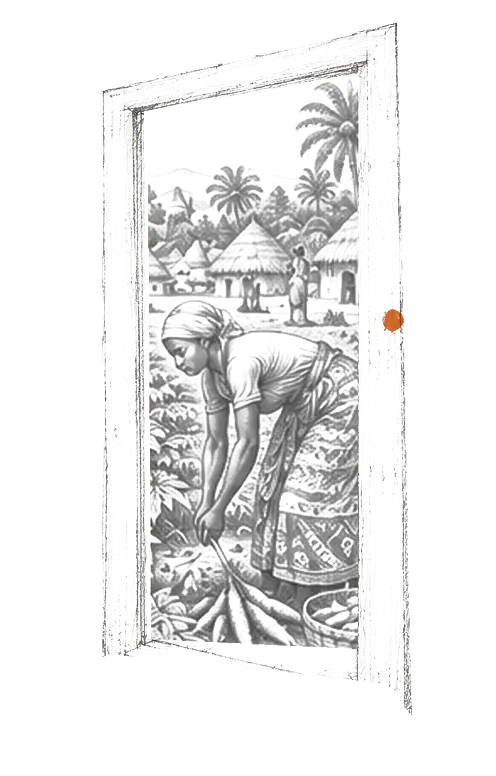
From his cell in the Monrovia prison, Gortokai reconstructs what led to the discovery, one Sunday in 1957, of Tene's body in a cassava patch. Taken in as a child by the girl's family and raised with her like a brother, he wants to marry her, but, with no parents to negotiate the bride price, he depends on Kema, Tene's sister. Urged on by his friends, he goes to an old diviner, who promises him a love potion.
Timeline
- 1932Love in EbonyCharles E. Cooper publishes the first Liberian novel.
- 1960–1968Poetry and novelDempster, Jaryenneh, then Bai T. Moore and his village crime.
- 1972–1974The last voicesReeves and Sankawulo, before the war interrupts everything.
Reading keys
- Americo-Liberian names are Anglo-Saxon, Cooper, Dempster, Tubman, Doe, inherited from the settlers or from their former American masters.
- The names of the interior, Kpelle, Bassa, Gio, Mandinka, designate the sixteen indigenous groups and immediately place a character in the social hierarchy.
- The word Congo locally designates the descendants of captives freed by the navy, and its use as an insult for the elites is charged.
- Vai, Kpelle and Gio societies are patrilineal, with powerful initiatory societies.
- Americo-Liberian domination, the exclusion of the populations of the interior until 1946 and the coup of 1980 form a dispute that has not been closed.
- The civil wars from 1989 to 2003, the child soldiers and the massacres are a subject of which national literature speaks little, for want of institutions to carry it.
- The poro and sande societies impose secrecy: a narrative may break off because what follows is reserved.
- Forced labour and the export of manpower to the rubber plantations are an old and awkward subject.
- Christianity, Methodist and Baptist, is the religion of the Americo-Liberian elites; Islam is present among the Mandinka and the Vai; ancestral cults dominate the interior.
- The poro societies for men and sande for women form religious and judicial institutions, with sacred woods and masks.
- The zoe, an initiate holding knowledge, is a central and ambivalent character.
- Leopard men and the secret societies accused of ritual crimes are a real subject in the country's judicial archives.
- Mourning includes a wake, songs and a deferred ceremony, with expenditure that commits the extended family.
- White marks the coming out of initiation and the rites of purification.
- The sande masks, danced by women, and the poro masks appear during initiation periods.
- 26 July, the day of the declaration of independence in 1847, is the civil landmark, and it commemorates an act of settlers.
- The Vai script, a syllabary invented around 1833 after a dream, is one of the rare African writings of local conception, and narratives were recorded in it.
- The Kpelle and Bassa tales, collected by Sankawulo and by the missionaries, form the narrative stock of the interior.
- The poro and sande societies and their vocabulary are a common knowledge that the texts assume is known.
- The memory of the foundation by American freedmen is the structuring historical reference, celebrated by some and contested by others.
- Liberia did not escape colonisation: it was colonised by African Americans, which is a distinct situation and not an absence.
- Anglo-Saxon names do not indicate European ancestry but a filiation with American slavery.
- The word Congo, in Liberia, does not designate the Central African country but a local social category.
- The Vai syllabary contradicts the idea of an area without a writing of its own, and it predates most colonial literacy campaigns.
Tales and mythologies 1
- TaleKpelle TalesKpelle woli-kaaAnonymous · 1930Kpelle, Bassa and Vai tales stayed outside national literature until the sixties, the country having been written from the coast and in English.Literature
A selection to begin with 7 / 9
- EssayChristianity, Islam and the Negro RaceEdward Wilmot Blyden · 1887An African writes from the only independent black state on the continent, on the eve of the partition of Africa.Literature
- NovelGuanya Pau: A Story of an African PrincessJoseph Jeffrey Walters · 1891A Vai princess flees the marriage to which she was promised as a child, in a Liberian novel of 1891.Literature
- NovelLove in EbonyCharles E. Cooper · 1932The elite from America has governed the country for a century and writes in the English manner, owing nothing to the peoples of the interior.Literature
- PoetryA Song Out of MidnightRoland T. Dempster · 1960Official poetry accompanies the ceremonies of the State, and it is through it that the country's letters make themselves known to the State.Literature
- EssayThoughts to Keep You ThinkingE. Toimu Reeves · 1972The country's printing press serves the state and the missions, and the short form stands in for the essay for lack of journals in which to publish one.Literature
- TaleThe Marriage of Wisdom and Other TalesWilton Sankawulo · 1974The stories of the interior move into writing in the language of the coast, carried by scholars trained by the missions.Literature
- EssayLiberianization or Gobbling Business?Albert Porte · 1974A village schoolteacher denounces a minister's conflict of interest, in a pamphlet that marked Liberia.Literature