Mauritania
- works
- 10
- 7 books · 3 films
- period covered
- 1731–1999
- language of writing
- Arabic and French
Slavery was formally abolished in Mauritania in 1981, and it became a crime only in 2007. The country is the last in the world to have taken those two steps. Tens of thousands of people descended from servile lines, called Haratin, still bear the juridical, economic and symbolic consequences of it, and the question runs through all public life. A whole literature has formed around that fact, written by authors who had to choose between stating it and being published.
Read moreShow less
That situation comes from an old social organisation. Moorish society is hierarchised into categories whose functions were inherited: the warrior lineages, the religious and learned lineages, the tributaries, the artisans, the griots, the captives. It is the religious lineages that produced one of the strongest scholarly traditions of the Sahara, with family libraries of Arabic manuscripts kept in the stone houses of the Adrar, at Chinguetti and Ouadane, staging towns of the caravans. Poetry in classical Arabic is still practised there as a living art, judged in public and learnt by heart.
The country is also the point where the Arab-Berber world and the West African world touch. The south of the river speaks Pular, Soninke and Wolof, the north Hassaniya, and tensions between the two produced mass expulsions in 1989. Literature in French came from there: Tène Youssouf Guèye, from the south, published in 1975 a play about exile, and cinema was born with Med Hondo, who filmed in the late sixties, from Paris, the condition of African workers, and with Sissako, who films the desert as an inhabited place.
What awaits the reader is a literature divided between two worlds that read each other little, and a learned Arabic poetry almost invisible in Europe. The novel that opens this page is a work of speculative fiction written in French, which its author later translated into Arabic himself.
A way to begin
L'Amour impossible
Moussa Ould Ebnou · 1990
A Mauritanian novel of anticipation written in French, which critics compare to Brave New World.
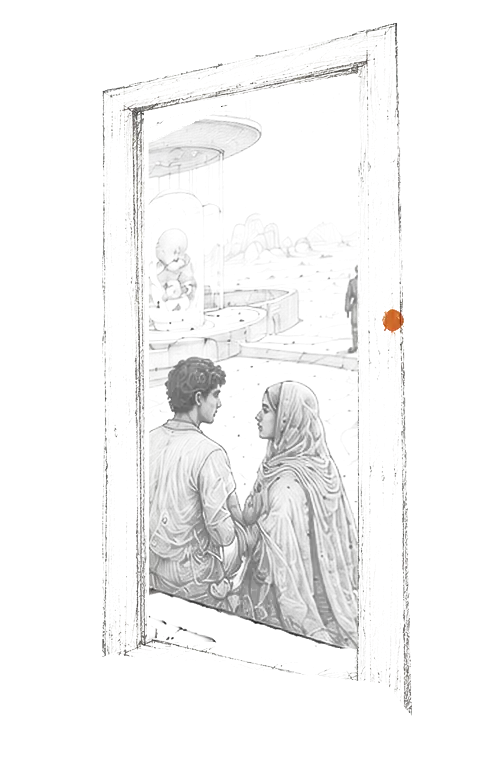
In a future society, a war of the sexes has separated men and women, and children are born in incubators. All that survives, regulated by law, is a meeting without a sequel between adolescents of the two sexes; at this first encounter, Adam and the young woman intended for him fall in love, which is a crime, and the authorities try to separate them.
Timeline
Reading keys
- The Moorish name reads with ould, "son of", and mint, "daughter of": Moussa Ould Ebnou is Moussa, son of Ebnou.
- The names of the south, in Diagana, Guèye, Athié, are Pular, Soninke or Wolof, and immediately signal the other half of the country.
- Moorish society is structured into inherited categories, and the name of the tribe indicates the place occupied in that hierarchy.
- The kunya and the religious titles, sheikh or marabout, are in current use and not honorific.
- Slavery and the condition of the Haratin are the central and most dangerous subject: activists have been imprisoned for addressing it.
- The expulsions of black populations in 1989 and 1990 and the executions of soldiers in the same period are an officially closed subject.
- The rivalry between Arabic speakers and black Mauritanians over the language of schooling is a permanent dispute.
- Restraint is valued in Moorish society, and poetry serves to say what conversation does not say.
- Maliki Sunni Islam is the state religion and the Republic is officially Islamic, which bounds the literary space.
- The Sufi brotherhoods, including the Tijaniyya and the Qadiriyya, structure religious life and scholarly networks.
- The zawiyas and the mahadras, nomadic schools where the Quran, grammar and poetry were learnt under a tent, are the traditional institution of teaching.
- The jinn of the desert and the practices of protection belong to the common stock, and the griots have a ritual role as much as a musical one.
- Muslim mourning is brief, with burial on the same day and three days of condolences.
- The melehfa, the coloured veil of Moorish women, and the blue boubou of the men indicate status and occasion.
- Tea, prepared in three servings each sweeter than the last, structures the duration of a visit and the conversation scenes.
- Ramadan and the Eids order the year, and the rainy season determines movements.
- The anthology of Moorish literature published in 1901 in English translation, with narratives, songs and legends of the western Sahara, is the accessible early source.
- The Wolof and Fulani sections of the great African collection of 1903 cover the south of the country.
- The tribal genealogies, which attach the lineages to prestigious Arab ancestors, serve as a social mythology.
- The libraries of Chinguetti and Ouadane are a reference of national pride.
- Mauritania is not a uniformly Arab country: nearly half the population speaks West African languages.
- The Haratin are not an ethnic group but a social category issued from slavery, and the word is charged.
- Poetry in classical Arabic is not here a marginal scholarly practice: it is alive, judged in public and practised by thousands of people.
- The desert is not empty: the towns of the Adrar were centres of learning with libraries that can still be visited.
Tales and mythologies 1
- PoetryHassaniya Arabic (Mali): Poetic and Ethnographic Textsلغن الحسانيةAnonymous · 1850In the Moorish country, everyone, from warrior to shepherd, knows verses in Hassaniyya by heart, and many compose them.Literature
Available in English 1
The books from this country that can be read in English, in the original or in translation.
- PoetryA Seller of WomenMarchand de femmesAminata Athié · 1992A poet from Nouakchott gives voice, in a few lines of verse, to the man who puts women up for sale.Literature
A selection to begin with 8 / 10
- Essayالوسيط في تراجم أدباء شنقيطAhmad ibn al-Amin al-Shinqiti · 1911not translated into EnglishA scholar of the Sahara, settled in Cairo, introduces the Arab East to the poetry and the land of Chinguetti.Literature
- TheatreLes Exilés de GoumelTène Youssouf Guèye · 1975not translated into EnglishA writer from Kaédi brings to the stage the history of the kingdoms of the Senegal river in their dealings with the traders of Saint-Louis.Literature
- CinemaSafrana or Freedom of SpeechSafrana ou le Droit à la paroleSidney Sokhona · 1978African immigrant workers learn farming from French peasants, in order to put it at the service of their country.Cinema
- PoetryA Seller of WomenMarchand de femmesAminata Athié · 1992A poet from Nouakchott gives voice, in a few lines of verse, to the man who puts women up for sale.Literature
- CinemaLife on EarthLa Vie sur terreAbderrahmane Sissako · 1998For a television series on the turn of the year 2000, a Mauritanian filmmaker films his father's village in Mali.Cinema
- PoetryCherguiya, odes lyriques à une femme du SahelOusmane Moussa Diagana · 1999not translated into EnglishAt the end of the nineties, a linguist from Kaédi writes of love between the Arab-Berber and Black African communities of his country.Literature