Nepal
- works
- 25
- 20 books · 5 films
- period covered
- 1400–1999
- language of writing
- Nepali
For a century, one family governed Nepal while making sure that nobody learnt to read. From 1846 to 1951, the Ranas exercised hereditary power while keeping the country closed to foreigners and school out of the people's reach, so that at their fall a handful of per cent of the population could read. A written literature under such conditions could only be born on the margins, carried by a few individuals who wrote without an audience, or in prison, and often from neighbouring India.
Read moreShow less
The stock on which it relied is old and rich. Nepal was never colonised, the Kathmandu valley produced a Newar civilisation with its temples, its chronicles and its languages, and the country has more than a hundred and twenty languages across four large linguistic families. A founding myth recounts that the valley was a lake that a bodhisattva emptied with a stroke of his sword, opening the gorge through which the river still flows. Bhanubhakta Acharya, in the nineteenth century, translated the Ramayana into Nepali and made that language a literary instrument, which earned him the title of the country's first poet.
The dominant form is the narrative poem and then the novel of social constraint. Lakshmi Prasad Devkota wrote in 1936 a long poem about a man who goes to Tibet to seek his fortune and dies on the way back, a text that every Nepali knows. Parijat published in 1965 the novel of a former Gurkha soldier whom a rebellious young woman confronts with his war crimes. Bishweshwar Prasad Koirala, a novelist and prime minister, wrote part of his work during his years of detention. The price is constant: censorship under the Ranas, censorship under the monarchy, then the civil war from 1996 to 2006 which emptied the villages of their young people.
What awaits the reader is a literature of the mountain and of departure, in which emigration is the ordinary destiny. The novel that opens this page follows a woman torn between her imprisoned husband and another man, and it was written in prison by the country's first elected head of government.
A way to begin
तीन घुम्ती
Bishweshwar Prasad Koirala · 1968
A novel written in prison by Nepal's first elected head of government: a woman torn between her imprisoned husband and another man.
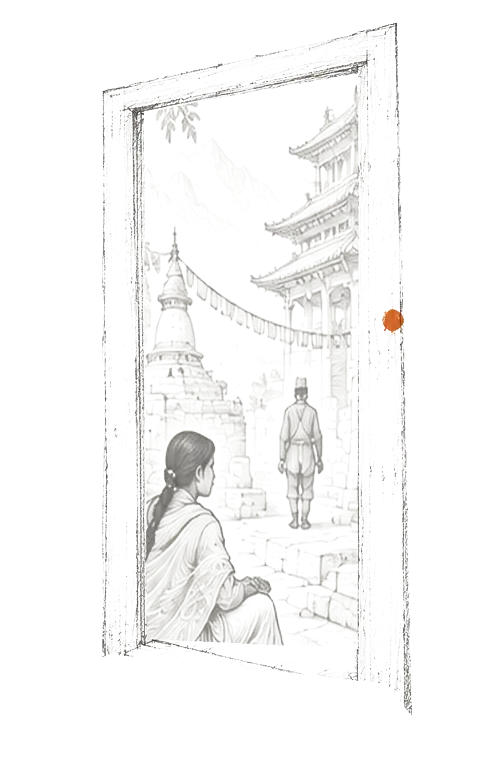
Indramaya, a young Newar woman from Kathmandu, loves Pitambar, son of a Brahmin family; marriage across castes is not accepted, but they marry anyway. An activist opposed to the king's regime, Pitambar is thrown into prison. During his detention, Indramaya falls for Ramesh, her husband's friend, and becomes pregnant; the story follows the inner struggle that ensues.
Timeline
- 1919–1936FoundersBhanubhakta, Lekhnath, Devkota. Nepali becomes a language of poetry.
- 1935–1946Prose and theatreMainali founds the short story; Bal Krishna Sama writes for the stage.
- 1960–1969The 1960 generationParijat, Indra Bahadur Rai, Bhupi Sherchan. An anxious modernity.
- 1964–1985Nepali cinemaAama, the country's first film, then Kusume Rumal, a full-house hit.
- 1968–1999Writing and filmingKoirala publishes from prison; documentary discovers the Himalaya.
Reading keys
- The name indicates the caste, the ethnic group and often the region: an Acharya or a Sharma is a Brahmin, a Shrestha or a Maharjan is Newar, a Gurung, Magar or Tamang belongs to a Tibeto-Burman language group.
- The Ranas and the Shahs are the families that governed, and their names carry that charge.
- Kinship terms distinguish the paternal and maternal sides and the order of birth, and one addresses strangers by a kinship term.
- Caste was officially abolished in 1963 but still organises marriages, and the Dalits suffer its effects.
- The Maoist civil war from 1996 to 2006, with its seventeen thousand dead, and the massacre of the royal family in 2001 are recent and heavy subjects.
- The monarchy, abolished in 2008, still divides, and the question of the secular character of the state is disputed.
- Caste discrimination and the fate of the Dalits are a subject that recent literature addresses head-on.
- Mass emigration to India and to the Gulf, and the deaths on building sites, are a contemporary narrative stock.
- Hinduism is in the majority, Buddhism important, and the two mingle to the point that some temples are frequented by both communities.
- The Newar of the valley practise a specific Buddhism and Hinduism, with a pantheon of their own and Buddhist castes.
- The Kumari, a young girl recognised as the incarnation of a goddess and venerated until her puberty, is a living institution of Kathmandu.
- The shamanism of the dhami and jhankri is practised in the mountains, and a shaman is consulted for an illness as a doctor is.
- Hindu mourning imposes on the son a year of white clothes, a shaved head and food prohibitions, visible in public.
- White is the colour of mourning, red that of marriage and of the marital vermilion.
- Dashain in autumn, with its animal sacrifices and its blessings, and Tihar are the major festivals that impose the return to the village.
- The tika, a mark of rice and vermilion on the forehead, is given by an elder and commits a relation.
- The myth of the valley-lake emptied by a bodhisattva is the narrative of origin of Kathmandu.
- The Ramayana in Nepali, translated in the nineteenth century, made that language a literary one and remains a school reference.
- The long poem of 1936 about the man who went to Tibet is known by heart and quoted like a proverb.
- The Newar narratives and the chronicles of the valley form a stock distinct from the Nepali one.
- Nepal was never colonised, and its closure until 1951 is the doing of an internal regime, not of a foreign power.
- Nepali is spoken as a mother tongue by only half the country, and more than a hundred and twenty languages are recorded there.
- The country is not exclusively Buddhist: Hinduism is in the majority there, and the Tibetan image of Nepal is a tourist simplification.
- The mountain is not a trekking setting: it is an economic obstacle and the motive for a departure.
Tales and mythologies 1
- ChronicleSvayambhu Puranaस्वयम्भू पुराणAnonymous · 1400The Buddhist myth of a lake drained by a bodhisattva's sword, from which emerge a habitable land and its sanctuary on the hill.Literature
Available in English 10
The books from this country that can be read in English, in the original or in translation.
- EpicBhanu Bhakta Ramayanaभानुभक्तको रामायणBhanubhakta Acharya · 1887The first epic of Nepali literature: the story of Rāma rendered into Nepali in the middle of the nineteenth century, published in full in 1887.Literature
- Short storiesThe WardनासोGuru Prasad Mainali · 1935A short story from 1935 about a childless Brahmin who takes a second wife, and about the first wife, who fades into the background.Literature
- PoetryMuna MadanमुनामदनLaxmi Prasad Devkota · 1936The poem of a departure for Tibet and of a woman who waits, known to all of Nepal.Literature
- TheatrePrahladप्रह्लादBalkrishna Sama · 1938A play from the late thirties that transposes a Hindu myth into a quarrel between human knowledge and faith.Literature
- NovelMountains Painted with TurmericबसाइँLil Bahadur Chettri · 1958A novel from 1958 about a family of poor peasants in eastern Nepal, struggling against a moneylender and a landowner.Literature
- NovelThe Window of the House Oppositeपल्लो घरको झ्यालGovinda Bahadur Malla 'Gothale' · 1959A novel of 1959: a young Newar bride, a colourless husband, and the man she watches through the window.Literature
- NovelAnuradhaअनुराधाBijaya Malla · 1961A novel of 1961 about a young woman from the Terai who refuses the husband chosen for her.Literature
- NovelThere's a Carnival Todayआज रमिता छIndra Bahadur Rai · 1964A novel of 1964 about Darjeeling in the aftermath of Indian independence, its tea workers and its political quarrels.Literature
- NovelBlue Mimosaशिरीषको फूलParijat · 1965A novel of 1965 about a former Gurkha soldier whom the encounter with a rebellious young woman confronts with his war crimes.Literature
- NovelThe Wake of the White Tigerसेतो बाघDiamond Shumsher Rana · 1970Palace intrigues in the Nepal of the Ranas: Diamond Shumsher Rana's great historical novel.Literature
A selection to begin with 10 / 25
- EpicBhanu Bhakta Ramayanaभानुभक्तको रामायणBhanubhakta Acharya · 1887The first epic of Nepali literature: the story of Rāma rendered into Nepali in the middle of the nineteenth century, published in full in 1887.Literature
- PoetryMuna MadanमुनामदनLaxmi Prasad Devkota · 1936The poem of a departure for Tibet and of a woman who waits, known to all of Nepal.Literature
- NovelThe Window of the House Oppositeपल्लो घरको झ्यालGovinda Bahadur Malla 'Gothale' · 1959A novel of 1959: a young Newar bride, a colourless husband, and the man she watches through the window.Literature
- NovelAnuradhaअनुराधाBijaya Malla · 1961A novel of 1961 about a young woman from the Terai who refuses the husband chosen for her.Literature
- CinemaAamaHira Singh Khatri · 1964A son returned from the army, a vanished mother, and the first fiction film shot in the kingdom.Cinema
- NovelBlue Mimosaशिरीषको फूलParijat · 1965A novel of 1965 about a former Gurkha soldier whom the encounter with a rebellious young woman confronts with his war crimes.Literature
- CinemaKumariPrem Bahadur Basnet · 1977A former living goddess faces marriage, in the first colour film of the kingdom.Cinema
- CinemaParal ko AagoPratap Subba · 1978A domestic quarrel brought to the screen in the hills of Darjeeling, based on a Nepali realist short story.Cinema
- CinemaKusume RumalTulsi Ghimire · 1985Two students in love, a rival, and the songs that made the film the first great success of Nepali cinema.Cinema
- CinemaHimalayaHimalaya, l'enfance d'un chefEric Valli · 1999A yak caravan in Dolpo, an old chief in mourning and his young rival, played by inhabitants of the valley.Cinema