Uganda
- works
- 10
- 9 books · 1 film
- period covered
- 1901–1999
- language of writing
- English
In June 1962, some thirty writers gathered for a week on the campus of Makerere, in Kampala. Achebe, Ngũgĩ, Soyinka, Okigbo, South Africans, West Indians, Americans: most were under thirty-five and almost none was yet famous. The title of the meeting posed a question that would occupy the continent for thirty years: can one speak of an African literature of English expression. Ngũgĩ arrived there under the name of James and would leave determined to bear it no longer. Nobody had invited a writer working in an African language.
Read moreShow less
Uganda was the logical place for that meeting. Makerere had been since the nineteen twenties the great college of East Africa, training the elites of Kenya, Tanzania and Uganda, with a library and a review. The country itself is made of old kingdoms, among them Buganda, with its court, its royal drums, its genealogies and its elaborate political system, which the British administered indirectly and whose king was exiled and then restored. The Nilotic north, for its part, had no kings and was treated as a reservoir of soldiers.
The most original form came from the north. Okot p'Bitek published in 1966 the long lament of an Acholi woman whose husband, back from school, finds her backward and prefers a modern woman who powders her face. The text imitates the structure of Acholi song, with its repetitions, its ritual insults and its cattle imagery, and the author had first written it in Acholi before translating it himself. The price was paid under Amin and afterwards: Okot p'Bitek was driven out of the country, John Ruganda left for Kenya, the Makerere review ceased publication, and production stopped for twenty years.
What awaits the reader is a poetry of addressed speech, with a present addressee and a held anger. The poem that opens this page is the lament of an Acholi wife against a husband who despises his people, and the author gave the husband's reply only in another book.
A way to begin
Song of Lawino: A Lament
Okot p'Bitek · 1966
An Acholi wife defends her culture against her Western-educated husband: one of the most widely read African works.
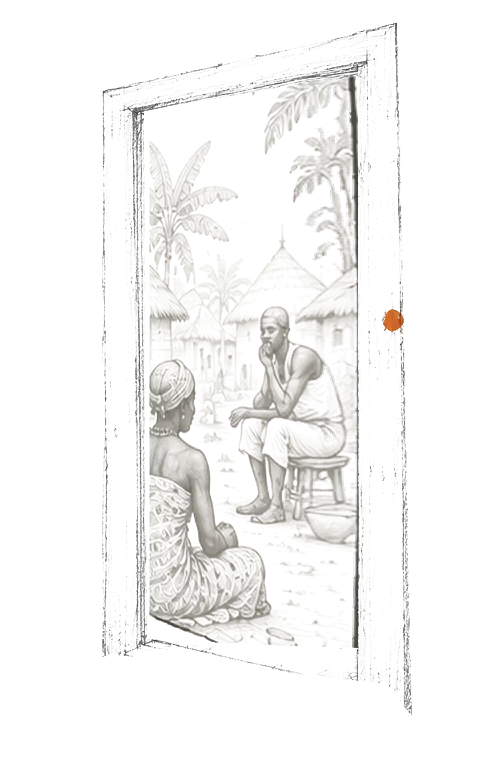
Lawino addresses her husband Ocol, who has taken a second wife, Clementine, and now despises everything that comes from his people. More than his infidelity, she reproaches him for this contempt, and defends Acholi culture chapter by chapter: the dances he finds shameful, cooking on a wood fire against the stove, the time of the seasons against the clock, ancestral religion against the missionaries' contradictions.
Timeline
- 1966–1970The Makerere generationOkot p'Bitek, Okello Oculi, John Ruganda. The university makes the literature.
- 2000KintuUgandan cinema begins, thirty years after the writers.
Reading keys
- Names indicate the region and the language: the Bantu names of the south, like Mukasa or Nakato, differ from the Nilotic names of the north, like Okot, Okello, Oculi.
- Among the Baganda, the clan, siga, passes through the father and determines food prohibitions and possible marriages.
- Baganda first names may indicate the position among siblings or the circumstances of birth, and twins have fixed names.
- The title of kabaka designates the king of Buganda, an institution still in existence, and not an ordinary customary chief.
- The Idi Amin regime, from 1971 to 1979, the expulsion of the Asians in 1972 and the massacres that followed are a subject that was long impossible.
- The war in the north and the abduction of children by the rebellion, from 1987, is a subject that foreign literature speaks of more than local literature.
- The division between a Bantu south and a Nilotic north runs through the whole political history of the country.
- Homosexuality carries very heavy penalties, which makes its literary evocation dangerous.
- Christianity, Catholic and Anglican, is in the majority, with a history of violent rivalry between the two missions, and Islam is present.
- The balubaale, divinities of Buganda, and Kintu, the first man and ancestor of the kings, belong to the Bantu stock of the south.
- The bacwezi, deified hero-spirits, are the object of a possession cult that ran through the whole Great Lakes region.
- Jok, among the Acholi of the north, designates spiritual powers, and rites of purification after a killing are practised.
- Mourning includes a wake, burial on the clan's land and a deferred ceremony of lifting of mourning.
- The royal drums of Buganda, each with its name and its rhythm, announce the events of the court, and mentioning them summons the institution.
- The gomesi and the kanzu, ceremonial garments, indicate respect and occasion.
- The calendar mixes Christian feasts, Muslim feasts and royal ceremonies.
- Kintu, first man of Buganda come down from the sky, and the long list of the kabaka form the narrative of origin of the south.
- The tales collected at the beginning of the twentieth century, notably Ganda and Nyoro, constitute the documented corpus.
- The bacwezi and their cult are a reference shared with Rwanda and Burundi.
- Acholi songs, with their fixed forms and their ritual insults, are the stock on which Okot p'Bitek built his work.
- Buganda is not Uganda: it is a kingdom inside the country, to which it gave its name, and that confusion is politically sensitive.
- Okot p'Bitek's poem is not a translation from English but a text thought in Acholi and retranslated by its author.
- The north-south division is not only ethnic: it is also economic, educational and military.
- The country cannot be summed up by Idi Amin, whose image nevertheless occupies the whole space abroad.
Tales and mythologies 1
- ChronicleThe Kings of BugandaBasekabaka be BugandaApolo Kagwa · 1901The author governed the kingdom, under British protectorate, at the time he was writing its history.Literature
A selection to begin with 8 / 10
- Short storiesKalasandaBarbara Kimenye · 1965The foibles and tricks of the inhabitants of a village in Buganda, in comic stories, around independence.Literature
- NovelProstituteOkello Oculi · 1968The author, a young Makerere graduate, publishes the book with an African publisher in Nairobi, refusing the European houses.Literature
- NovelReturn to the ShadowsRobert Serumaga · 1969The flight of an African businessman after a coup, pursued by the shadows of his lost loyalties.Literature
- TheatreThe BurdensJohn Ruganda · 1970The play shows what a broken political career does to a Ugandan family after independence.Literature
- TheatreOluyimba lwa WankokoByron Kawadwa · 1971not translated into EnglishA stranger seizes a royal court, in a satirical opera in Luganda, a founding work of Ugandan musical theatre.Literature
- TheatreWhen the Hunchback Made RainElvania Namukwaya Zirimu · 1975Mankind facing supernatural powers, in the best-known play of a Ugandan playwright.Literature
- NovelAbyssinian ChroniclesAbessijnse kroniekenMoses Isegawa · 1998A cunning child grows up under Obote and Amin, between a tyrannical mother and a country going under.Literature
- Short filmKintuLovinsa Kavuma · 1999A co-production between the United Kingdom and Uganda, directed by a filmmaker trained in London.Cinema