Saint Lucia
- works
- 3
- 3 books
- period covered
- 1956–1990
- language of writing
- English
On the evening of 19 June 1948, an iron left on in a tailor's workshop set fire to a wooden house in Castries. The blaze destroyed a large part of the town and left more than eight hundred families homeless. A young man of eighteen, Derek Walcott, drew from it a poem, “A City's Death by Fire”, which launched his career.
Read moreShow less
Saint Lucia passed several times from France to England before being ceded to the British in 1814. Castries was first called Le Carénage, and the town took the name of a French officer, the Marquis de Castries. Slavery was abolished in 1834, and the island became independent on 22 February 1979. English is the official language, but people also speak a French-based Creole, Kwéyòl, which is celebrated at the end of October. The island counts two Nobel laureates born on the same day, a 23 January: the economist Arthur Lewis, crowned in 1979, and Walcott, in 1992.
Literature was born of a small group. In 1950 the twins Derek and Roderick Walcott founded with friends the St Lucia Arts Guild, where Roderick staged his plays, including one on the feast of La Rose, one of the two flower societies that divide the island. Garth St. Omer, of the same generation, published in London in 1968 a brief and dark first novel about a young intellectual of the island. The price, here, is exile: Walcott lived in Trinidad and then in the United States, his brother in Canada, St. Omer in California.
What awaits the reader is an English crossed by Creole and by the great European texts, and a small island that takes itself as the subject of an epic. The poem that opens this page appeared in 1990, two years before its author's Nobel, and found its first French translation only in 2026.
A way to begin
Omeros
Derek Walcott · 1990
Homer among the fishermen of Saint Lucia: the epic of a small island, hailed by the Nobel two years after its publication.
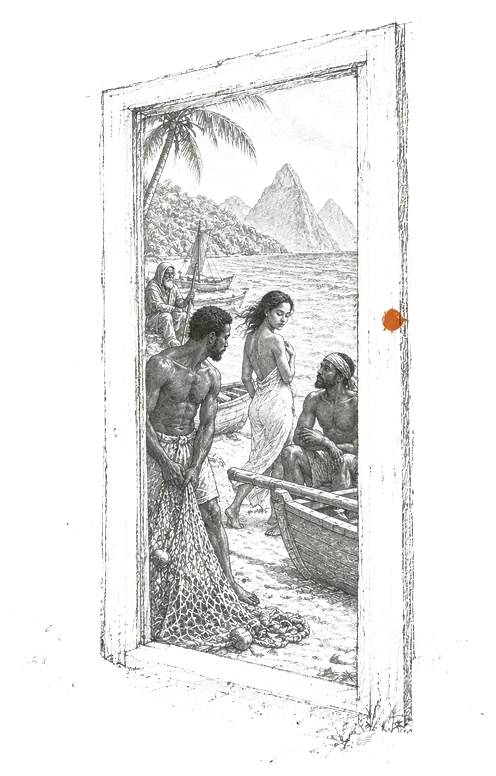
On Saint Lucia, two fishermen, Achille and Hector, fight over the beautiful Helen, while Philoctete, another fisherman, suffers from a wound. Major Plunkett and his wife Maud have their own story, and the narrator weaves into the tale that of his own life. Seven Seas, an old blind man, stands in for Homer: the poem transposes the Iliad and the Odyssey to the twentieth-century Caribbean.
Timeline
- 1948–1950The fire and the Arts GuildCastries burns; the Walcott twins found the St Lucia Arts Guild with friends.
- 1956–1972Theatre and novelRoderick Walcott's plays on the flower festivals, Garth St. Omer's first novel.
- 1979–1992Independence and OmerosThe island becomes independent; Omeros appears in 1990 and Walcott receives the Nobel in 1992.
Reading keys
- The island bears the name of Saint Lucy of Syracuse, and many places keep a French name, a legacy of the first colonists who came from Martinique.
- About four inhabitants out of five are of African descent; most of the others are of mixed descent, and the island also has Indo-Caribbean, Lebanese and Syrian families.
- A small Kalinago population, descended from the first inhabitants, lives mainly around Choiseul.
- The societies of La Rose and La Marguerite have their kings, queens, princes and judges, a hierarchy that reproduces the order of colonial society.
- Almost the whole population belongs to one of the two flower societies, rivals since slavery, and the rivalry remains lively.
- The Catholic Church long condemned these societies, and it banned Roderick Walcott's play about La Rose for immorality and sacrilege.
- Kwéyòl, the language of the home, stands beside English, the language of school and the state, and the choice between the two is never neutral.
- The exile of writers, who left to teach and publish abroad, is part of the island's literary history.
- The great majority of Saint Lucians are Catholic.
- The feast of La Rose, on 30 August, the day of Saint Rose of Lima, mixes religious ceremonies and costumed parades.
- On 29 June the fishermen's feast honours Saint Peter: the boats are decorated and blessed before the festivities.
- The flower societies have kept from their origins rites and night-time gatherings that the Church regarded with suspicion.
- La Rose is celebrated on 30 August and La Marguerite on 17 October, with their songs led by a lead singer, the chantwèl.
- Carnival, which used to be held before Lent, was moved to July in 1999.
- The month of October is devoted to Creole culture, and Jounen Kwéyòl, at the end of the month, is its high point.
- Every year the week of 23 January honours the island's two Nobel laureates.
- Derek Walcott, Nobel laureate in 1992, is the island's great figure, and a square in Castries has borne his name since 1993.
- Arthur Lewis, Nobel laureate in economics in 1979, shares with him his birth date and the national memory.
- The Castries fire of 1948 is a collective landmark and the starting point of Walcott's work.
- The St Lucia Arts Guild, founded in 1950, is regarded as the cradle of the island's theatre and poetry.
- Saint Lucia has been an independent state since 1979, a member of the Commonwealth, and not a French territory, despite its names and its Creole.
- Its Creole is close to those of Martinique and Guadeloupe, but the official language is English.
- Walcott also appears in the catalogue under Trinidad and Tobago, where he did most of his theatre; he is here for Omeros.
- The characters of Omeros bear Greek names, Achille, Hector, Helen, but they are fishermen and inhabitants of the island.
A selection to begin with 2 / 3
- TheatreThe Banjo ManRoderick Walcott · 1956The festivities of La Rose brought to the stage, with their songs and rivalries, by Derek Walcott's twin brother.Literature
- NovelA Room on the HillGarth St. Omer · 1968The youth of a Saint Lucian intellectual in a colonial and Catholic society, in the author's first novel.Literature