Tanzania
- works
- 16
- 12 books · 4 films
- period covered
- 1870–1994
- language of writing
- Swahili and English
The first president of Tanzania translated Shakespeare into Swahili. Julius Nyerere, a schoolteacher become head of state, put two plays of the English repertoire into Swahili verse, not out of affectation but to demonstrate that an African language could carry anything. He made Swahili the language of school, of administration and of the army, in a country of a hundred and twenty languages in which none was in the majority, and the operation succeeded: Tanzania is the country in Africa where an African language has most completely replaced that of the coloniser.
Read moreShow less
Swahili was not an arbitrary choice. It is a Bantu language of the coast, charged with Arabic and Persian vocabulary by a thousand years of trade in the Indian Ocean, and it was written in Arabic characters long before the arrival of the Europeans: the oldest dated Swahili manuscript is an epic poem of 1728. The cities of the coast, Kilwa, Zanzibar, Bagamoyo, belonged to a world that stretched from Arabia to India, with its ships, its jurists and its poets. Poems in counted verse were written there when Europe was still unaware that those ports existed.
Hence a literature on two levels that speak little to each other. On one side an abundant production in Swahili: Shaaban Robert, considered the national poet, Muhammed Said Abdulla who invented the Swahili detective novel in 1960, Ebrahim Hussein who wrote in 1969 a play about the anticolonial revolt of 1905. On the other an anglophone production turned outwards, including Abdulrazak Gurnah, who left Zanzibar at eighteen after the revolution of 1964, and who received the Nobel prize in 2021 for novels written in England.
What awaits the reader is a country where the national language has won, and a literature half of which remains invisible to anyone who reads only English. The novel that opens this page follows a boy handed over to a merchant to pay his father's debts, across East Africa before the Great War, and it is the book that made the future Nobel laureate known.
A way to begin
Paradise
Abdulrazak Gurnah · 1994
The book that made Abdulrazak Gurnah, Nobel laureate in literature in 2021, known: East Africa on the eve of the Great War.
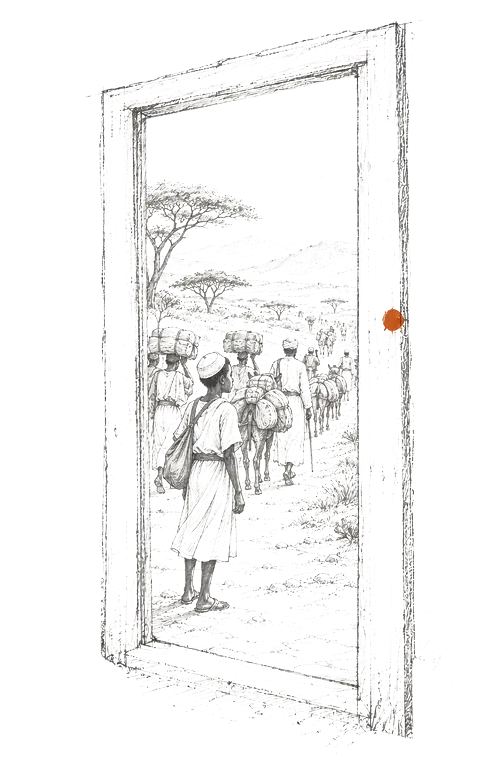
Yusuf is twelve when his father, deep in debt, hands him over to a rich merchant he believes to be his uncle and whom he must serve to pay off the debt. From the shop to the caravans heading inland, he crosses an East Africa of traders, porters and notables, and discovers what his own freedom is worth in an enclosed garden that looks like paradise.
Timeline
- 1960–1968Modern SwahiliShaaban Robert, and Muhammed Said Abdulla, who invents the Swahili detective novel.
- 1968–1972Theatre and novelEbrahim Hussein's Kinjeketile; Palangyo, Ruhumbika, Penina Mlama.
- 1975–1986Tanzanian cinemaFimbo ya Mnyonge, Harusi ya Mariam. A rare, cooperative output.
- 1987–2001Gurnah and afterMemory of Departure; Maangamizi, the country's first film submitted to the Oscars.
Reading keys
- On the coast and in Zanzibar, names are Arab-Swahili, with bin and binti for filiation, and often an Omani, Indian or Comorian origin.
- Inland, Bantu names indicate the group, and the prefix m- designates a person, wa- a people: an Msukuma belongs to the Wasukuma.
- The societies of the north-west are in part matrilineal, those of the north patrilineal, and the system determines inheritance.
- Mzee, the elder, is a title of respect used currently and replacing the name.
- The Zanzibar revolution of 1964 and the massacres that accompanied it are a raw subject, notably for the population of Arab and Indian origin.
- The union between the mainland and Zanzibar remains a permanent political dispute.
- The socialist period, ujamaa, with its forcibly grouped villages, is judged in contrasting ways.
- Sorcery and the killing of people with albinism are contemporary social realities with grave consequences.
- Islam has dominated the coast and Zanzibar for a thousand years, Christianity the interior, and the ancestral cults coexist with both.
- The Sufi brotherhoods and the old mosques of the coast belong to the world of the Indian Ocean.
- The mganga, healer and diviner, is an ordinary character, distinct from the malevolent sorcerer, the mchawi.
- Spirits, mizimu and pepo, take possession of the body, and possession rites are practised all along the coast.
- Muslim mourning is brief, with burial on the same day and three days of condolences; Christian mourning in the interior includes a wake and a collection.
- The kanga, a piece of cloth worn by women, carries a printed proverb that is chosen for what it says. A kanga is a message.
- Taarab, the music of Zanzibar mixing Arab and Indian influences, accompanies weddings and is sung in Swahili.
- Ramadan and the Eids order the year on the coast, with a nocturnal life during the month of fasting.
- The Swahili tales dictated by inhabitants of Zanzibar and published in 1870, in Swahili and in English on facing pages, form the founding corpus.
- Sungura the hare is the central trickster of the Swahili stock, and he triumphs over the big animals.
- Classical Swahili poetry, with its fixed forms and its manuscripts in Arabic characters, is a learned reference.
- The Maji Maji revolt of 1905, in which people believed that a water made them invulnerable, is the shared anticolonial memory.
- Swahili is not an Arabic language: it is a Bantu language with a strong Arabic lexical contribution, and its grammar is African.
- Zanzibar is not a tourist island without history: it was the capital of an Omani sultanate and a centre of the slave trade.
- Swahili literature is abundant and old, and ignoring it because it is not translated distorts any idea of Tanzanian production.
- The kanga is not a simple wrapper: the proverb it carries is chosen and may be aimed at someone.
Tales and mythologies 1
- TaleSwahili Tales, as Told by Natives of ZanzibarEdward Steere · 1870Tales of the Swahili coast, the cunning hare first among them, collected from the mouths of inhabitants of Zanzibar and printed with their English translation.Literature
Available in English 6
The books from this country that can be read in English, in the original or in translation.
- NovelKusadikika: A Country in the SkyKusadikika, nchi iliyo anganiShaaban Robert · 1951A political fable about a country where one must believe without ever asking, written in Swahili at the height of colonisation.Literature
- NovelDying in the SunPeter K. Palangyo · 1968A son's return to the bedside of an unloved father, in a village in northern Tanzania just after independence.Literature
- TheatreKinjeketileEbrahim Hussein · 1969The 1905 uprising against Germany, brought to the stage in Swahili in the first years of independence.Literature
- NovelVillage in UhuruGabriel Ruhumbika · 1969A village caught between clan and nation, at the moment when Tanganyika wins its sovereignty.Literature
- NovelRosa MistikaEuphrase Kezilahabi · 1971The first novel of the great Swahili writer of Tanzania, about a girl left at the mercy of adults' abuses.Literature
- NovelParadiseAbdulrazak Gurnah · 1994The Swahili coast on the eve of the Great War, when the Europeans are finishing establishing themselves there and the trade with the interior is living its last years.Literature
A selection to begin with 10 / 16
- NovelKusadikika: A Country in the SkyKusadikika, nchi iliyo anganiShaaban Robert · 1951A political fable about a country where one must believe without ever asking, written in Swahili at the height of colonisation.Literature
- NovelMzimu wa Watu wa KaleMuhammed Said Abdulla · 1960not translated into EnglishA murder solved by a detective in the manner of Sherlock Holmes, transposed into the setting and language of Zanzibar.Literature
- TheatreKinjeketileEbrahim Hussein · 1969The 1905 uprising against Germany, brought to the stage in Swahili in the first years of independence.Literature
- NovelVillage in UhuruGabriel Ruhumbika · 1969A village caught between clan and nation, at the moment when Tanganyika wins its sovereignty.Literature
- NovelRosa MistikaEuphrase Kezilahabi · 1971The first novel of the great Swahili writer of Tanzania, about a girl left at the mercy of adults' abuses.Literature
- CinemaFimbo ya MnyongeAnonymous · 1974The film belongs to Tanzanian production of the 1970s, supervised by the state as part of the cultural policy of ujamaa.Cinema
- NovelKasri ya Mwinyi FuadShafi Adam Shafi · 1978not translated into EnglishMasters and slaves of a great Zanzibari house, in the last days of the sultanate.Literature
- CinemaArusi ya MariamuRon Mulvihill and Nangayoma Ng'oge · 1985Hospital medicine and the medicine of healers face to face, in the first co-production between Tanzania and the United States.Cinema
- CinemaMama TumainiSigve Endresen and Martin Mhando · 1986The film belongs to the co-productions between Tanzania and Scandinavian cooperation, important in the country since the 1970s.Cinema
- CinemaThese HandsFlora M'mbugu-Schelling · 1992A whole day in a quarry near the Tanzanian capital, with Mozambican refugee women who break stone by hand, without a word of commentary.Cinema