Botswana
- works
- 9
- 8 books · 1 film
- period covered
- 1913–2000
- language of writing
- English
In 1964, a woman of twenty-seven arrived in Botswana with a teacher's visa and a son, and would not obtain citizenship for another fifteen years. Bessie Head had been born in a South African psychiatric asylum, to a white mother interned for having had a child by a black man, in a country where that birth was an offence. A refugee without papers in a village in Botswana, she wrote there a body of work about that village, and the country that had barely tolerated her today claims her as its greatest writer.
Read moreShow less
That story tells of a particular position. Botswana is a country of savanna and desert, thinly populated, which knew neither settler colonisation nor a war of liberation: a British protectorate administered from a distance, it became independent in 1966 without violence, with one of the poorest economies in the world, before diamonds changed everything. The Tswana kingdoms had a remarkable political institution, the kgotla, an assembly where anyone may speak before the chief, and which still functions today as a local court.
Written literature is therefore recent and not abundant, but it has a character of its own: it looks at the village and not the city, and conflict there is social rather than racial. Leetile Raditladi had published in 1945 a play in Setswana about a chief assassinated by his own people. Andrew Sesinyi wrote in 1981 the first Botswanan novel in English. Barolong Seboni set up a poetry of drought and light. The price is smallness: a country without publishing or a sufficient audience, whose authors publish in Gaborone in tiny print runs or abroad.
What awaits the reader is a calm writing, attentive to the gestures of daily life and to public speech, without the violence that runs through the neighbouring literatures. The novel that opens this page tells of a thwarted love between a village boy and a young woman from Gaborone, and its author is regarded as the country's first novelist in English.
A way to begin
Love on the Rocks
Andrew Sesinyi · 1981
A thwarted love between a village boy and a young woman from Gaborone, by Botswana's first novelist in English.
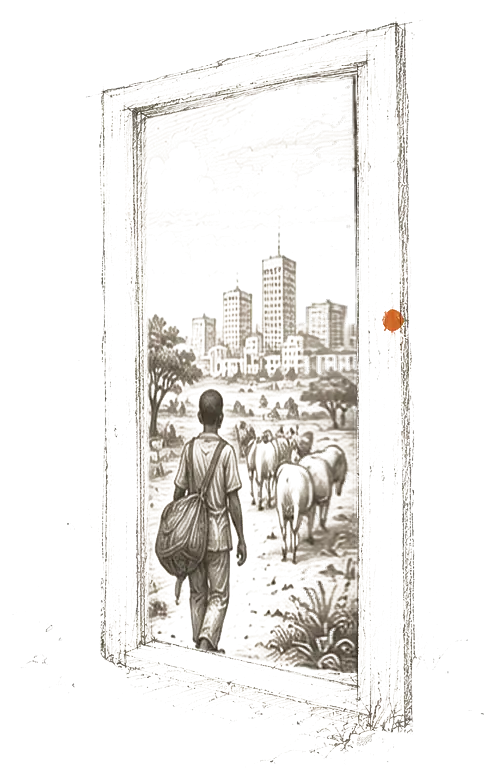
Pule Nkgogang grows up in the village, herding cattle under a harsh uncle, then makes his way to Gaborone, where he finds work and resumes his studies. There he loves Moradi, an educated young woman of the city. Moradi's parents see him as a boy of no standing and want to marry their daughter into an influential family, while Pule's family would like to choose him a wife in the village.
Timeline
Reading keys
- Setswana names are often sentences: Mmegi, Kgosi, Seboni, with the prefix mo- for the person and ba- for the people. A Motswana belongs to the Batswana.
- The kgosi is the chief, and the kgotla the assembly where matters are discussed before him. Those two words come up constantly and designate real institutions.
- Tswana societies are patrilineal, with a system of age classes, the mephato, which organised collective work.
- Bogadi, the payment made by the groom, is counted in cattle and negotiated between families.
- The condition of the San, called Basarwa, expelled from the Kalahari reserve and long treated as inferiors, is the most difficult subject in the country.
- Chieftaincy and parliamentary democracy coexist, and criticising a kgosi commits one differently from criticising a minister.
- Relations with neighbouring South Africa, on which the country long depended economically, are a sensitive subject.
- At the kgotla, speech is free but regulated: one does not interrupt, one waits one's turn, and a character who speaks badly in public loses standing.
- Christianity has been in the majority since the nineteenth century, with numerous African independent churches.
- Modimo is the supreme god and the badimo the ancestors, addressed for family affairs.
- The ngaka, healer and diviner, throws the bones to make a diagnosis, and the accusation of boloi, sorcery, has real consequences.
- The San cosmology of the Kalahari, documented since the nineteenth century, constitutes a distinct and much older stratum.
- Mourning imposes on the widow a dark garment and a seclusion of several months, with prohibitions on movement.
- Funerals bring together the extended family and each person's contribution is counted publicly.
- The rain rites, addressed to the ancestors at the end of the dry season, are awaited and recounted.
- 30 September, the day of independence in 1966, is the civil landmark.
- The San narratives of the Kalahari, with the mantis and the transformer animals, belong to the corpus documented since the nineteenth century.
- The Setswana proverbs and tales, published as early as 1879 by the missionaries, form the domestic stock.
- The kgotla and its protocol are a reference that any Botswanan text assumes is known.
- The narratives about the Tswana chiefs of the nineteenth century, including Khama, serve as a common political memory.
- Botswana is not entirely desert: the north is an inland delta and most of the population lives in the east.
- The San are not "first men" frozen in prehistory but contemporary citizens deprived of their lands.
- Bessie Head is claimed by Botswana and by South Africa, and her work belongs to both literary histories.
- The country's political stability, often cited as an example, has not prevented exclusions of which literature speaks little.
Tales and mythologies 1
- PoetryPraise-Poems of Tswana ChiefsAnonymous · 1965Tswana oral poetry, still recited at the installation of a chief or a president of Botswana.Literature
A selection to begin with 7 / 9
- ChronicleDinwao leha e le dipolelo kaga dico tsa seCwanaAlfred John Wookey · 1913not translated into EnglishThe origins, chiefs and customs of the main Tswana peoples, in a history book written in Setswana.Literature
- CinemaThe Dop DoctorL. C. MacBean and Fred Paul · 1915Adaptation of a successful English novel set during the Boer War.Cinema
- TheatreMotswasele IILeetile Disang Raditladi · 1945not translated into EnglishIt is the first historical drama written by an author from Botswana, in Setswana.Literature
- NovelWhen Rain Clouds GatherBessie Head · 1968First novel by a South African exile, written in Botswana in the years of independence.Literature
- PoetryImages of the SunBarolong Seboni · 1986First collection by a poet from Botswana, published by an American university where he was pursuing his studies.Literature
- Short storiesChildren of the TwilightMoteane Melamu · 1987A collection by a Botswana academic devoted to the South African townships in the time of the racial laws.Literature
- NovelFar and Beyon'Unity Dow · 2000A family in Botswana facing AIDS, poverty and men who abuse their power, by a judge.Literature