Burkina Faso
- works
- 23
- 15 books · 8 films
- period covered
- 1962–1999
- language of writing
- French
Since 1969, the capital of African cinema has been a city with no sea, no forest and no industry. Every two years Ouagadougou hosts a pan-African festival whose grand prize is awarded under the name of the Stallion of Yennenga, after a Mossi princess whose ride founds the dynasty. Directors from all over the continent have been coming there for more than half a century, and the country equipped itself with schools, laboratories and a film library, in material conditions that predisposed it to none of that.
Read moreShow less
That decision is consistent with the country's history. The Mossi kingdoms held for four centuries without letting themselves be Islamised or conquered, with a dense political organisation, land chiefs distinct from political chiefs and a recited dynastic memory. Burkina moreover went through, between 1983 and 1987, a political experiment that made culture an instrument of government, and the festival gained from it means and a visibility it has never lost since. One has to picture full cinemas in a city where the electricity was intermittent.
What Burkinabe cinema invented is a form without effects: wide shot, real time, the village filmed without music or exoticism. Gaston Kaboré showed in 1988 a Mossi village swallowed by the city. Idrissa Ouédraogo filmed in 1989 a child and an old woman accused of sorcery, and the film was seen all over the world. Fanta Régina Nacro shot in 1998 a ten-minute comedy about a husband who refuses the condoms his wife brings back from the city. The price was dependence: these films are made with European money and are little seen in the country they show.
What awaits the viewer is a slowness that is not contemplation but attention, and a trust in faces. The novel that opens this page chronicles a Bwa village before and during the colonial conquest, and it was written by a man who was also a deputy.
A way to begin
Crépuscule des temps anciens
Nazi Boni · 1962
The first novel from Upper Volta: the chronicle of a Bwa village, between novel and fireside tale.
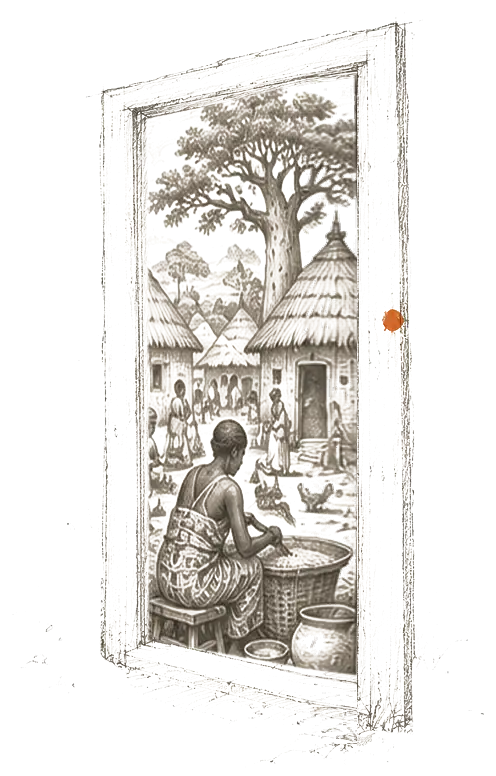
In Bwa country, the narrative opens on a golden age of nearly three centuries. In Bwan, Térhé, a young man of strength and beauty, gradually eclipses the glory of Kya, a warrior who kills out of vanity. He loves Hakanni, whom he cannot marry, custom invoking a distant kinship. Around them, feasts, rites, hunts and labours set the rhythm of village life.
Timeline
- 1961–1962First textsOuédraogo in the theatre; Nazi Boni writes the country's first novel.
- 1971–1984Novel and poetryNikiéma, Coulibaly, Bazié, and Pacéré, who invents bendrology.
- 1972–1982Birth of cinemaDjim Kola makes the first feature; Fespaco settles in Ouagadougou.
- 1986–1989Kaboré and OuédraogoZan Boko, then Yaaba. Burkinabè cinema becomes a reference.
- 1998A new generationRoamba, Yaméogo, and Fanta Régina Nacro, the country's first woman director.
Reading keys
- Names indicate the group: Ouédraogo, Kaboré, Compaoré are Mossi, Coulibaly and Traoré refer to the Mandinka area, Hien and Somé to the Lobi and Dagara country.
- The name Ouédraogo means "male stallion" and refers to the son of Yennenga, ancestor of the Mossi dynasty.
- Among the Mossi, the political chief, the naaba, and the land chief, the tengsoba, are two distinct authorities that a narrative never confuses.
- The sinankunya, joking kinship between groups, authorises ritual insult and prevents conflict.
- The assassination of Thomas Sankara in 1987 and the years that followed are a subject whose treatment places an author politically.
- The accusation of sorcery against elderly women, which leads to real expulsions from villages, is a subject addressed head-on by the cinema.
- Excision is approached by several film-makers, which brought their films difficulties.
- The respect due to the elders organises speech, and one does not interrupt; the palabre takes the necessary time.
- A Muslim majority, an important Christianity, ancestral cults everywhere beneath them, often among the same people.
- The tengsoba, land chief, manages relations with the powers of the soil, distinct from political power.
- The masks of the Bwa and Bobo country, made of leaves or of painted planks, come out on ritual dates and embody spirits.
- Sorcerers and soul-eaters are an accusation with real social consequences.
- Funerals take place in two stages, with a deferred and costly second ceremony that releases the dead person.
- The mask of leaves, worn at Bwa funerals, marks the passage between worlds.
- Dolo, millet beer, is shared during palabres and rites, and the cabaret where it is drunk is a social place.
- The Ouagadougou film festival, every two years, has become a national gathering as much as a continental one.
- Yennenga, the Mossi princess who fled on horseback and whose son founds the dynasty, is the emblem of the country and the name of the festival trophy.
- The Mossi and Bwa tales, with the hare and the hyena, form the domestic narrative stock.
- The naaba and his court, with their protocol and their spokesmen, are a constant political referent.
- Thomas Sankara and his speeches have become a reference quoted well beyond the country.
- Burkina is nothing like a desert: the south is watered and cultivated, and most of the population lives there.
- Burkinabe cinema is not an auteur cinema detached from its audience: it was conceived as a tool of education and debate.
- The tengsoba is not a sorcerer but a land authority with a recognised ritual competence.
- The country's name dates from 1984: for earlier works it is necessary to search under the name Upper Volta.
Tales and mythologies 2
- TaleContes de jadis, récits de naguèreÉtienne Sawadogo · 1982not translated into EnglishLegends, tales and stories from Upper Volta, published in Dakar in the early eighties.Literature
- NarrativeHistoire et coutumes royales des Mossi de OuagadougouYamba Tiendrébéogo · 1964not translated into EnglishThe history and rites of the Mossi court, told by one of its dignitaries.Literature
A selection to begin with 10 / 23
- CinemaBlood of the PariahsLe Sang des pariasMamadou Djim Kola · 1973A love thwarted by caste, in a family that thinks itself modern.Cinema
- Feature filmPaweogoSanou Kollo · 1983The first feature of an Upper Voltan filmmaker, on the temptation of exile in neighbouring Côte d'Ivoire.Cinema
- PoetryOrphelin des collines ancestralesJacques-Prosper Bazié · 1984not translated into EnglishThe first book of a poet and journalist from Ouagadougou.Literature
- PoetryParturitionBernadette Dao · 1986not translated into EnglishThe verse of a Burkinabe woman author, published in a collective collection under the revolution.Literature
- CinemaZan BokoGaston Kaboré · 1988A Mossi village devoured by the city, and a peasant who refuses to leave.Cinema
- CinemaYaabaIdrissa Ouédraogo · 1989The friendship between a child and an old woman held to be a witch, filmed in Mooré with the people of a village.Cinema
- Feature filmKeita! The Heritage of the GriotKeïta ! L'Héritage du griotDani Kouyaté · 1995The first feature of a Burkinabè filmmaker from a line of griots, between Western schooling and the word of the elders.Cinema
- CinemaLe Truc de KonatéFanta Régina Nacro · 1998A village comedy about the condom, shot by a Burkinabè woman director.Cinema
- CinemaSilmandéS. Pierre Yaméogo · 1998A family of Lebanese traders in Ouagadougou caught up in the turmoil of power.Cinema
- CinemaGarbaAdama Roamba · 1999Children who have run away from a Koranic school, left to themselves in a Burkinabè city.Cinema