United States
- works
- 250
- 160 books · 90 films
- period covered
- 1782–2000
- language of writing
- English
For a century, reprinting an English book without paying anything was perfectly legal in the United States. The law of 1790 protected only citizen or resident authors, and the presses of Philadelphia brought out Dickens's novels a few days after the packet boat arrived. Having come in 1842 to plead for an international copyright, Dickens was called ungrateful by the newspapers that were pillaging him. Foreigners were protected only from 1891, and the Berne Convention would wait until 1989.
Read moreShow less
That gratuity fabricated a market before a literature: a publisher had little reason to pay an American author when an English novel cost nothing. Harriet Beecher Stowe experienced it the other way round, losing in 1853 her suit against an unauthorised German translation of Uncle Tom's Cabin, the court holding that to translate was not to reproduce.
What the country ends by inventing is a writing that takes speech for its norm. Whitman composed Leaves of Grass in 1855 and set part of the volume in type himself; Twain recounted in 1876 a Mississippi childhood, before having it told, in a later book, by a boy whose grammar is that of his street. The price is read in the trials and in the lists. Emily Dickinson left at her death in 1886 nearly one thousand eight hundred poems that her editors corrected and punctuated; the 1955 edition was needed to read them as she had written them. Allen Ginsberg's collection was seized in 1957 and his publisher prosecuted for obscenity, while Henry Miller waited until 1964 to be legally published at home. The Hollywood blacklists, from 1947, kept screenwriters out for ten years, and Elia Kazan, who gave names in 1952, went on directing.
What awaits the reader is a corpus that speaks rather than declaims, in which the road narrative and the detective novel are worth as much as the great books. The novel that opens this page had sold fewer than twenty-five thousand copies at its author's death in 1940, and it was a hundred and fifty-five thousand copies distributed to soldiers in 1945 that brought it out of oblivion.
A way to begin
The Great Gatsby
Francis Scott Fitzgerald · 1925
A mysterious neighbour, enormous parties and a green light across the bay: Fitzgerald's novel, free of rights.
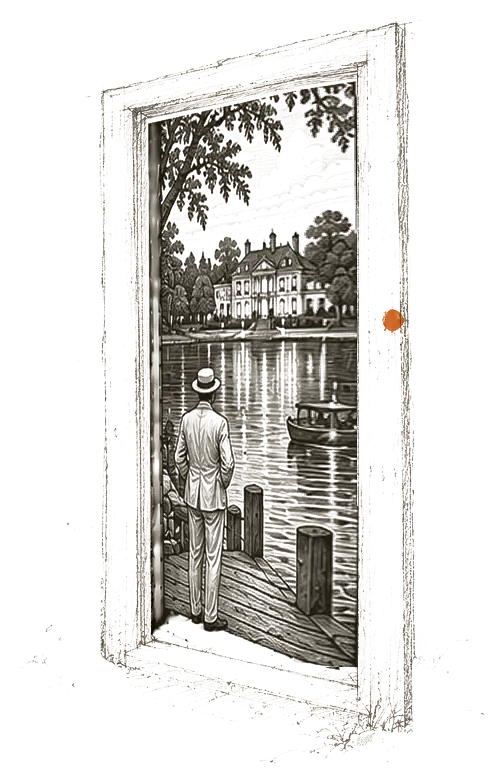
In the spring of 1922, Nick Carraway, come from the Middle West to sell bonds in New York, rents a small house on Long Island next to Gatsby's mansion. All summer Gatsby gives enormous parties there at which he keeps apart, and no one knows where he comes from. On the opposite shore of the bay lives Daisy, Nick's cousin, at the end of whose dock a green light shines.
Timeline
- 1840–1865American RenaissanceMelville, Hawthorne, Whitman, Dickinson. The country gives itself a literature.
- 1880–1910RealismTwain, James, Crane. The Mississippi and Europe, two Americas.
- 1920–1930Lost GenerationFitzgerald, Hemingway, Dos Passos. Paris, drink, disillusion.
- 1918–1935Harlem RenaissanceHughes, Hurston, McKay. The Black voice enters literature.
- 1929–1945Great DepressionSteinbeck, Faulkner. The South and the migrants.
- 1930–1950Hollywood's golden ageThe studio, the western, film noir. An industry becomes an art.
- 1950–1970Beat and countercultureKerouac, Ginsberg. Then New Hollywood overturns the table.
Reading keys
- The suffixes of generation, Junior, III, count as part of the name, and the middle initial serves to distinguish namesakes in a country that has many of them.
- The surnames of black families come from emancipation, and some were refused and then replaced in the twentieth century, a change of name that is a political act and not a whim.
- In the South, the double first name, Billy Ray, Mary Lou, is a complete name in use, and the mother's maiden name often becomes the middle name.
- The Hispanic names of the South-West follow the usage of two surnames, and indigenous names were translated or replaced by the administrations and the schools.
- The vocabulary of race has changed several times in a century, and a word present in a text of 1885 today causes the book to be withdrawn from certain school programmes.
- The memory of segregation and of the lynchings is a living subject, supported by figures and places, and not a closed past.
- The post-war blacklists and the hearings of the committee on un-American activities left resentments that the film world has not settled.
- Abortion, guns and religion situate a text from the first mention, and bans on books in school libraries are a current practice, not a memory.
- Religious practice is high and fragmented into denominations, which means one must know which one a character attends: it states their class, their region and often their vote.
- The Puritan inheritance of New England, with election and fault inscribed in bodies, structures Hawthorne and Melville long after the end of the colonial theocracies.
- The black church produced a rhetoric, that of the sermon, which poetry and political speech use directly, as James Weldon Johnson does in 1927.
- Hoodoo and the conjure practices of the South are documented by Zora Neale Hurston, an anthropologist before being a novelist, and are distinct from Haitian vodou.
- The successive religious revivals, tents, itinerant preachers, healings, provide a scene that the literature of the South constantly uses.
- Thanksgiving, the fourth Thursday of November, is the great family scene of the calendar, and its narrative of origin is contested by the indigenous nations who make it a day of mourning.
- The Fourth of July, with its fireworks and its neighbourhood barbecues, serves as a civic landmark, and Juneteenth, on 19 June, commemorates the late announcement of emancipation in Texas.
- The body is presented at the funeral home, the casket open, before a ceremony at which the eulogy is delivered by relatives.
- The end-of-year ball and the graduation are codified rites of passage, and a novel uses them as a hinge without having to describe them.
- The King James Bible provides the rhythm, the titles and the formulas, including in authors without faith, and a sentence of Faulkner's or Steinbeck's may be a quotation.
- Moby-Dick, Huckleberry Finn and the 1925 novel about the Long Island millionaire form the trio that school has made common to all.
- The frontier and the western constitute a repertoire of situations, appearing after the official closing of the frontier in 1890.
- The African American tales of the cunning rabbit, noted by Joel Chandler Harris in 1880 in a nostalgic framing now criticised, and the Dakota legends published by Zitkála-Šá in 1901 are the two entries into the oral stock.
- Blues and jazz provide titles, refrains and a way of scanning that the poetry of Harlem claims.
- Immigrants' names were not changed at Ellis Island: the modifications came from the families themselves, often years after arrival.
- The South is a literary region with a chronology of its own, with its defeat, its memory and its forms, and is not read as a variant of the rest of the country.
- The word liberal does not have the French sense: it designates the left of the political spectrum, and the word conservative does not cover the European right.
- A considerable part of so-called American cinema was made by foreigners who arrived as adults, from Lubitsch to Forman, which explains the place of Europe in its forms.
- The ambition of the great American novel is a category of criticism and publishing, not a programme that authors set themselves.
Tales and mythologies 1
- TaleOld Indian LegendsZitkála-Šá · 1901These legends, heard in her childhood, are written down in English by a Dakota woman who went through an Indian boarding school.Literature
A selection to begin with 10 / 250
- NovelUncle Tom's CabinHarriet Beecher Stowe · 1852A law of 1850 obliges the inhabitants of free states to help capture those who have fled, on pain of fine and imprisonment. The novel gives faces and names to what the law treats as property.LiteraturePublic domain
- PoetryLeaves of GrassWalt Whitman · 1855This collection arrives without metre or rhyme and without an author's name, preceded by the portrait of a man in shirtsleeves who speaks of his flesh and that of others.LiteraturePublic domain
- NovelThe Adventures of Tom SawyerMark Twain · 1876The book looks at childhood from the outside, with the complicity of the adult who remembers it and the irony of one who has seen what the small town was worth.LiteraturePublic domain
- NovelTropic of CancerHenry Miller · 1934This book recounts the misery of an American in Paris without making a misfortune of it, and without restraint in its words.Literature
- CinemaOn the WaterfrontElia Kazan · 1954The film was shot in thirty-six days, in the middle of winter, almost entirely on the waterfront of Hoboken, with many dockers among the extras.Cinema
- PoetryHowl and Other PoemsAllen Ginsberg · 1956The poem was read in public, in a San Francisco gallery, before it was printed, and the collection was tried for obscenity.Literature
- PoetryComplete PoemsEmily Dickinson · 1960Short poems, sent by the hundred to those close to her but almost never printed, whose punctuation and concision baffled the first editors.Literature
- CinemaThe Manchurian CandidateJohn Frankenheimer · 1962Adapted from a novel by Richard Condon translated in France the same year, the film moves from the Korean front to American political life.Cinema
- CinemaBlood FeastHerschell Gordon Lewis · 1963Made for drive-in theatres on a minimal budget, the film shows the mutilations of its victims in colour, and was banned outright in France.Cinema
- CinemaMy Fair LadyGeorge Cukor · 1964Adapted from the Broadway musical based on a play by George Bernard Shaw, the film was shot entirely in the studio, in Burbank.Cinema