Equatorial Guinea
- works
- 13
- 13 books
- period covered
- 1953–1999
- language of writing
- Spanish
Between 1962 and 1978, no book appeared. The country became independent in 1968, and the following year its first president set about eliminating those who could read. Teachers, priests, civil servants, writers: a third of the population fled or disappeared, the schools closed, the word intellectual became an accusation. Historians of Equatorial Guinean literature call that period the years of silence, and the expression is to be taken in the strict sense, that of a national library which stops being written.
Read moreShow less
That sixteen-year gap has a particular consequence: the country's literature was refounded from exile, in Spanish. Equatorial Guinea is the only Spanish-speaking state in Africa, a former Spanish colony where Fang, Bubi and a Portuguese creole on the island of Annobón are also spoken, and where the language of the former coloniser has become, by historical accident, the language of a diaspora. Authors publish in Madrid, in Barcelona and in Malabo, and their books circulate badly in the country they describe. The first Equatorial Guinean novel, which appeared in 1953, was moreover so much in conformity with colonial discourse that it has been called a literature of consent.
The dominant form is the narrative of childhood and of the seminary. Donato Ndongo-Bidyogo told in 1987 of a boy brought up between the Spanish catechism and the rites of his lineage, without ever naming the country or the characters. María Nsué Angüe published two years earlier the first novel written by a woman, about a young girl caught between custom and modernity. Juan Balboa Boneke entitled his collection "The Exile". The price was distance: a literature written for a readership that is not the one it speaks about.
What awaits the reader is a restrained prose, often in the first person, in which childhood serves as a refuge and political history appears only in outline. The novel that opens this page is told by a nameless young man looking back on his childhood in the last years of the Spanish colony, and its author sees in it the autobiography of his generation more than his own.
A way to begin
Shadows of Your Black Memory
Donato Ndongo-Bidyogo · 1987
A childhood in Río Muni in the last years of the Spanish colony, in the novel often regarded as its author's best.
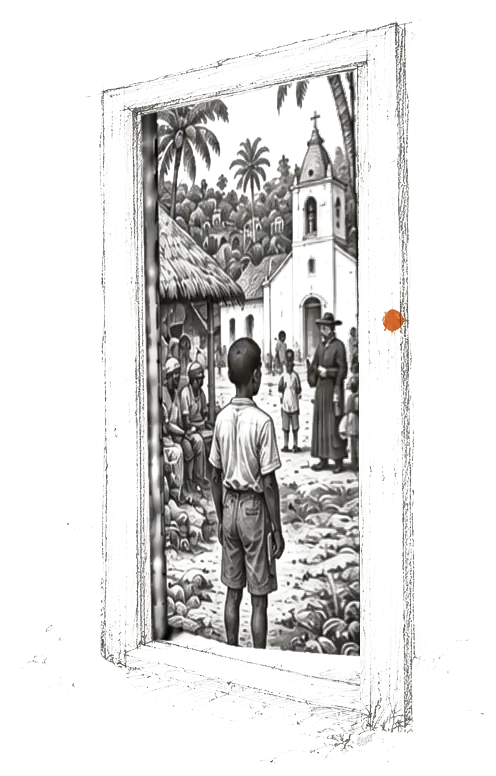
A nameless young man looks back on his childhood in Río Muni, in the last years of the Spanish colony. Between the extended family, the villagers, the sorcerers and the Catholic priests who teach him, he is torn between the cult of the ancestors and the faith he is taught. His child's gaze, which the adult takes up with irony, brings out the contradictions of colonial rule.
Timeline
- 1953–1962First novelsLeoncio Evita, Maplal Loboch, Daniel Jones Mathama.
- 1978–1985Return after the silenceRaquel Ilombé, Balboa Boneke, and María Nsué Angüe's Ekomo.
- 1987Ndongo-BidyogoShadows of Your Black Memory, in the year four books appear at once.
Reading keys
- Names combine the Spanish usage of two surnames with Fang or Bubi names, which produces forms such as Donato Ndongo-Bidyogo.
- The Fang of the mainland are patrilineal and segmentary, the Bubi of the island of Bioko have a different organisation. The name immediately places the origin.
- Initiation makes the adult more than age does, and an uninitiated character remains a junior.
- Double naming, a Spanish Christian first name and a lineage name, is the ordinary trace of colonisation.
- The dictatorship from 1968 to 1979 and the regime that has succeeded it since forbid direct criticism. Authors write from abroad or by allusion.
- The years of silence are recounted through the detour of the childhood narrative rather than through testimony.
- The distinction between mainland Fang and island Bubi is a politically sensitive subject.
- Initiatory knowledge is not transmitted outside the circle, and a narrative may break off for that reason.
- Spanish Catholicism, implanted by the Claretian missions, is in the majority and coexists with the ancestral cults.
- The Fang cult of ancestral skulls, the byeri, and mbiri or bwiti exist on this side of the border too: the religious stock is the same as in Gabon.
- The Bubi of Bioko have their own spirits and their own ritual organisation, distinct from the Fang stock.
- An accusation of sorcery has real consequences and is never a narrative ornament.
- Funerals are held in two stages, with a deferred and costly lifting of mourning.
- White kaolin marks contact with the ancestors in Fang rites.
- Widowhood imposes on the woman lasting prohibitions of dress and of movement.
- Spanish Catholic feasts, with their processions, structure the official calendar.
- The Fang narratives, with the Mvett and the epics of Engong, are shared with Gabon and the south of Cameroon.
- The Bubi stock of the island of Bioko, which is distinct, has its own narratives of origin and its own spirits.
- The corpus collected by German and Spanish ethnographers at the beginning of the twentieth century constitutes the older documentation.
- The narratives of the slave trade and of the cocoa plantation on Bioko form a memory common to the islanders.
- Spanish here is not a language of Latin America but the language of an African colony, with its own usages and its own accent.
- The country is made of an island and a piece of mainland separated by the sea, with two distinct histories. Treating them as one block means missing the narratives.
- The years of silence are not a metaphor: written production really was interrupted for sixteen years.
- The recent oil rent has not produced a national literature: authors continue to publish in Spain.
Tales and mythologies 1
- NovelEl párroco de NiefangJoaquín Mbomío Bacheng · 1996not translated into EnglishSeventeen years after the fall of Macías, a former political prisoner turned journalist in Europe tells of a priest's return to his village.Literature
Available in English 2
The books from this country that can be read in English, in the original or in translation.
- NovelShadows of Your Black MemoryLas tinieblas de tu memoria negraDonato Ndongo-Bidyogo · 1987Settled in Spain since adolescence, a journalist from Niefang writes the childhood of his generation on the eve of independence.Literature
- PoetryLöbëlaJusto Bolekia Boleká · 1999A water nymph and the memory of the Bubi people, sung between two languages.Literature
A selection to begin with 10 / 13
- NovelCuando los combes luchabanLeoncio Evita Enoy · 1953not translated into EnglishA young draughtsman from Bata has the traditions of the coast published in Madrid as the elders tell them.Literature
- PoetryCeibaRaquel Ilombé · 1978not translated into EnglishTen years after independence, a woman born in Corisco publishes the first collection of poems signed by an Equatorial Guinean woman.Literature
- PoetryO BoribaJuan Balboa Boneke · 1982not translated into EnglishThree years after the end of Macías's dictatorship, a Bubi poet publishes in Spain the poems of his exile.Literature
- NovelEkomoMaría Nsué Angüe · 1985not translated into EnglishSix years after the end of Macías's dictatorship, an Equatorial Guinean woman trained in Spain publishes in Madrid the first novel by a woman from her country.Literature
- PoetryVoces de espumasCiriaco Bokesa · 1987not translated into EnglishEight years after the fall of Macías, a former Bubi chaplain publishes his poems, written on the soil of his own country.Literature
- PoetryGritos de libertad y de esperanzaAnacleto Oló Mibuy · 1987not translated into EnglishAfter the fall of Macías, a former Fang seminarian turned anthropologist gathers the cries of his people.Literature
- TheatreEl hombre y la costumbrePancracio Esono Mitogo Obono · 1990not translated into EnglishEleven years after the fall of Macías, a comedy of manners performed on the country's stages is published in Madrid.Literature
- TheatreAntígonaTrinidad Morgades Besari · 1991not translated into EnglishTwelve years after the fall of Macías, a teacher from Malabo gives the myth of Antigone the face of dictatorship.Literature
- PoetryLöbëlaJusto Bolekia Boleká · 1999A water nymph and the memory of the Bubi people, sung between two languages.Literature
- NovelLa cargaJuan Tomás Ávila Laurel · 1999not translated into EnglishThe colonial past of a town on the Equatoguinean mainland, reread in the light of independence.Literature