Greece
- works
- 63
- 46 books · 17 films
- period covered
- -700–1983
- language of writing
- Greek
The national poet of Greece wrote his first lines in Italian and had no command of Greek at twenty-four. The son of a count and of his servant, brought up on Zakynthos and educated in Italy, Dionysios Solomos had himself taught his mother's language, then composed in May 1823 a hymn of a hundred and fifty-eight stanzas whose first ones became the country's anthem. The rest of his work remained in pieces: his great poems are unfinished and appeared only in 1859, two years after his death, which dismayed the newspapers that had celebrated him.
Read moreShow less
This country did indeed have to fabricate its written language at the same time as its state. Two forms of Greek confronted each other for a century and a half: a learned, purified language, imposed on the administration and the school, and the spoken language, of which Yannis Psycharis made a manifesto in 1888. The quarrel caused deaths in 1901, during riots against a translation of the Gospels into the popular language, and the spoken language became official only in 1976. To which is added an antiquity that Europe had appropriated and that had to be taken back.
The Greek form is the poem, and the country produced two Nobel prizes for poetry in twenty years. The price has to do with politics: Constantine Cavafy lived in Alexandria and did not sell his poems, he had them printed as loose sheets for his friends; Yannis Ritsos was deported to island camps, his books banned and burnt; under the dictatorship of the colonels, from 1967 to 1974, Giorgos Seferis broke the silence with a public declaration and died before the fall of the regime, while Theo Angelopoulos filmed in 1975 a troupe of actors crossing thirteen years of dictatorship, occupation and civil war.
What awaits the reader is a poetry that speaks of stones, sea and the dead without emphasis, and a prose that holds catastrophe at a distance. The novel that opens this page, published in 1946, sets a young man of letters against an old Cretan workman, and it draws on a real venture: its author had worked a mine with a workman named Giorgis Zorbas.
A way to begin
Zorba the Greek
Nikos Kazantzakis · 1946
A man of books and a Cretan workman who owes nothing to anyone: the book that made Kazantzakis known outside Greece.
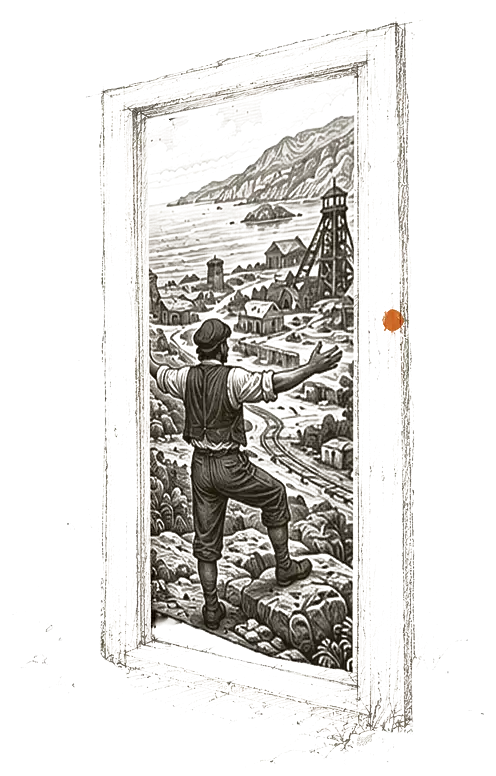
A young man of letters lands in Crete to work a mine and takes on as foreman an old workman met at the port. One has read the Buddha and hesitates before everything; the other eats, dances, seduces and decides. The work goes badly, winter passes, and the boss watches his employee live.
Timeline
- -750EpicHomer. Everything begins there, or nearly.
- -472–-405Classical AthensAeschylus, Sophocles, Euripides, Aristophanes. Theatre is invented.
- 1453–1821Under the OttomansThe language survives in folk songs and in the Church.
- 1880–1930RevivalCavafy in Alexandria, Palamas in Athens. Modern Greek becomes literary.
- 1935–1970The 1930s generationSeferis and Elytis, two Nobel prizes. Kazantzakis writes apart.
Reading keys
- Surnames carry regional suffixes that place a family: -akis in Crete, -idis among the refugees from Pontus, -opoulos in the Peloponnese, -atos in the Ionian islands.
- Women's names take the genitive form of the father's or the husband's name, and the same person appears in two forms according to the period.
- The grandfather's first name goes to the eldest, which multiplies namesakes in a family narrative.
- Baptismal godparenthood is a kinship in its own right, and the godfather names the child.
- The catastrophe of 1922, the exchange of populations with Turkey and the settlement of a million and a half refugees are the matrix of the Greek twentieth century.
- The civil war of 1946 to 1949, the island camps and the certificates of political loyalty divided families, and the vocabulary used situates a text.
- The dictatorship of 1967 to 1974, censorship and each person's role during those seven years are not settled.
- The Macedonian question, the name of the neighbouring country and relations with Turkey are subjects on which one does not joke.
- Orthodoxy is constitutive of national identity, the Church having run the school and the civil registry under Ottoman rule, and the religious calendar still structures the year.
- Local saints, miraculous icons and pilgrimages, that of Tinos in particular, are institutions and not folklore.
- The ancient stock is present in place names and in the language, but living belief is Christian, with pagan survivals in the agrarian rites.
- The Kallikantzaroi, malicious goblins of the twelve days of Christmas, and the evil eye are part of the domestic references that the texts do not explain.
- Orthodox Easter is the major festival, with the resurrection at midnight, the lamb and the Saturday soup, and the Lent that precedes it.
- 25 March and 28 October are the two national dates, one for the insurrection of 1821, the other for the refusal of 1940.
- Mourning involves black worn for a long time, commemorative meals on fixed dates and the exhumation of the bones after a few years, a common practice that the narratives mention.
- Blue and white are political, and the blue thread against the evil eye is an everyday object.
- Homer and tragedy are a common school stock, but the living reference passes above all through the popular songs and the modern songs.
- Nikolaos Politis's Paradoseis, published in 1904, is the reference collection of legends, and rebetiko provides the musical material that cinema takes up.
- Digenis Akritas and the Byzantine frontier songs form the medieval heroic repertoire, shared with Cyprus.
- The bridge of Arta, whose master mason must wall up his wife, is the ballad common to the whole Balkan area.
- Modern Greek is not ancient Greek: the continuity of the language is real but a reader today does not read Homer without a translation.
- Modern Greek literature does not prolong antiquity: it constituted itself in the nineteenth century against a European learned tutelage.
- Greece was Ottoman for nearly four centuries, something that the image of a purely ancient country makes disappear.
- An important part of this literature was written outside the borders, in Alexandria, in Constantinople, in Odessa and in Paris.
- The catalogue mixes ancient and modern authors, which is a convenience of classification and not a thesis about continuity.
Tales and mythologies 3
- EpicThe OdysseyὈδύσσειαHomer · -700A Greek epic of the Archaic period, composed to be sung, about a king's long return to his island after the Trojan War.Literature
- TaleAesop's FablesΜῦθοιAesop · -570Short fables in which animals play the roles of men, handed down by word of mouth before being gathered in writing three centuries later.Literature
- NarrativeTraditionsΠαραδόσειςNikolaos Politis · 1904A collection of oral traditions published in two volumes in 1904, gathered throughout the country with the help of schoolteachers.Literature
A selection to begin with 10 / 63
- PoetryHymn to LibertyΎμνος εις την ΕλευθερίανDionysios Solomos · 1825Written in 1823, in the midst of the war of independence, the song became the national anthem of the country; its author, trained in Italy, chose to write in the language of the people.Literature
- EssayΤο ταξίδι μουYannis Psycharis · 1888not translated into EnglishPublished in 1888, the book is the manifesto of demoticism. It opened the Greek language controversy, which sent crowds into the streets of Athens in 1901 and was not settled until 1976.LiteraturePublic domain
- NovelΗ φόνισσαAlexandros Papadiamantis · 1903not translated into EnglishA short novel of 1903, first published in instalments, it follows an old island woman whom the condition of poor girls leads to a terrible conclusion, and it does not judge her.LiteraturePublic domain
- PoetryPoemsΠοιήματαConstantine Cavafy · 1935A short body of work by an Alexandrian clerk who never sold a single line, gathered into a volume by his friends shortly after his death.Literature
- Feature filmBitter BreadΠικρό ψωμίGrigoris Grigoriou · 1951A drama of 1951 shot in the courtyards and on the building sites of Athens, about a working-class family overwhelmed by the war and postwar poverty.Cinema
- Feature filmThe Counterfeit CoinΗ κάλπικη λίραGiorgos Tzavellas · 1955A sketch film from 1955, shot entirely in a studio, it follows a counterfeit gold coin through the poor and bourgeois Athens of the postwar years.Cinema
- PoetryThe Moonlight SonataΗ σονάτα του σεληνόφωτοςYannis Ritsos · 1956A long monologue from 1956, written under police surveillance, it makes an old woman speak before a silent young man, in a house where nothing moves any more.Literature
- Feature filmThe Ogre of AthensΟ ΔράκοςNikos Koundouros · 1956Film noir of 1956 about an ordinary employee who takes on the identity of a gangster among the underworld of Athens cabarets.Cinema
- PoetryThe Axion EstiΆξιον ΕστίOdysseas Elytis · 1959A poem of 1959 whose form is borrowed from the Orthodox liturgy, it gives Greece a book-temple, which Theodorakis's music carried before the general public.Literature
- Feature filmThe Travelling PlayersΟ θίασοςTheo Angelopoulos · 1975A 1975 fresco that spans thirteen years of Greek history through the eyes of a travelling theatre troupe.Cinema