Montenegro
- works
- 4
- 4 books
- period covered
- 1833–1957
- language of writing
- Montenegrin
At about fifty, a Montenegrin voivode decided to learn to read. Marko Miljanov had fought all his life and was illiterate, like almost all his countrymen. He then set about writing seventy-five short anecdotes in order to fix a distinction he judged to be disappearing: junaštvo consists in defending oneself from others, čojstvo in defending others from oneself. The second is worth more than the first.
Read moreShow less
That detail says the essential about a country where literature was long a duty and not a profession. A prince-bishop writes the national epic, a war chief writes the moral code, and both do so in decasyllables or in sententious phrases cut to be remembered. One does not write for a public of readers, one writes for people who will recite. Montenegro produces few books and many formulas. Transmission passed through the one-stringed gusle and through the memory of lineages, and the epic decasyllable served there as a common metre long before serving as a literary one.
The form that results is brief, cutting, and it has a price. In 1847, Njegoš composed a dramatic epic that is at the same time a political manifesto, and that stages the extermination of converts to Islam. The text is the national monument and a permanent problem, discussed for a hundred and seventy-five years without the discussion running out. A century later, Mihailo Lalić writes the civil war and the mountain as a machine for grinding down loyalties. Montenegrin literature is an examination of honour, conducted by people who find no satisfaction in it and who nevertheless write in the language of that honour.
What awaits the reader is an unusual density: few pages, many maxims, a language aiming at memory rather than at pleasure. The poem that opens this page gathers the chiefs of the Montenegrin clans at Christmas before Ottoman power, and both its historical truth and its political uses are still debated.
A way to begin
The Mountain Wreath
Petar II Petrović-Njegoš · 1847
The poem of the prince-bishop Njegoš, free of rights: the chiefs of the Montenegrin clans gathered at Christmas before Ottoman power.
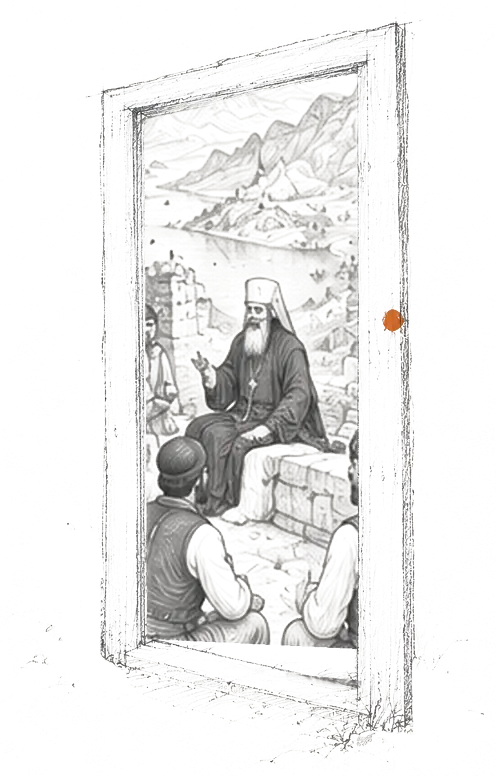
At the beginning of the eighteenth century, Metropolitan Danilo gathers the chiefs of the Montenegrin clans for Christmas, divided among themselves and threatened by Ottoman power. In decasyllabic verse, through dialogues and monologues, the poem gives the chiefs a voice, shows the customs of a clan society caught between the Ottoman Empire and Venice, and raises the question that tears the assembly apart: what to do with the Montenegrins who have converted to Islam.
Timeline
- 1847The Mountain WreathNjegoš, prince-bishop and poet, writes the country's founding text.
- 1901–1957After NjegošMarko Miljanov tells of honour; Mihailo Lalić writes the war.
Reading keys
- Belonging to the clan, the pleme, and to the lineage, the bratstvo, precedes the individual. A character introduces himself by his father and his clan before his trade.
- Names end in -ić or -ović, and the intermediate patronymic is common: Marko Miljanov means Marko son of Miljan.
- The slava, the feast of the family's saint, is transmitted through the men and identifies the lineage.
- The kum, godfather, and the pobratim, sworn brother, create kinships as binding as blood. Betraying a pobratim is the worst of failings.
- Blood vengeance, krvna osveta, was regulated by truces and mediations. A narrative that stages it describes a system of law, not a savagery.
- The question of whether Montenegrins are a people distinct from the Serbs divides the country and its literature. Settling it one way or the other is a political act.
- The given word binds absolutely and the narrative treats it as a contract. Going back on it dishonours an entire line.
- Codified boasting is part of male conversation and is not taken at face value.
- Orthodoxy dominates, with an institutional peculiarity: until the nineteenth century the prince was also bishop, which explains why the national epic is signed by a metropolitan.
- A Muslim minority and a Catholic minority, notably Albanian, have long been present and appear in the narratives, often as protagonists of the conflict.
- Orthodox funeral rites extend over years, with the lamentation sung by women, the tužbalica, which is a literary genre in its own right.
- The mountain is inhabited: springs, passes and rocks have their spirits, and the landscape is never a mere setting.
- Black is worn for a long time and funeral lamentation is public, performed by women according to fixed forms.
- Orthodox Christmas falls on 7 January, with the ritual log, the badnjak.
- The one-stringed gusle accompanies epic song. Its presence signals a solemn moment or a claim.
- The costume with belt and weapon, still worn at ceremonies, marks rank and the memory of the clans.
- The Mountain Wreath by Njegoš, a dramatic epic of 1847, is the text that the whole country knows and discusses.
- Marko Miljanov's Examples of Humanity and Bravery supply the definition of čojstvo, an untranslatable word that opposes humanity to mere courage.
- The epic cycle of Kosovo and Kraljević Marko are shared with Serbia and sung to the gusle.
- Avdo Međedović, an illiterate butcher from Bijelo Polje, is the singer whose twelve thousand lines served as proof for the modern theory of orality.
- The cult of honour and bravery is not celebrated without reservation by the country's authors. Njegoš and Miljanov measure it, question it and show its cost.
- Čojstvo has no French equivalent. Translating it as "humanity" loses the idea that it means protecting others from oneself.
- Marko Miljanov is presented here as Montenegrin and elsewhere as Serbian. Both claims exist and this file does not rank them.
- The smallness of the corpus does not indicate a smallness of the tradition: that tradition was long oral, and the book arrived there late.
Tales and mythologies 1
- PoetryПјеванија црногорска и херцеговачкаSima Milutinović Sarajlija · 1833not translated into EnglishIn the Montenegro of the clans, epic songs are passed on by word of mouth and have never yet been printed in a collection.Literature
Available in English 3
The books from this country that can be read in English, in the original or in translation.
- PoetryThe Mountain WreathГорски вијенацPetar II Petrović-Njegoš · 1847Prince-bishop of a small mountain state still organised in clans, the author strives to make a nation of it.Literature
- NarrativeHonor and HeroismPrimjeri čojstva i junaštvaMarko Miljanov · 1901Montenegro, which became independent after the war against the Ottomans, is ruled by Prince Nikola.Literature
- NovelThe Wailing MountainLelejska goraMihailo Lalić · 1957The novel returns to the war that set the Communist partisans against the royalist Chetniks in Montenegro.Literature
A selection to begin with 2 / 4
- NarrativeHonor and HeroismPrimjeri čojstva i junaštvaMarko Miljanov · 1901Montenegro, which became independent after the war against the Ottomans, is ruled by Prince Nikola.Literature
- NovelThe Wailing MountainLelejska goraMihailo Lalić · 1957The novel returns to the war that set the Communist partisans against the royalist Chetniks in Montenegro.Literature