Croatia
- works
- 54
- 41 books · 13 films
- period covered
- 1501–1988
- language of writing
- Croatian
In 1501, in Split, a notable who usually wrote in Latin for learned Europe finished a poem in the language of the street. Marko Marulić tells how Judith beheaded an Assyrian general, and he tells it in Croatian, for fellow citizens who feared an Ottoman siege. The book would wait twenty years for its Venetian printer. It inaugurates a literature.
Read moreShow less
There are in fact two Croatias, and they did not speak to each other for centuries. The coastal one looks towards Venice: Dubrovnik is an independent republic, Držić is performed there in 1559 and Gundulić writes there in 1622 a baroque meditation on the prodigal son. The inland one looks towards Vienna and Budapest, it is continental, administrative, and it will produce Zagreb. Sea and plain each have their tradition, their syntax and their models, and the country lives on that disagreement more than on its unity. Three dialects share the territory and the literary language was fixed only in the nineteenth century, so that old texts read today like cousin languages of the one in the newspapers.
What Croatia invented is a literature that argues with itself. The pamphlet, the polemical essay and the critical novel are one single gesture there, and Krleža spent fifty years contradicting his contemporaries. The price is visible in 1943: Ivan Goran Kovačić writes The Pit, in which a blinded peasant recounts the massacre of his own people by militiamen from his own country. The author, a Croat and a partisan, is killed the same year. Thirty-five years later, Lordan Zafranović films the same subject and the scandal starts again. Looking at what one's own side has done is here a literary tradition, not an accident.
What awaits the reader is therefore a prose that argues, that calls the reader to witness and refuses the smooth story. There is little consolation in it and a great deal of intelligence. The novel that opens this page tells of a painter's return to the small town from which his mother had driven him, and Croatian critics regard it as the first fully modern novel of that literature.
A way to begin
The Return of Philip Latinowicz
Miroslav Krleža · 1932
The Return of Philip Latinowicz: Krleža's masterpiece as a novelist, translated into French as early as 1957.
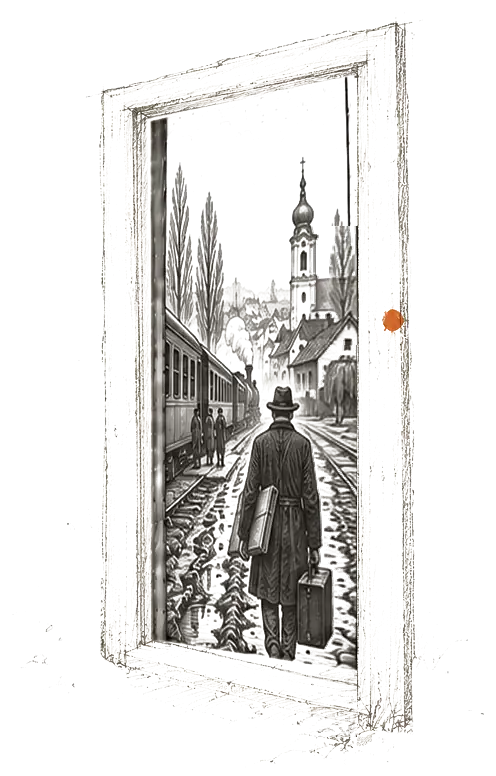
A painter in his forties returns to the small Croatian town from which his mother had driven him twenty-three years earlier, to seek what he lacks in order to paint again. There he finds his mother, the canon who may be his father, and a provincial society taken up with money and bedroom affairs.
Timeline
- 1501–1630Dalmatian RenaissanceMarulić, Držić, Gundulić. Split and Dubrovnik, a literature of cities.
- 1835–1880Illyrian revivalMažuranić, Preradović, Šenoa. Croatian gives itself a language and a novel.
- 1890–1920ModernistsMatoš, Vojnović, Nazor. Vienna and Paris pass through Zagreb.
- 1932–1955KrležaThe Return of Philip Latinovicz, then Goran Kovačić's Jama.
- 1954–1982Zagreb schoolBauer, Mimica, Papić, Zafranović. An auteur cinema in Yugoslavia.
Reading keys
- Croatian names often end in -ić, which meant "son of". They are written in the Latin alphabet with diacritics: č, ć, š, ž, đ. Confusing č and ć changes the name.
- Female first names in -ica are affectionate diminutives and not children's names: an adult woman may be called Marica all her life.
- The patron saint's day, the imendan, is celebrated alongside the birthday.
- The baptismal godfather, kum, is a lasting institution, called upon for the family's important decisions.
- The role of the Independent State of Croatia from 1941 to 1945 and the crimes committed by the Ustaše remain a subject of public conflict. The works that address it, from Kovačić to Zafranović, have all provoked controversy.
- Under socialist Yugoslavia, censorship was less direct than elsewhere in the East but real: people wrote by allusion, and the habit can still be heard.
- The question of whether Croatian and Serbian are one language or two is political and not linguistic. Asking it naively passes for a provocation.
- Adults use the formal address for a long time, and the shift to the familiar form is negotiated.
- Conversation admits sarcasm and frontal contradiction without this meaning hostility.
- Catholicism is in the majority and served as a national marker against Serbian Orthodoxy and Bosnian Islam. A mention of a church in a narrative is often an indication of belonging as much as of faith.
- Marian pilgrimage, notably to Marija Bistrica, organises the popular calendar of the country's interior.
- The vile, fairies of forests and springs, and the krsnik, men able to fight sorcerers in dreams, belong to the Istrian and Kvarner stock. They are not decorative in the narratives that summon them.
- Glagolitic, the Slavic alphabet that Croatia kept long after the others, remains a matter of pride and appears in descriptions of old churches.
- Black is the colour of mourning, worn for a long time by widows in rural areas and on the coast.
- The funeral wake and the mass on the fortieth day organise the time of mourning. A family that does not appear marks itself out.
- Carnival, notably in Rijeka, is a moment of reversal when one may say what is not said the rest of the year.
- The red and white chequerboard, the šahovnica, is a national emblem whose use has varied according to regimes, which makes it charged.
- Priče iz davnine by Ivana Brlić-Mažuranić, inventions built on Slavic mythology, with Regoč the giant and Stribor and his forest: every Croatian child knows them.
- The Death of Smail-aga Čengić by Mažuranić, an epic of 1846 on the death of an Ottoman chief, is the school text par excellence.
- The Zlatorog, the chamois with golden horns who guards the mountain, circulates between the Croatian and Slovene traditions.
- The folklore of Istria and Kvarner supplies the vile, the krsnik and the vukodlak, revenant dead distinct from the vampire of fiction.
- Croatia is not a Balkan country in the mind of most of its authors, who attach themselves to Central Europe and to the Mediterranean. Using the word as self-evident grates.
- Dubrovnik was not Venetian: the city was an independent republic for centuries, which explains its own literature.
- The name Krleža refers to a communist writer and polemicist, not to a consensual national author. Reading him as a quiet classic means missing his books.
- The violence of the 1940s and the 1990s does not explain Croatian literature, which has five centuries of written existence before them.
Tales and mythologies 1
- TaleCroatian Tales of Long AgoPriče iz davnineIvana Brlić-Mažuranić · 1916Eight tales today, six originally, invented from scratch on the names and beings of a mythology that Christianity had covered over.Literature
A selection to begin with 10 / 54
- PoetryJuditaMarko Marulić · 1501not translated into EnglishA biblical widow whom the author made the figure of a Dalmatian town threatened by the Turks, and the first art poem of this literature.Literature
- TheatreHekubaMarin Držić · 1559not translated into EnglishThe only tragedy by the great comic playwright of Ragusa, taken from Euripides by way of the Italian, and which the Senate of the city at first refused to let be performed.Literature
- PoetrySuze sina razmetnogaIvan Gundulić · 1622not translated into EnglishThe first penitential poem of the literature of Ragusa, in three laments, on a parable that everyone knew.Literature
- PoetryThe PitJamaIvan Goran Kovačić · 1944A long poem written in the maquis by a man who had not seen what he describes, and whom the war killed before it appeared.Literature
- CinemaH-8Nikola Tanhofer · 1958A 1957 news item told in reverse: the accident is known from the start, and all the suspense lies in the passengers' seats.Cinema
- CinemaTrain Without a TimetableVlak bez voznog redaVeljko Bulajić · 1959The internal colonisation of post-war Yugoslavia, seen from the carriages of a train of migrants.Cinema
- NovelCyclopsKiklopRanko Marinković · 1965Zagreb on the eve of the invasion of 1941: an intellectual who fasts to escape the army, among men of letters who quote Homer and Shakespeare.Literature
- CinemaRondoZvonimir Berković · 1966A love triangle built like a rondo: every Sunday the same game of chess returns, slightly changed.Cinema
- CinemaAccidental LifeSlučajni životAnte Peterlić · 1969Two Zagreb office workers and their uneventful lives: an existential study of urban alienation.Cinema
- CinemaOccupation in 26 PicturesOkupacija u 26 slikaLordan Zafranović · 1978Three friends from Dubrovnik, a Croat, an Italian and a Jew, separated by the occupation of 1941.Cinema