North Macedonia
- works
- 38
- 28 books · 10 films
- period covered
- 1845–2000
- language of writing
- Macedonian
For twenty-seven years, this country had no name. Recognised in 1993 under the provisional designation of the former Yugoslav Republic of Macedonia, for lack of agreement with Greece, which disputed the use of the word, it became North Macedonia only in 2019, at the end of a treaty negotiated on the shore of a lake. A state whose existence was not in question spent a quarter of a century discussing how to call itself. Its literature was written in that situation.
Read moreShow less
The dispute did not concern only a word. The corpus itself is disputed: the collection of popular songs published in 1861 by the Miladinov brothers is claimed by Bulgaria and by Macedonia, both countries seeing in it a monument of their own revival. The two brothers died the same year in an Ottoman prison in Constantinople. Grigor Prlichev, who won a poetry competition in Athens in 1860 and found himself hailed as a second Homer, wrote in Greek before turning to Slavic. Nothing here belongs to a single country, and nineteenth-century authors moved from one language of culture to another without seeing any betrayal in it.
Hence a formal consequence: the Macedonian literary language was codified late, in 1945, by a poet, Blaže Koneski, and the first book printed in the popular language dates from 1939, a collection by a worker from Veles on the day labourers of the tobacco fields. Writing in this language was therefore a founding act before being an aesthetic choice, and the authors of the following generation had to invent a prose where only a new norm existed. The price has been a literature always obliged to justify its existence, including before its immediate neighbours.
What awaits the reader is short texts, a restrained lyricism and a marked taste for the village as a place of enigma. The poem that opens this page tells the last fight of a chief who protected the villages against plunderers, and it was first written in Greek by a poet who later made a Slavic version of it.
A way to begin
The Sirdar
Grigor Prličev · 1860
A heroic poem written in Greek by a poet from Ohrid, crowned in Athens in 1860, free of rights.
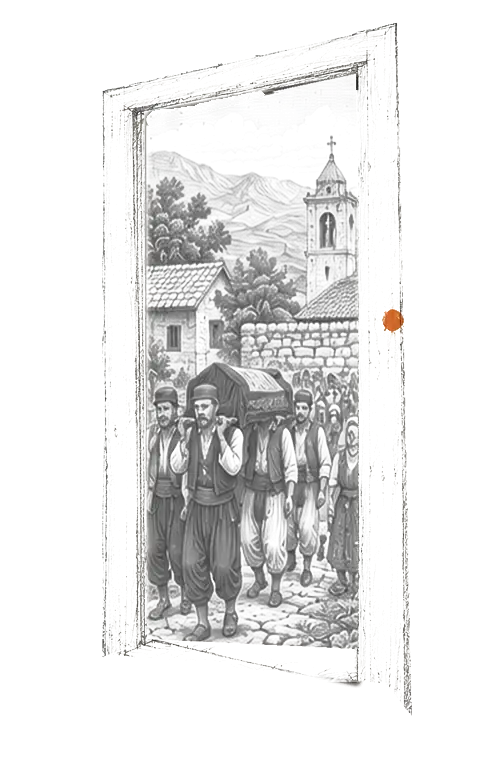
In the mid-nineteenth century, in western Macedonia, Kuzman Kapidan protects the villages against the raids of plunderers. The poem, in nine cantos, tells of his last fight, then his mother's grief and the return of his body to his own people. The poet drew on a folk song.
Timeline
- 1845–1863AwakeningThe Miladinov brothers, Prlichev. A language between Greek, Bulgarian and Serbian.
- 1928–1945CodificationRacin and Beli mugri; Koneski fixes literary Macedonian in 1945.
- 1952First novel, first filmJanevski publishes, Nanović shoots Frosina. The same year.
- 1958–1976Macedonian cinemaMitrović, Gapo, Cenevski, Gligorovski. Skopje produces its own films.
- 1961–1987The Čingo generationŽivko Čingo, Stefanovski in the theatre, Stole Popov on screen.
Reading keys
- Macedonian is written in Cyrillic, with letters of its own such as ѓ and ќ. Names end in -ski, -ov or -ev, and the feminine form adds an a.
- The intermediate patronymic appears in official documents.
- The slava, the feast of the family's patron saint, is transmitted through the men and identifies the lineage, as in Serbia.
- The godfather, kum, plays a lasting role and his opinion counts in marriages.
- The question of the name, that of the language and that of national identity are three live disputes, with Greece and with Bulgaria. Addressing them head-on in a text is a political act.
- The very large Albanian minority and the conflict of 2001 are subjects handled with caution.
- The Yugoslav period is judged in contrasting ways and mentioning it places an author politically.
- Hospitality is obligatory and refusal offends; one insists several times before accepting.
- Orthodoxy is in the majority, with a Church whose autonomy was contested for decades, which makes it a political subject.
- A large Muslim population, Albanian, Turkish and Torbesh, is present, with Sufi brotherhoods and tekke.
- Ohrid, with its literary schools of the ninth century and its dozens of churches, is the holy place of Slavic memory and an object of claims.
- The samovili of the springs and the zmey belong to village belief, with the same cast as in Bulgaria.
- Black is the colour of mourning and is worn for a long time.
- The funeral ritual follows dated stages, forty days, six months, one year, with the distribution of boiled wheat.
- The family slava, with its bread and its candle, is the central domestic rite.
- The chain dances, the oro, performed at weddings and festivals, obey an order of precedence that can be read.
- The collection of the Miladinov brothers of 1861, claimed by Macedonia and by Bulgaria, is the common founding monument.
- "Longing for the South", a poem written in Moscow by Konstantin Miladinov, is the most translated text of the country and its emblem.
- The tales collected by Marko Cepenkov, a tailor from Prilep turned collector of seven hundred narratives, form the narrative stock.
- The samovili, the zmey and the foundation sacrifice of the bridge circulate throughout the Balkan area.
- The ancient Macedonia of Alexander and contemporary North Macedonia are two distinct objects, and the dispute concerns precisely their confusion.
- Macedonian is a Slavic language codified in 1945; Bulgaria considers it a variant of Bulgarian, which is a political debate as much as a linguistic one.
- The Miladinov brothers belong to two national literary histories at once, and ranking the claims would be taking a side.
- The youth of the written norm does not mean the absence of a tradition: the schools of Ohrid are nine centuries ahead of it.
Tales and mythologies 1
- TaleOtherworldly Tales Collected in 19th Century MacedoniaМакедонски народни умотворбиMarko Cepenkov · 1972The body of folklore gathered by one man in Ottoman Macedonia, collected in ten volumes fifty years after his death.Literature
Available in English 10
The books from this country that can be read in English, in the original or in translation.
- PoetryThe SirdarСердаротGrigor Prličev · 1860A heroic poem written in Greek by a poet from Ohrid and crowned in Athens in 1860.LiteraturePublic domain
- PoetryLonging for the SouthТ'га за југKonstantin Miladinov · 1861The homesickness of a student from the Balkans in Moscow, which became the poem that Macedonia learns at school.Literature
- EssayOn Macedonian MattersЗа македонцките работиKrste Petkov Misirkov · 1903A book of 1903 that calls for a Macedonian nation and a written Macedonian language, at the moment when the neighbouring powers are contesting the region.Literature
- PoetryWhite DawnsБели мугриKosta Racin · 1939The poems of a potter from Veles about the poor of his country, printed near Zagreb on the eve of the war.Literature
- NovelThe Legend of Kalesh AndjaКалеш АнѓаStale Popov · 1958A Macedonian historical novel about a woman from Mariovo abducted by an Ottoman dignitary, in the sixteenth century.Literature
- TheatreDarknessЦрнилаKole Čašule · 1960A drama about the divisions within the Macedonian revolutionary movement, written at the turn of the sixties.Literature
- NovelThe Big WaterГолемата водаŽivko Čingo · 1971A Macedonian novel about childhood shut away in a state orphanage, in the aftermath of the Second World War.Literature
- TheatreWild FleshДиво месоGoran Stefanovski · 1979A family from Skopje caught between the fates of its three sons and the threat of demolition, on the eve of the war.Literature
- NovelPireyПирејPetre M. Andreevski · 1980A Macedonian novel of the Balkan Wars and the Great War, seen through a peasant couple caught between the armies.Literature
- NovelMy Father's BooksТатковите книгиLuan Starova · 1992A library saved from every border: the saga of an Albanian family between two countries and two regimes.Literature
A selection to begin with 10 / 38
- PoetryБѫлгарски народни пѣсниDimitar Miladinov · 1861not translated into EnglishThe major collection of folk songs from Ottoman Macedonia, printed in Zagreb on the initiative of two brothers from Struga.Literature
- PoetryLonging for the SouthТ'га за југKonstantin Miladinov · 1861The homesickness of a student from the Balkans in Moscow, which became the poem that Macedonia learns at school.Literature
- PoetryWhite DawnsБели мугриKosta Racin · 1939The poems of a potter from Veles about the poor of his country, printed near Zagreb on the eve of the war.Literature
- CinemaMacedonian Blood WeddingМакедонска крвава свадбаTrajče Popov · 1967A 1967 film based on a Macedonian play from the turn of the century, about a Christian peasant woman abducted by an Ottoman bey.Cinema
- CinemaRepublic in FlamesРепубликата во пламенLjubiša Georgievski · 1969A film of 1969 about the uprising of 1903 and the Kruševo Republic, a founding episode for Macedonia.Cinema
- CinemaBlack SeedЦрно семеKiril Cenevski · 1971A film of 1971 about Macedonian soldiers of the Greek army deported to an island camp during the civil war.Cinema
- NovelThe Big WaterГолемата водаŽivko Čingo · 1971A Macedonian novel about childhood shut away in a state orphanage, in the aftermath of the Second World War.Literature
- CinemaPhoenixФениксPetar Gligorovski · 1976An animated short film made in Skopje in 1976, composed of metamorphoses of forms rather than a story.Cinema
- TheatreWild FleshДиво месоGoran Stefanovski · 1979A family from Skopje caught between the fates of its three sons and the threat of demolition, on the eve of the war.Literature
- CinemaHappy New Year '49Среќна нова '49Stole Popov · 1986A Macedonian film from 1986 about a family from Skopje caught up in the Cominform crisis, in 1948.Cinema