Niger
- works
- 19
- 11 books · 8 films
- period covered
- 1911–1987
- language of writing
- French
In 1958, a French ethnologist shot in Abidjan a film about young Nigerien migrants and let one of them improvise the whole commentary. Oumarou Ganda, a former rifleman in Indochina and a docker, recounts his own life in it while playing a character who is not quite himself. Eleven years later, he directed his first film and took up the same subject on his own account: a former soldier returns home after Indochina and finds no place there. The actor become author answers the film in which he had served as material.
Read moreShow less
That reversal says a great deal about a country that has been filmed more than it has filmed, and described more than it has written. Niger is a territory of Sahel and desert, straddling several worlds: the Hausa in the south, with their merchant cities and their poetry in ajami, that is to say in Arabic script; the Tuareg in the north, with their Tifinagh alphabet and their sung poetry; the Songhai-Zarma along the river, with their possession cults. None of those three ensembles spontaneously reads the books of the others, and French, the official language, is the mother tongue of almost nobody.
The form that results is the narrative of resistance and the poem of drought. Abdoulaye Mamani wrote in 1980 the story of a Hausa queen who confronts a French military column in 1899 and becomes a figure of refusal. Hawad, a Tuareg poet, invented a writing he calls furigraphy, in distorted Tifinagh, to say exile and thirst. Moustapha Alassane filmed in 1973 a Songhai legend with village actors. The price was the absence of means: Nigerien cinema was made with almost nothing, a borrowed camera and village actors, and it stopped for lack of successors.
What awaits the reader is a dry writing, without ornament, in which the landscape is never decorative. The novel that opens this page tells of the resistance of a queen of Azna country to the Voulet-Chanoine column, and Med Hondo filmed it from a screenplay co-written by the author.
A way to begin
Sarraounia
Abdoulaye Mamani · 1980
The resistance of a queen of Azna country to the Voulet-Chanoine column: a Nigerien classic, filmed by Med Hondo.
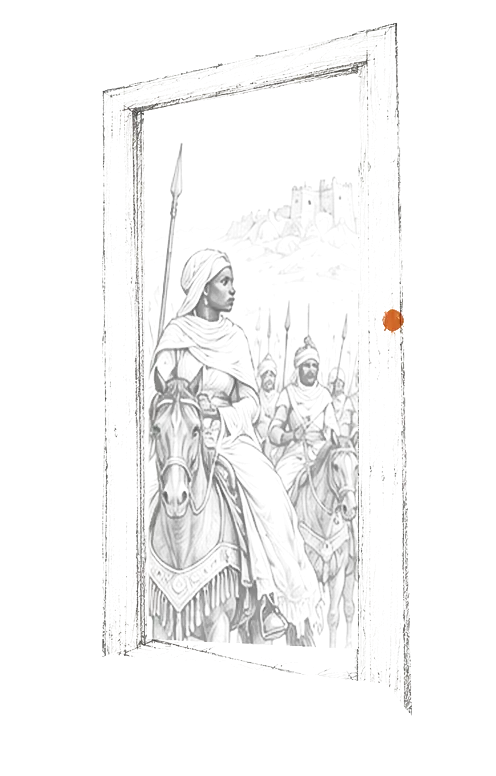
In 1899 the Voulet-Chanoine column advances towards Lake Chad, burning the villages in its path. At Lougou, in the heart of Azna country, Sarraounia, queen and priestess of a people faithful to the old cults, trained in the use of weapons and plants, refuses to submit when so many neighbouring chiefs choose to compromise. She gathers her warriors and allies to await the invaders.
Timeline
- 1959–1971First authorsIbrahim Issa, Boubou Hama. Writing at the moment of independence.
- 1969–1972Oumarou GandaCabascabo, drawn from his Indochina war; Alassane invents African animation.
- 1977–1981The Nigerien novelIdé Oumarou, Amadou Ousmane, Halilou Sabbo. The city and power.
- 1980SarraouniaMamani gives an African queen back her role in the colonial conquest.
- 1982–1987Cinema and Tuareg poetryMoustapha Diop films; Hawad writes in Tamasheq.
Reading keys
- Names indicate the group: Hausa in the south, Zarma and Songhai along the river, Fulani, Tuareg and Kanuri elsewhere.
- Among the Tuareg, society is in part matrilineal and women hold the tent and the Tifinagh writing, which they teach.
- The Tuareg men's veil is not a religious garment but a marker of status and of restraint.
- Joking kinship between groups authorises ritual insult and forbids conflict.
- The Tuareg rebellions and the marginalisation of the north are raw subjects.
- The famines of the nineteen seventies and eighties are a common narrative stock and an implicit political accusation.
- Status slavery, officially abolished but socially persistent, is a subject little approached head-on.
- Restraint is valued among the Tuareg, where one shows neither hunger nor pain, and a narrative signals it through silences.
- Islam is very much in the majority, with the Sufi brotherhoods and a tradition of Hausa scholars writing in ajami.
- The bori, a Hausa possession cult, and the Songhai-Zarma holey bring spirits down into the bodies of the adepts. These are not scenes of madness.
- The spirits of the river and of the bush have names and requirements, and the rites concerning them coexist with the mosque.
- The jinn belong to Quranic cosmology and not to folklore.
- Muslim mourning is brief, with burial on the same day and three days of condolences.
- The indigo of Tuareg clothing, a dye that marks the skin, gave the men of the desert their nickname.
- The Cure salée festival, the annual gathering of Fulani and Tuareg herders, is the great meeting of the north.
- Ramadan and the Eids order the calendar, and the dry season organises the narratives.
- Sarraounia, the Hausa queen who confronted the Voulet-Chanoine column in 1899, is the national heroic reference.
- The Hausa tales, published from 1913 in Hausa and in English, form a considerable documented stock.
- The bori and its pantheon of spirits are a common knowledge that the texts do not translate.
- The Songhai narratives about the empire of Gao and its sovereigns provide the historical depth of the river.
- Niger is not Nigeria: two distinct countries, one francophone and Sahelian, the other anglophone and far more populous.
- The veil of Tuareg men is not religious, and Tuareg women are not veiled.
- The bori and the holey are not residual superstitions but organised therapeutic institutions.
- Hausa has been written in Arabic characters for centuries, which contradicts the idea of an area without writing.
Tales and mythologies 1
- TaleHausa Tales and TraditionsLitafi na tatsuniyoyi na HausaFrank Edgar · 1911Hausa tales and traditions written down by their own storytellers, at the beginning of colonial occupation.Literature
A selection to begin with 10 / 19
- CinemaCabascaboOumarou Ganda · 1969The return of a former rifleman from Indochina, played by the filmmaker who had himself fought in that war.Cinema
- CinemaToulaMoustapha Alassane · 1973A Songhay legend of drought and sacrifice, in which water is paid for with a human life.Cinema
- CinemaL'Étoile noireDjingarey Maïga · 1975The first feature film by a self-taught filmmaker, on the divide between two ways of living in the Niamey of the seventies.Cinema
- NovelGros planIdé Oumarou · 1977not translated into EnglishA novel about power and its elites in the Africa of independence, drawing on direct experience of ministerial cabinets and administrations.Literature
- CinemaGossiGatta Abdourahamane · 1979A film of custom produced by the national television of Niger, which records an initiation rite for marriage.Cinema
- CinemaWasan KaraInoussa Ousseini · 1980A short documentary on a village custom that each year re-enacts, while mocking it, a scene from public life.Cinema
- CinemaSi les cavaliers…Mamane Bakabé · 1982An epic of resistance to the French conquest, drawn from a Nigerien play devoted to the sultanate of Damagaram.Cinema
- CinemaLe Médecin de GafiréMoustapha Diop · 1982A Sahelian co-production that sets medicine from the European schools face to face with that of the bush healers, without ruling the latter wrong.Cinema
- PoetryCaravane de la soifHawad · 1985not translated into EnglishThe thirst and wandering of a nomadic people, in poems written in Tamajaq and calligraphed in Tifinagh.Literature
- Short filmFalawMariama Hima · 1985A short Nigerien documentary on an aluminium smelter in Niamey, by the country's first woman director.Cinema