Thailand
- works
- 12
- 10 books · 2 films
- period covered
- 1345–2000
- language of writing
- Thai
In 1767, a Burmese army took Ayutthaya and burned the city. The capital of Siam contained palaces, temples and entire libraries of palm-leaf manuscripts: four centuries of literature, chronicles, treatises and poems disappeared in a few days. The following dynasty, installed in Bangkok, set about reconstituting everything from memory, summoning the survivors who knew the texts by heart, and had the national epic rewritten by a commission that the king himself presided over.
Read moreShow less
A literature that has been rebuilt in that way keeps a particular relation to its classics: they are at once ancient and recent, and it is known that they were remade. Sunthorn Phu, a court poet in the nineteenth century, a drunkard, imprisoned, for a time a monk out of necessity, composed an epic of tens of thousands of lines about a flute-playing prince abducted by a sea ogress, and his verses are learnt at school. The country was never colonised, which makes it a unique case in the region, and its language is written in an alphabet derived from Khmer, itself come from India, with no space between words.
The dominant form in the twentieth century is the social novel, and it ran up against a precise limit. Siburapha published in 1937 the story of a young man in love with an older aristocrat, and would later be imprisoned for his ideas; Kukrit Pramoj, an aristocrat and future prime minister, recounted in 1953 four reigns seen from the palace. Cinema underwent a spectacular renewal at the end of the nineteen nineties, with ghost films and colourful westerns that rework the popular forms.
What awaits the reader is a surface politeness that covers precise relations of power, and a constant attention to rank, which the language itself imposes in every sentence. The poem that opens this page was begun in prison by a court poet disgraced more than once, and it remains the longest Thai poem.
A way to begin
Phra Aphai Mani
Sunthorn Phu · 1870
The longest Thai poem, free of rights: a musician prince with a magic flute, a sea ogress and mermaids.
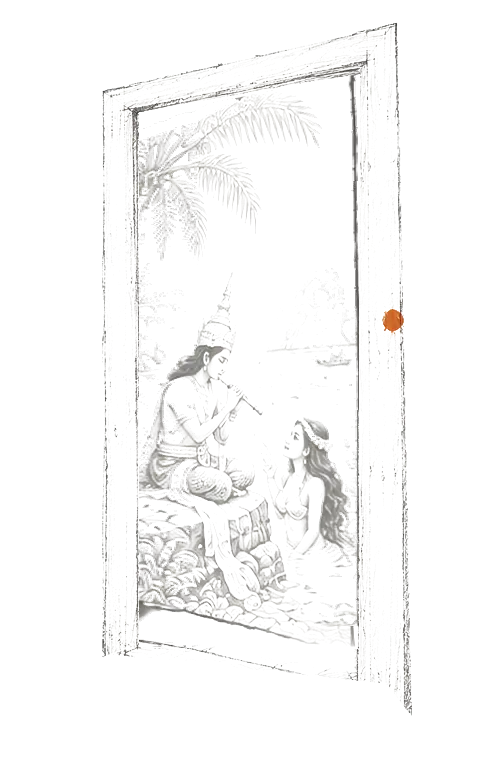
Prince Aphai Mani has learned to play a magic flute that puts to sleep or kills, and his brother the use of the sword; their father, who expected kingly learning of them, drives them out. A sea ogress abducts Aphai, takes the form of a beautiful young woman and keeps him for years in her cave, where their son is born. Helped by a family of merfolk, he escapes to an island guarded by a hermit, loves a mermaid, then a princess promised to a prince of Lanka.
Timeline
- 1844Sunthorn PhuPhra Aphai Mani, the great poetic epic of Siam.
- 1937–1953The modern novelSiburapha and Kukrit Pramoj: Siam becomes Thailand.
- 1981–2000TodayChart Korbjitti is twice awarded; Nonzee and Wisit revive the cinema.
Reading keys
- Family names have existed only since 1913 and are often very long, unique to one family: two people with the same name are almost always related.
- Everyone is called by their first name, preceded by Khun, and one-syllable nicknames are in constant use, including in the civil registry.
- Forms of address encode rank and age, and the pronouns vary according to who is speaking to whom: Thai has more than a dozen of them.
- The royal family has a vocabulary of its own, a language within the language, which must be used when speaking of it.
- The crime of lèse-majesté carries very heavy penalties, which makes any critical evocation of the monarchy impossible and bounds the literary space.
- The massacres of students in 1973 and 1976 and the successive coups are approached with caution.
- Losing face is an operative category: direct conflict is avoided, and an open confrontation is a social failure.
- The smile does not necessarily indicate contentment: it serves to maintain the surface, including in anger.
- Theravada Buddhism is very much in the majority, with an organised clergy and a frequent temporary passage through the monastery for men.
- The phi, spirits of places and of the dead, receive offerings in the little houses seen in front of every building. They are not decorations.
- Amulets, protective tattoos and monks renowned for their power are the object of a considerable market.
- The cult of Rama, through the epic, founds royal legitimacy: the kings bear his name.
- Black and white are worn in mourning, and Buddhist funerals include several days of wake before the cremation.
- Each day of the week has its colour, and one dresses accordingly for certain occasions.
- Songkran in April, the new year when people sprinkle each other with water, and Loy Krathong, the festival of floating lanterns, mark the calendar.
- One does not touch a person's head and one does not point one's feet towards others or towards an image of the Buddha: the verticality of the body is meaningful.
- The national epic, the Thai version of the Ramayana reconstituted after 1767, is known through masked dance, mural paintings and school.
- The Three Worlds, a fourteenth-century cosmological treatise, describes the hells, the paradises and the rebirths, and provides the imagery of the beyond.
- The Jataka, including a collection of fifty narratives proper to the region, are told to children.
- Nang Nak, the ghost of a woman who died in childbirth and continues to live beside her husband, is the most adapted legend in the country.
- Thailand was never colonised, which explains the continuity of its monarchy and the severity of its legal protection.
- The Thai smile is not a sign of happiness: it is a social tool that also covers embarrassment and anger.
- The spirit houses are not tourist folklore but a daily cult with its offerings.
- Thai is written in an alphabet of Indian origin, with no space between words, and has no relation to Chinese.
Tales and mythologies 1
- ChronicleThree Worlds According to King Ruangไตรภูมิพระร่วงPhya Lithai · 1345A treatise on Buddhist cosmology from the kingdom of Sukhothai, regarded as one of the oldest texts of Thai literature.Literature
Available in English 7
The books from this country that can be read in English, in the original or in translation.
- PoetryPhra Aphai ManiพระอภัยมณีSunthorn Phu · 1870The longest epic in the Thai language, composed in verse by a court poet at the time when Europeans were arriving in Siam.Literature
- NovelBehind the Paintingข้างหลังภาพSiburapha · 1937A sentimental novel written after the end of the absolute monarchy by a journalist committed against censorship.Literature
- NovelFour Reignsสี่แผ่นดินKukrit Pramoj · 1953The great novel of modern Thailand, written twenty years after the end of the absolute monarchy by an aristocrat and journalist.Literature
- NovelLetters from ThailandจดหมายจากเมืองไทยBotan · 1969A Chinese immigrant tells his mother of his life in Bangkok, in an epistolary novel that won a prize in 1969.Literature
- NovelA Child of the NortheastลูกอีสานKampoon Boontawee · 1976A year of drought in a village of north-eastern Thailand, seen by an eight-year-old child.Literature
- NovelThe JudgmentคำพิพากษาChart Korbjitti · 1981A novel of a Thai village where rumour judges and condemns, by a writer from the provinces.Literature
- NovelMonsoon CountryPira Sudham · 1988A boy from Isan who became a scholarship holder in Europe, between two worlds, in a Thai novel written in English.Literature
A selection to begin with 10 / 12
- Epicรามเกียรติ์Phutthayotfa Chulalok (Rama I) · 1797not translated into EnglishThe story of Rama turned Thai, the national epic from which the masked khon theatre draws almost all its repertoire.Literature
- NovelBehind the Paintingข้างหลังภาพSiburapha · 1937A sentimental novel written after the end of the absolute monarchy by a journalist committed against censorship.Literature
- NovelFour Reignsสี่แผ่นดินKukrit Pramoj · 1953The great novel of modern Thailand, written twenty years after the end of the absolute monarchy by an aristocrat and journalist.Literature
- NovelLetters from ThailandจดหมายจากเมืองไทยBotan · 1969A Chinese immigrant tells his mother of his life in Bangkok, in an epistolary novel that won a prize in 1969.Literature
- NovelA Child of the NortheastลูกอีสานKampoon Boontawee · 1976A year of drought in a village of north-eastern Thailand, seen by an eight-year-old child.Literature
- NovelThe JudgmentคำพิพากษาChart Korbjitti · 1981A novel of a Thai village where rumour judges and condemns, by a writer from the provinces.Literature
- PoetryปณิธานกวีAngkarn Kalayanapong · 1986not translated into EnglishA poet's pledge, by the man regarded as the father of modern Thai poetry.Literature
- NovelMonsoon CountryPira Sudham · 1988A boy from Isan who became a scholarship holder in Europe, between two worlds, in a Thai novel written in English.Literature
- CinemaNang NakนางนากNonzee Nimibutr · 1999One of the best-known ghost legends of Thailand, brought to the screen by the new wave of national cinema.Cinema
- CinemaTears of the Black Tigerฟ้าทะลายโจรWisit Sasanatieng · 2000The first feature film of a former art director, a pastiche of the Thai westerns and melodramas of the fifties.Cinema