Angola
- works
- 30
- 25 books · 5 films
- period covered
- 1887–1999
- language of writing
- Portuguese
Part of Angolan literature was written in a concentration camp, on an island of Cape Verde. Arrested in 1961 and sentenced to fourteen years, José Luandino Vieira was sent to the penal camp of Tarrafal, on the island of Santiago, where the Portuguese dictatorship had been shutting up its opponents since the nineteen thirties. He stayed there eight years and wrote most of his work there, in a language he fabricated by mixing Portuguese and the Kimbundu of the suburbs of Luanda, sent out in fragments.
Read moreShow less
That twisting of the language is the Angolan mark. The country was colonised for longer than almost all its neighbours, five centuries, and Luanda is an old creole city where Portuguese mixed with Kimbundu long before anyone decided to make literature of it. Authors therefore worked on an already mixed material, that of the musseques, the working-class neighbourhoods, with their syntax, their proverbs and their humour. Writing as an Angolan meant refusing the Portuguese of Lisbon without switching to an African language, and fabricating instead a third language that existed only orally.
The price was exceptionally heavy. The war began in 1961 and ended in 2002: forty-one years, first against Portugal, then between Angolans, with foreign powers on each side. One generation of writers was imprisoned, another fought, a third governed. Pepetela fought in the maquis before writing, Óscar Ribas, who was blind, spent his life collecting Kimbundu traditions, Ana Paula Tavares wrote the war from the bodies of women. Sarah Maldoror filmed in 1972 the revolt of Luanda after a story by Luandino.
What awaits the reader is a prose that sounds like a spoken language one has never heard, dense, funny and difficult. The novel that opens this page tells of a guerrilla base in the Mayombe forest, and its author, a former guerrilla, denounces in it the divisions within the movement.
A way to begin
Mayombe
Pepetela · 1980
Life in a guerrilla base during the war of independence, told by Pepetela, himself a former guerrilla; Angola's national prize for literature in 1980.
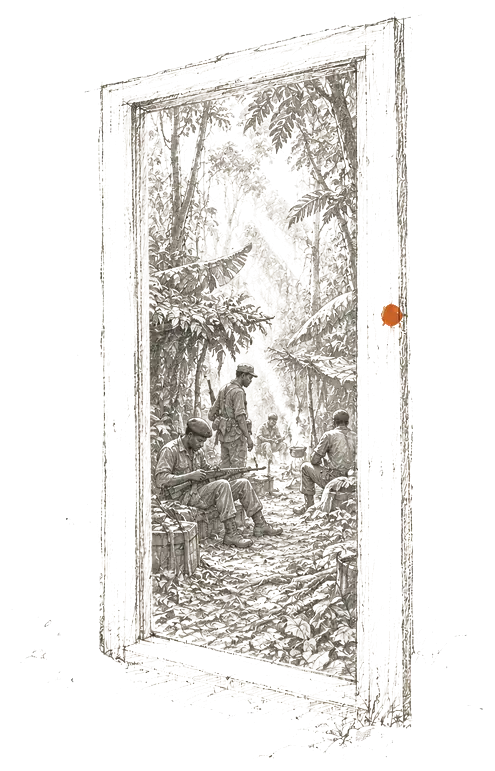
In the Mayombe forest, in Cabinda, guerrillas hold a base hidden beneath the trees and lay ambushes for the colonial army. Under the command of Sem Medo, ethnic rivalries, hunger and ideological quarrels undermine their unity, and an affair with the political commissar's fiancée causes a scandal.
Timeline
- 1889–1956Before the warCordeiro da Matta, Bessa-Victor. A nascent literature of Luanda.
- 1957–1974Poetry of the struggleViriato da Cruz, António Jacinto, Luandino Vieira. Writing from prison.
- 1972SambizangaSarah Maldoror films the Angolan struggle from neighbouring Congo.
- 1975–1985After independencePepetela, Uanhenga Xitu, Ruy Duarte de Carvalho, Ana Paula Tavares.
- 1989–1993Civil warAgualusa publishes A Conjura; cinema barely restarts.
Reading keys
- Names mix Portuguese and the Bantu languages, and many authors adopted a war name or a pen name: Pepetela, Uanhenga Xitu, Luandino.
- The Kimbundu societies of the north are matrilineal: inheritance and authority pass through the maternal uncle, which changes the reading of family relations.
- The Ovimbundu of the centre and the Bakongo of the north have different systems, and regional belonging was a stake of the civil war.
- The name of the musseque, a working-class neighbourhood of Luanda, places a character socially as surely as a surname does.
- The civil war from 1975 to 2002, the massacres of 27 May 1977 within the ruling party and the responsibilities of each camp are still difficult subjects.
- The role of foreign powers, Cuba, South Africa, the United States, the Soviet Union, is recounted according to the author's camp.
- Criticism of the party in power since independence is expressed through allegory and satire.
- Sorcery, kimbanda for the healer and feitiço for the spell, explains success and misfortune, and the accusation is dangerous.
- Catholicism and Protestantism are massively implanted, with a recent expansion of the revival churches.
- Nzambi is the creator, and the kilulu, spirits of the dead, like the kianda, spirits of the waters of Luanda, belong to the Kimbundu stock and coexist with the church.
- The kianda, a female spirit of the bay of Luanda, is a recurring literary figure that is not a metaphor.
- The kimbanda, healer and diviner, is an ordinary character to be distinguished from the malevolent sorcerer.
- Funerals include a wake, a burial, then a deferred and costly lifting of mourning that commits the extended family.
- White and red have precise ritual uses in Kimbundu ceremonies.
- Widowhood imposes on the woman public prohibitions of dress and of behaviour.
- Semba, ancestor of samba, and the more recent kuduro accompany festivities and funerals.
- The fifty Kimbundu tales collected by Héli Chatelain in 1894, published in the original language with a translation, form the founding documented corpus.
- The narratives about the kianda and the spirits of the bay of Luanda are known to all the inhabitants of the city.
- Queen Nzinga, who stood up to the Portuguese in the seventeenth century, is the major historical reference.
- The narratives of the war, of the maquis and of the musseques constitute a narrative stock shared by several generations.
- Luandino's language is not a faulty Portuguese but a deliberate construction, and French translations struggle to render it.
- Kimbundu matrilineality entirely changes the reading of relations of authority in the novels.
- Five centuries of Portuguese presence make Luanda an old creole city and not a recent colonial post.
- The forty-one-year war is not the sole subject of this literature, which includes texts from as early as 1889.
Tales and mythologies 1
- TaleFolk-Tales of AngolaHéli Chatelain · 1894Oral tales from the Luanda region, written down at the end of the nineteenth century.Literature
Available in English 4
The books from this country that can be read in English, in the original or in translation.
- Short storiesLuuanda: Short Stories of AngolaLuuandaJosé Luandino Vieira · 1964Three stories from the poor districts of Luanda, written in prison in the early sixties.Literature
- PoetrySacred HopeSagrada EsperançaAgostinho Neto · 1974The prison poems of the future Angolan head of state, between colonial night and hope of freedom.Literature
- NovelCreoleNação crioulaJosé Eduardo Agualusa · 1997Angola in the time of the slave trade, seen through the letters of a European traveller.Literature
A selection to begin with 10 / 30
- DocumentaryO caminho de ferro de BenguelaArtur Pereira · 1913A railway filmed in colonial Angola in 1913.Cinema
- NovelUangaÓscar Ribas · 1951not translated into EnglishA wedding and a spell in old Luanda, between fiction and ethnography.Literature
- Short storiesLuuanda: Short Stories of AngolaLuuandaJosé Luandino Vieira · 1964Three stories from the poor districts of Luanda, written in prison in the early sixties.Literature
- Feature filmSambizangaSarah Maldoror · 1972A woman searches for her imprisoned husband, at the dawn of the armed struggle for Angolan independence.Cinema
- PoetrySacred HopeSagrada EsperançaAgostinho Neto · 1974The prison poems of the future Angolan head of state, between colonial night and hope of freedom.Literature
- PoetryRitos de passagemAna Paula Tavares · 1985not translated into EnglishAn intimate poetry of the female body, ten years after independence.Literature
- Feature filmThe Train of CanhocaComboio da CanhocaOrlando Fortunato de Oliveira · 1989Prisoners crammed into a wagon in the sun, a few years before the colonial war.Cinema
- Feature filmCaravanaRogelio París · 1990A Cuban military convoy on its way to an isolated bridge, in a country torn apart by fighting.Cinema
- Feature filmO miradouro da LuaJorge António · 1993A son goes to Angola to meet an unknown father, in the time of the civil war.Cinema
- NovelCreoleNação crioulaJosé Eduardo Agualusa · 1997Angola in the time of the slave trade, seen through the letters of a European traveller.Literature