Hungary
- works
- 92
- 54 books · 38 films
- period covered
- 1569–1991
- language of writing
- Hungarian
One morning in 1936, at his table in the Café Central in Budapest, Frigyes Karinthy heard a train start up. There is no station in the vicinity. Those were the first signs of a brain tumour, removed a few months later in Stockholm by the best neurosurgeon in Europe. Karinthy remained conscious, his skull open, and he afterwards wrote the account of what he had heard, seen and thought during the operation. He died two years later.
Read moreShow less
That taste for observation applied to oneself comes from a particular situation: Hungarian has no close relative within a thousand kilometres, it was rebuilt around 1800 by a reform that fabricated thousands of words, and everything was invested in that language which almost nobody reads from outside. The treaty of 1920 then removed from the country two thirds of its territory and left a third of Hungarian speakers outside the borders, so that Hungarian literature is practised also in Romania, in Slovakia and in Serbia.
The form is short, ironic and exact: the review Nyugat imposes at the beginning of the century the short story, the brief poem, the essay, and István Örkény brings the narrative down to a page in 1968. The price was paid twice. In 1944, four hundred thousand Jews of Hungary were deported in two months, and the poet Miklós Radnóti was shot in November during a forced march; his notebook would be found in his coat pocket at the exhumation, a year and a half later. Imre Kertész, back from Auschwitz at fifteen, took years to have his narrative accepted, published in 1975 to indifference. Sándor Márai left in 1948, remained banned at home and died in California in 1989. Péter Bacsó's satirical film about the political trials waited ten years before its release.
What awaits the reader is a prose that keeps its composure in impossible situations, and a comedy that consoles for nothing. The novel that opens this page tells of the war between two gangs of schoolboys over a vacant lot in Budapest, with its president, its ranks and its flag, and it is on the Hungarian school syllabus.
A way to begin
The Paul Street Boys
Ferenc Molnár · 1907
The Paul Street Boys, free of rights: the Hungarian novel best known abroad, brought to the screen seven times.
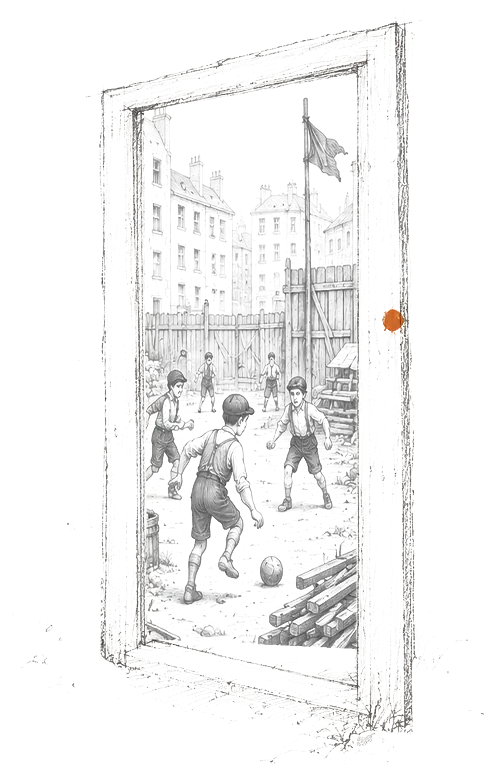
Budapest, 1889. A band of schoolboys rules over the grund, the only vacant lot in the neighbourhood, which they regard as their homeland, with a president, ranks and a flag. The Red Shirts, who meet in the Botanical Garden, want to take it from them. Boka, the leader, prepares the defence; little Nemecsek, the troop's only private, whom nobody takes notice of, ventures into the enemy camp.
Timeline
- 1823–1849Reform and revolutionPetőfi, poet and revolutionary, dies at twenty-six on a battlefield.
- 1908–1941The journal NyugatAdy, Kosztolányi, Babits. Budapest becomes a literary capital.
- 1944–1945ExterminationThe Hungarian Jewish community is deported. Kertész, a teenager, returns and will write it.
- 1956UprisingCrushed by tanks. Many leave, including part of Hungarian cinema.
Reading keys
- The family name precedes the first name, as in East Asia: Molnár Ferenc is Ferenc Molnár, and Western editions reverse the order without signalling it.
- Female first names often take the wife's suffix in old documents, a married woman being designated by her husband's full name followed by a marker.
- Many Jewish families of Budapest Magyarised their surname between 1880 and 1930, and the date of that change is legible in the registers.
- Diminutives are systematic and affectionate, and the move from the full name to the diminutive marks a change of relation in a dialogue.
- The treaty of Trianon, in 1920, is the permanent reference of public discourse, and the way of naming it situates a text politically.
- Hungarian responsibility in the deportations of 1944, the Horthy administration and the role of the gendarmes are subjects of open conflict, including before the courts and the monuments.
- The uprising of 1956, its crushing and the fate of its actors are officially commemorated, but the detail of the collaborations remains sensitive.
- The Roma, half a million people, occupy a place that literature rarely approaches head-on, and anti-Roma prejudice is a documented subject.
- The country is two thirds Catholic with a strong Calvinist minority, which has its colleges, its austere style and its own geography east of the Danube.
- Budapest had one of the largest Jewish communities in Europe, with its press and its theatre, and the Dohány street synagogue remains the largest on the continent.
- The pre-Christian stock was reconstituted in the nineteenth century from the songs: the marvellous stag that leads the ancestors, the world tree, the táltos, a healing shaman.
- Popular cults mix Marian pilgrimages and practices of conjuration, and a village novel holds them as self-evident.
- 20 August, the feast of Saint Stephen, celebrates the state with its relic and its fireworks, and 15 March commemorates 1848 with the tricolour cockade worn on the lapel.
- The carnival visits, Easter Monday when women are sprinkled with water or perfume, and Saint Lucy's day are dated rites that the narratives use.
- Paprika, lard and Tokaj wine are not clichés but social markers, and the Viennese café of Budapest is a place of literary work.
- Catholic funerals include a vigil, and on 1 November the cemeteries light up with candles throughout the country.
- The legend of the marvellous stag, transmitted by the medieval chronicles and taken up by Elek Benedek's collection in 1894, is the people's narrative of origin.
- János Kriza's collection of Székely tales, in 1863, is the reference of the folklore of Transylvania, a region that counts as much as the country in the imagination.
- Sándor Petőfi, the poet of the 1848 revolution, who disappeared in combat at twenty-six and was never found, is the absolute national figure, quoted from memory.
- János Arany's epic poem about Toldi, a peasant become a knight, is part of the common school baggage.
- Hungarian is neither Slavic nor Germanic: it is a Finno-Ugric language, without gender, with eighteen cases, and Hungarians are not Slavs surrounded by Germans.
- Transylvania has been Romanian since 1920 and shelters an important Hungarian minority: a Hungarian author from Cluj is not a foreign author in this literature.
- Nostalgia for greater Hungary is not a sentimental setting but an active political programme, and a text that evokes it takes a position.
- The family name placed first means that the same author appears in two forms in catalogues, which multiplies duplicates.
- Hungarian literature arrived late in French, in waves, and an author's absence from the catalogue measures the state of translations.
Tales and mythologies 1
- PoetryThe Folk-Tales of the MagyarsVadrózsákJános Kriza · 1863Ballads, songs and tales from the Székely villages of Transylvania, printed in the local dialect and followed by a glossary.Literature
A selection to begin with 10 / 92
- PoetryJohn the ValiantJános vitézSándor Petőfi · 1845A shepherd driven from his village becomes a hussar, saves a princess and remains faithful to his childhood sweetheart.LiteraturePublic domain
- NarrativeA Journey Round My SkullUtazás a koponyám körülFrigyes Karinthy · 1937A Hungarian writer starts hearing noises coming from nowhere, learns what he has in his head, and goes off to be operated on in Sweden.Literature
- NovelEmbersA gyertyák csonkig égnekSándor Márai · 1942Two old men meet for dinner after more than four decades, and one expects from the other an answer he has been preparing all his life.Literature
- Short storiesOne Minute StoriesEgyperces novellákIstván Örkény · 1968Very short grotesque tales whose last sentence overturns everything, with a note to the reader at the head.Literature
- CinemaThe Upthrown StoneFeldobott kőSándor Sára · 1969A young man barred from film school becomes a surveyor in Rákosi's Hungary and gradually loses his illusions.Cinema
- CinemaThe Lady from ConstantinopleSziget a szárazföldönJudit Elek · 1969An old lady in Budapest tries to exchange her flat, and discovers over the course of the visits the city of her time.Cinema
- CinemaThe FalconsMagasiskolaIstván Gaál · 1970A trainee discovers on the plain a farm breeding trained birds of prey, and the strict order that reigns there.Cinema
- CinemaSzindbádZoltán Huszárik · 1971An ageing seducer relives, in no particular order, his past love affairs and the meals of former days, in the Hungary of small towns.Cinema
- NovelFatelessnessSorstalanságImre Kertész · 1975An adolescent from Budapest is deported and describes the camp as a series of reasonable stages, never expressing indignation.Literature
- CinemaThe WitnessA tanúPéter Bacsó · 1979A dyke keeper whom the regime draws out of prison moves from one absurd post to the next, waiting for a service to be demanded of him.Cinema