Tajikistan
- works
- 19
- 14 books · 5 films
- period covered
- 1912–1998
- language of writing
- Tajik
Tajik and Persian are the same language, written in two different alphabets. A Tajik and an Iranian understand each other when speaking, but cannot read each other: one has written in Cyrillic since 1940, the other in Arabic characters for a thousand years. Two imposed changes, from Arabic-script Persian to Latin in 1929 and then to Cyrillic in 1940, cut Tajikistan off from its own library, that of Ferdowsi, of Hafez and of Rudaki, which was born in part on its territory.
Read moreShow less
For it is there that literary Persian began. Rudaki, held to be the first great poet of the Persian language, was from Samarkand, in the Tajik area, and the Samanid dynasty of Bukhara made Persian in the ninth century a language of the court and of learning against Arabic. The Tajiks are the direct heirs of that culture, but the Soviet borders placed Bukhara and Samarkand in Uzbekistan, so that the country claims a depth whose cities are at the neighbour's. A cultivated Tajik quotes Rudaki knowing that his native city now has another official name.
The literature of the twentieth century was born of that situation. Sadriddin Aini, trained in the madrasas of Bukhara, wrote in 1930 the first modern Tajik novel, about a shepherd caught up in the revolution, after having been flogged by the emir and left for dead. He was the man who carried a learned Persian culture over into a Soviet literature in Cyrillic, and he paid for that passage with a silence about what he had lost. Cinema filmed in 1971 an episode from the Book of Kings, the one about the father who kills his son without recognising him, a way of recalling to whom that text belongs. The civil war from 1992 to 1997 then stopped everything, and part of the writers left for Moscow.
What awaits the reader is a Persian literature written in Cyrillic, with the memory of a displaced greatness. The novel that opens this page follows a shepherd of the Emirate of Bukhara from poverty to the emir's prison, and it is regarded as the first novel written in Tajik.
A way to begin
Дохунда
Sadriddin Aini · 1930
Regarded as the first novel written in Tajik: a shepherd of the Emirate of Bukhara, from poverty to the emir's prison. Free of rights.
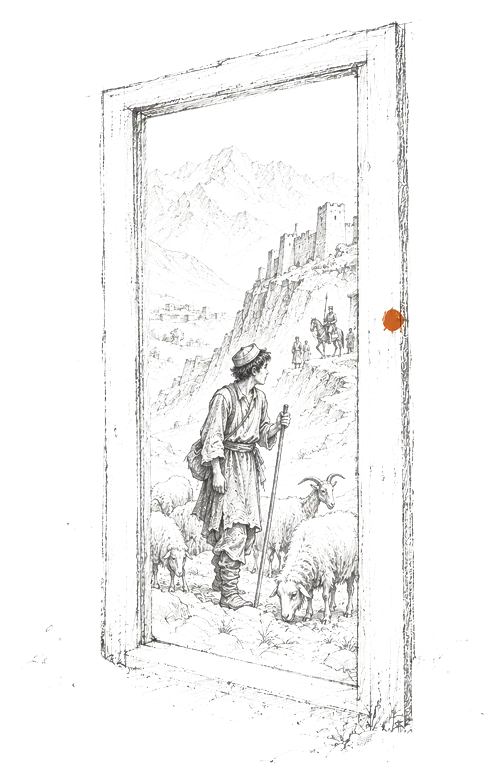
An orphan born in the mountains of the Emirate of Bukhara, Yodgor herds the flocks of a rich landowner and knows the poverty of the Tajik peasants; he is nicknamed dokhunda, the beggar. Thrown into the emir's underground prison, he meets a Bolshevik there who opens his eyes to his condition. His fiancée, Gulnor, also refuses oppression, while the emirate collapses and civil war spreads through the country.
Timeline
- 1920–1934FoundationFitrat, then Aini, bring modern Tajik prose into being.
- 1936–1947Soviet periodTursunzoda, Lohuti. Poetry becomes official and popular.
- 1970–1980ThawLoiq Sher-Ali, Bozor Sobir, Zulfiqarov. Persian verse returns.
- 1971–1993Tajik cinemaKimyagarov films the Shahnameh; Khudojnazarov is awarded in Venice.
Reading keys
- Names often end in -ov or -ova, a Russian inheritance, and many have taken up forms in -zoda or -i since 1991.
- The name may indicate the town of origin, Samarqandi, Bukhori, Khujandi, and that origin remains socially determining.
- The regions, Khujand in the north, Kulob in the south, the Pamirs in the east, structure political life, and regional origin can be read in the name.
- The extended family and the neighbourhood organise mutual aid, and respect for elders imposes forms of address.
- The civil war from 1992 to 1997, its tens of thousands of dead and its regional division are an officially closed subject.
- Criticism of the authorities is risky, and part of the authors write from Russia or Europe.
- Relations with Uzbekistan, over the cities of Persian culture and over water, are a permanent dispute.
- The Pamiris, Ismailis speaking distinct languages, are a minority whose place is little discussed publicly.
- Hanafi Sunni Islam is in the majority, with an Ismaili minority in the Pamirs whose spiritual authority is the Aga Khan.
- Sufism marked the region, and the tombs of saints are visited despite state surveillance.
- Zoroastrianism left Nowruz, the fires and a vocabulary, and the country claims that priority.
- Possession rites and healers, mostly women, coexist with official Islam.
- Mourning includes a wake, a swift burial and commemorations on the seventh and the fortieth day, with costly meals that the state has tried to limit by law.
- Nowruz on 21 March is the main festival, with sumanak prepared collectively.
- Atlas, a brightly coloured silk cloth, indicates the region and the occasion.
- Pilaf and the cloth laid on the ground organise hospitality and the conversation scenes.
- Ferdowsi's Book of Kings is the narrative stock common with Iran and Afghanistan, and the country claims it fully.
- Rudaki, the first great poet of the Persian language, born in what is now the Tajik area, is the founding reference.
- The Gurughli cycle, the Tajik version of the Koroglu in eastern Persian, is a recognised oral heritage.
- The traditions of the Pamirs, with their shrines and their popular Ismailism, form a distinct stock.
- Tajik is not a Turkic language: it is Persian, and classifying it with Uzbek or Kazakh is an error of family.
- The Cyrillic alphabet signals no kinship with Russian: it was imposed in 1940 on an Indo-European language.
- Bukhara and Samarkand are cities of Persian culture situated in Uzbekistan, which makes the literary geography of the region illegible without that key.
- The country claims Ferdowsi and Rudaki on the same footing as Iran, and such competing claims are ordinary in Central Asia.
Tales and mythologies 1
- EpicГӯрғулӣAnonymous · 1930not translated into EnglishThe cycle is sung through a whole night to a long-necked lute, and the collections gathered since the thirties amount to some hundred thousand lines.Literature
A selection to begin with 10 / 19
- NarrativeБаёноти сайёҳи ҳиндӣAbdurauf Fitrat · 1912not translated into EnglishA Bukharan student settled in Istanbul writes to awaken the emirate, which the Jadid reformists want to modernise.Literature
- PoetryҚиссаи ҲиндустонMirzo Tursunzoda · 1948not translated into EnglishIndia is on the eve of its independence, which will be proclaimed in August 1947.Literature
- CinemaA Poet's FateСудьба поэтаBoris Kimyagarov · 1959The Tajik studio celebrates Rudaki, a tenth-century poet whom the republic regards as the founder of its literature.Cinema
- NarrativeДар он дунёFazliddin Muhammadiev · 1965not translated into EnglishThe only fictionalised account of the pilgrimage to Mecca published in the Soviet Union, by a Tajik writer who had made it.Literature
- PoetryShabdaravGulrukhsor Safieva · 1975not translated into EnglishA poetic essay on the home front in wartime, by the principal female voice of Tajik poetry.Literature
- PoetryГули хорBozor Sobir · 1978not translated into EnglishSix years after his first book, the poet works in the press in Dushanbe, ten years before the State Prize that will bring him recognition.Literature
- CinemaВ талом снеге звон ручьяDavlat Khudonazarov · 1982A Tajik shepherd keeps the memory of a war fought far from his mountains, forty years earlier.Cinema
- CinemaAdonis XIVАдонис XIVBako Sadykov · 1986An apprentice filmmaker shoots a silent fable that Soviet censorship will judge too clear to be shown.Cinema
- CinemaKosh ba koshКош ба кошBakhtyar Khudojnazarov · 1993A year after independence, civil war breaks out in Tajikistan and reaches the capital.Cinema
- CinemaThe Flight of the BeeParvaz-e zanburJamshed Usmonov and Min Byung-hun · 1998At the end of the civil war, two young filmmakers trained in Moscow shoot in a village with a few tens of thousands of dollars.Cinema