Austria
- works
- 73
- 45 books · 28 films
- period covered
- 1600–1989
- language of writing
- German
Karl Kraus spent six years writing an eight-hundred-page tragedy of which he announces in the preface that it would require ten evenings and a theatre on Mars. The lines are not invented: they are sentences taken from the newspapers, the communiqués and the street conversations during the First World War, reassembled as they stood. The play appeared in 1919, then in book form in 1922, and has almost never been performed in full. Its author had already written that war begins in the columns.
Read moreShow less
That way of holding language to be the scene of the crime is the country's speciality. Vienna was in 1914 the capital of an empire of fifty million inhabitants; in 1919 it administered six million. In that city, at the same moment, psychoanalysis, the critique of language and logical positivism were being invented, and literature inherited from it a methodical mistrust of the ready-made phrase, that of the newspapers, that of families, that of the state.
The form is the negative monologue, the repetition that slips, the comedy without an exit. The price was the annihilation of a milieu. Jura Soyfer died of typhus at Buchenwald in 1939. Joseph Roth died the same year in Paris. Musil died in Geneva in 1942, almost alone, leaving his great novel unfinished. A Viennese film of 1924 imagined the city expelling its Jews and then recalling them: it was lost for ninety years and found in 2015 in a flea market in Paris. After the war, the quarrel continues otherwise: Thomas Bernhard forbade by will the performance of his plays in Austria, and Elfriede Jelinek is treated there as a public enemy.
What awaits the reader is a prose that dismantles the commonplace until it confesses, with a drollery that does not reassure. The story that opens this page is the confession of an old Scottish lady, who tells of the casino day that upended her life twenty-five years earlier, and it has been filmed four times.
A way to begin
Twenty-Four Hours in the Life of a Woman
Stefan Zweig · 1927
A confession in a short narrative, free of rights, brought to the cinema four times.
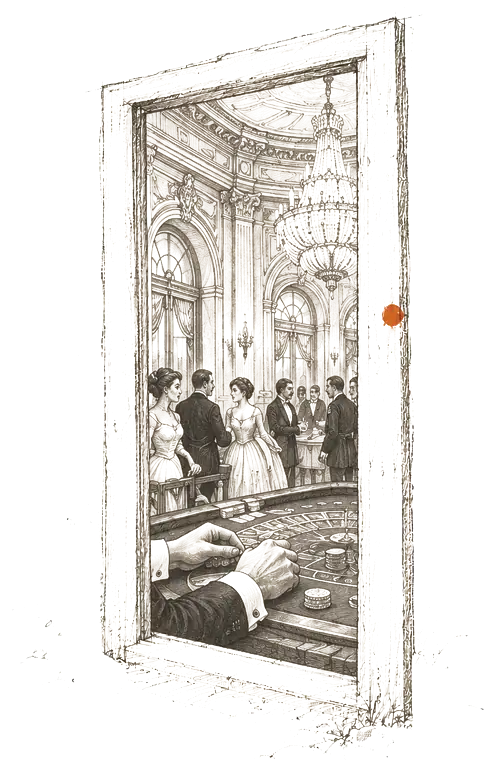
In a boarding house on the Riviera, a wife's flight with a young man met the day before divides the guests. An old Scottish lady then confides to the narrator the day that, twenty-five years earlier, turned her life upside down: a widow of two years, she was captivated, in the casino, by the feverish hands of a young gambler.
Timeline
- 1890–1914Vienna 1900Schnitzler, Hofmannsthal, Kraus, Freud, Klimt. A civilisation at its peak, and aware of it.
- 1918–1938After the EmpireZweig, Roth, Musil. Writing a world that no longer exists.
- 1938–1945ExileAlmost all of them leave. Zweig takes his own life in Brazil in 1942.
Reading keys
- Titles and functions stand in for the name in Viennese usage, Herr Hofrat, Frau Doktor, including for a title inherited from the spouse, and the novel uses it as a comic system.
- The particle von was abolished in 1919 along with the nobility, so that an author born von Hofmannsthal legally ceases to be so in the course of his life.
- The diminutive in -erl is constant in spoken language and gives a dialogue a gentleness that often contradicts its content.
- Czech, Hungarian, Croatian and Polish names are everywhere in the Viennese registers, an inheritance of the empire, and signal no recent immigration.
- The thesis of Austria as the first victim of Nazism, official until the nineteen eighties, has been refuted by historians, and Austrian participation in the Shoah has become a central but still raw subject.
- The Waldheim affair in 1986 is the moment when that debate broke out publicly, and it structures the literature that followed.
- The civil war of 1934, the dictatorship of the Christian Social party and the Anschluss of 1938 are recounted in divergent ways according to political families.
- Disparaging one's own country is a recognised literary genre here, which is disconcerting: insulting Austria is part of the Austrian tradition.
- Baroque Catholicism left a theatricality, processions and an aesthetic of decor that literature turns into satire.
- Anticlericalism is old and cohabits with a social practice of Catholicism: people marry in church without believing, and the texts note it.
- Vienna had one of the largest Jewish communities in Europe, and its absence after 1945 is a constant fact, often stated through silence.
- The popular Alpine figures, the Perchten and the Krampus who accompany Saint Nicholas with horns and whip, are alive and provide material for the grotesque.
- The cult of the beautiful funeral, the schöne Leich, is a Viennese institution: the procession, the music and the central cemetery are part of the national narrative.
- The café is a codified place of work and sociability, with its reserved table and its glass of water, and a novel sets whole scenes there.
- The ball, from the Opera ball to the guild balls, organises the winter and provides a setting for social comedy.
- The Krampuslauf of December and the Alpine village festivals are dated rites that the texts use without explaining them.
- The Habsburg empire, its end in 1918 and the nostalgia for it are the permanent reference, down to the term Kakania invented by Musil to name it.
- The Viennese popular theatre of the nineteenth century, Nestroy and Raimund, provides a language and types that every author assumes are known.
- Psychoanalysis is a common knowledge, not an exotic theory: the characters speak of the unconscious as of a familiar object.
- Sissi, operetta and the waltz form the official image of the country, against which literature almost always writes.
- Austria is not a little Germany: it was a multinational empire, and its literature has other references, other cities and another humour.
- The German of Austria has its own vocabulary, including for the months and foods, and an untranslated text immediately signals its origin.
- Zweig, Roth and Musil are not Viennese authors of atmosphere: they write about the dissolution of a precise political order.
- The violence of contemporary authors against their country is not gratuitous provocation but a constituted genre, with its trials and its scandals.
- The catalogue mixes authors of German, Hebrew and Yiddish language born in the empire, and language does not state belonging.
Tales and mythologies 1
- NarrativeThe Perchten and the KrampusPerchten und KrampusAnonymous · 1600Two winter beliefs of the Austrian Alps: an old woman who punishes the lazy, and a horned demon who comes with the saint of children.Literature
A selection to begin with 10 / 73
- TheatreThe Last Days of MankindDie letzten Tage der MenschheitKarl Kraus · 1922Five acts and hundreds of scenes, in which the war of 1914 is told through the very phrases it had printed.LiteraturePublic domain
- CinemaThe City Without JewsDie Stadt ohne JudenHans Karl Breslauer · 1924A silent satire in which a small state in crisis expels its Jews, based on a hugely successful Viennese novel.Cinema
- NovelThe Man Without QualitiesDer Mann ohne EigenschaftenRobert Musil · 1930A man who takes a year's leave from his own life, in a Vienna busy preparing celebrations for 1918.LiteraturePublic domain
- NovelThe Radetzky MarchRadetzkymarschJoseph Roth · 1932Three generations of a family ennobled after Solferino, and the Austro-Hungarian Empire wearing away around them.LiteraturePublic domain
- TheatreVinetaJura Soyfer · 1937not translated into EnglishA 1937 parable about a drowned city whose inhabitants have lost their memory, performed on a small political stage in Vienna.LiteraturePublic domain
- CinemaThe Angel with the TrumpetDer Engel mit der PosauneKarl Hartl · 1948Three generations of a family of Viennese piano makers, from 1888 to 1945, and a house into which the country's history enters room by room.Cinema
- CinemaEroicaWalter Kolm-Veltée · 1949Beethoven between disappointed admiration for Bonaparte, thwarted loves and a deafness that sets in.Cinema
- CinemaAsphaltHarald Röbbeling · 1951Five teenage destinies in the grey Vienna of 1950, drawn from police files and told one after another.Cinema
- NovelThe Piano TeacherDie KlavierspielerinElfriede Jelinek · 1983A Viennese piano teacher, drilled by her mother since childhood, and the young student who falls in love with her.Literature
- NovelExtinctionAuslöschungThomas Bernhard · 1986An Austrian exile, heir despite himself to his family's estate, sets out to write in order to erase everything that this place represents.Literature