Slovakia
- works
- 50
- 40 books · 10 films
- period covered
- 1784–1991
- language of writing
- Slovak
The first Slovak novel was written in a spelling its author had fabricated for himself alone. Jozef Ignác Bajza, a Catholic priest, had it printed at his own expense between 1783 and 1785: a young Venetian travels through the Orient and then through northern Hungary, and the journey serves as a pretext for a critique of the clergy and the lords. Church censorship seized the second volume, which was published only in 1955, a hundred and seventy years later.
Read moreShow less
The country spent a century deciding in what language it wrote. Bajza had his spelling, Bernolák proposed another in 1787 for the Catholics, Ľudovít Štúr fixed a third in 1846 on the speech of the centre, adopted by the Lutherans, and a compromise came in 1852. Before that, Slovaks wrote in Latin, in German, in Hungarian or in Czech. After 1867, the Hungarian administration closed their institutions, including the Matica in 1875. Then Prague decided in their place, until 1993.
The form is the poem and the ballad, up to the wave of cinema of the nineteen sixties that filmed the villages with the peasants in them. The price has several faces. The satellite state from 1939 to 1945 deported almost all its Jewish population, paying Germany by head. Laco Novomeský, poet and minister, was sentenced in 1954 at the trial of the bourgeois nationalists and spent years in prison. Dominik Tatarka signed Charter 77 and lost the right to publish. Ladislav Mňačko, an official journalist, left the country in 1967 after a public protest. Dušan Hanák's documentary about old peasants, shot in 1972, stayed sixteen years in reserve.
What awaits the reader is a literature of the mountain, of the village and of impossible loyalty, without national grandiloquence. The novel that opens this page, published in 1959, follows a wounded partisan who relives in hospital his war and the hamlet that had sheltered his group, and it is probably based on its author's experience.
A way to begin
Death Is Called Engelchen
Ladislav Mňačko · 1959
Death Is Called Engelchen: a wounded partisan relives the war and the destruction of a village that had sheltered him. Translated into French as early as 1961.
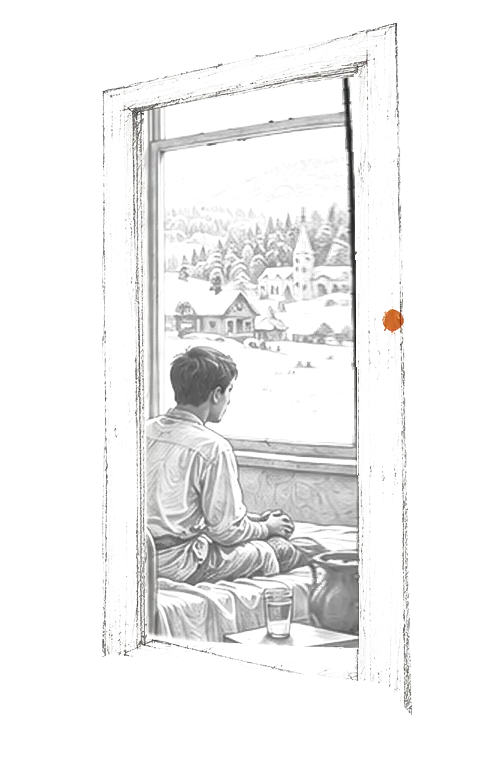
At the end of the war, the young partisan Voloďa, shot in the back, wakes with no feeling in his legs. In hospital he relives his partisan life: the hamlet of Ploština, whose inhabitants protect his group, and his affair with Marta, a Jewish woman who obtains intelligence from influential Germans. Against the partisans comes a hunting commando with dogs, led by Otto Skorzeny and his deputy Engelchen, "little angel".
Timeline
- 1785–1846CodificationBajza writes the first novel; Štúr fixes literary Slovak.
- 1846–1900RomanticsSládkovič, Botto, Hviezdoslav. The country sings itself before it exists.
- 1921–1943Avant-gardesSmrek, Novomeský, Fabry. Surrealism passes through Bratislava.
- 1947–1962War and postwarMináč, Bednár, Mňačko, and Bielik's first feature films.
- 1962–1972New WaveUher, Kadár, Jakubisko, Hanák. Ten years before normalisation.
Reading keys
- Female family names take the ending in -ová, including for foreign names, which is disconcerting when the same family appears in two forms.
- Many nineteenth-century authors bear a pen name built on a place or a quality, and their civil name is different, which multiplies catalogue entries.
- Hungarian, German and Rusyn names are frequent and say nothing about present belonging, the region having been administered in Hungarian for centuries.
- Village kinship, with godparenthood and obligatory neighbourliness, structures rural narratives more than the nuclear family.
- The Slovak state from 1939 to 1945, its priest president and the deportation of the Jews are the most disputed subject, and the commemorations show it every year.
- The uprising of 1944, its real extent and its later political use are the object of opposed readings.
- The separation of 1993, decided without a referendum, and the relation to Prague are treated with a sensitivity that the reader must perceive.
- The Hungarian minority of the south and the Roma population, one of the largest in Europe in proportion, are subjects in which every word counts.
- Catholicism is in the majority and Lutheranism a minority but a decisive one: the written language, the schools and a great part of nineteenth-century literature are of Protestant origin.
- The Rusyns of the east are Greek Catholic or Orthodox, with their wooden churches and their own calendar.
- The pagan stock surfaces in the tales: the víly, young dead women who dance, Morena the death of winter, and the witches of Kupala night.
- The Marian pilgrimages of Levoča and Šaštín gather crowds and serve as a landmark in village narratives.
- The exit from winter is marked by the drowning of a straw figure representing death, a documented rite still practised in the villages.
- Embroideries and headdresses differ from one valley to another and signal a character's exact origin.
- Funeral vigils gather the village around songs, and funeral lamentations are an attested poetic genre.
- Sheep's cheese, plum brandy and the festival of the end of the harvest are the landmarks of the rural calendar that the texts assume are known.
- Pavol Dobšinský's collection of tales, published between 1880 and 1883, is the canonical corpus, with its ninety narratives and its three-headed dragons.
- Juraj Jánošík, an outlaw and righter of wrongs hanged in 1713, is the popular figure par excellence, taken up in poem, in film and in song.
- The debate on the written language, from Bernolák to Štúr, is a constant reference: quoting an old spelling is a political gesture.
- The great poetry of the nineteenth century, from Sládkovič to Hviezdoslav, provides the lines that school has made common.
- Slovak and Czech are close but distinct, and the history of their separation is the very subject of nineteenth-century Slovak literature.
- Slovakia was not a Czech province: it spent a thousand years in the kingdom of Hungary, which explains the place of Hungarian in its archives and its names.
- The Czechoslovak New Wave includes a distinct Slovak school, and the films of Jakubisko or Hanák do not belong under Prague.
- Ján Kollár, a Slovak, wrote his great poem in Czech: the catalogue places him in both countries, and that is a fact of linguistic history and not an error.
- The catalogue stops in the mid nineteen eighties, which measures the state of French translations and not the country's production.
Tales and mythologies 1
- TaleTraditional Slovak FolktalesProstonárodné slovenské povestiPavol Dobšinský · 1880The great collection of Slovak folk tales, gathered by a pastor in the nineteenth century.Literature
A selection to begin with 10 / 50
- NovelRené, or: A Young Man's Adventures and ExperiencesRené mládenca príhody a skúsenostiJozef Ignác Bajza · 1784The Upper Hungary of the Enlightenment, where a reforming parish priest writes a novel in Slovak and runs up against Church censorship.Literature
- EssayNárečja slovenskuo alebo potreba písaňja v tomto nárečíĽudovít Štúr · 1846not translated into EnglishUpper Hungary in the 1840s, where a handful of young scholars decide to give the Slovaks their own written language.Literature
- PoetryThe Bloody SonnetsKrvavé sonetyPavol Országh Hviezdoslav · 1919A cry against the war, raised by an old poet in the very first weeks of the world conflict.Literature
- PoetryNedeľaLaco Novomeský · 1927not translated into EnglishA social poetry of the city, which denounces in a low voice rather than through slogans.Literature
- NovelDémon súhlasuDominik Tatarka · 1956not translated into EnglishA grotesque satire of the cult of personality and servile approval under Stalinism.Literature
- CinemaThe Shop on Main StreetObchod na korzeJán Kadár · 1965A small man caught between his conscience and the persecution of the Jews in wartime Slovakia.Cinema
- CinemaDragon's ReturnDrak sa vraciaEduard Grečner · 1967A mountain ballad about a village's hatred of a man cast out.Cinema
- CinemaThe Sweet Time of KalimagdoraSladký čas KalimagdoryLeopold Lahola · 1968The fable of a man for whom each year is a lifetime, from childhood to old age.Cinema
- CinemaBirds, Orphans and FoolsVtáčkovia, siroty a blázniJuraj Jakubisko · 1969Three young people who choose madness and play in order to survive in a world in ruins.Cinema
- CinemaPictures of the Old WorldObrazy starého svetaDušan Hanák · 1972Elderly peasants, on the margins of socialist society, tell the story of their lives in front of the camera.Cinema