France
- works
- 202
- 142 books · 60 films
- period covered
- 1100–2000
- language of writing
- French
On 20 August 1857, the criminal court of the Seine sentenced Baudelaire to a fine of three hundred francs for an offence against public morals and ordered the withdrawal of six poems. The same deputy prosecutor, Ernest Pinard, had appeared in February against Flaubert, who was acquitted. The ban on the six pieces remained in force for ninety-two years: a law of 1946 creating a procedure for the revision of literary trials was needed, then a ruling of the Court of Cassation of 31 May 1949, before they could be published again.
Read moreShow less
That length says something particular about France: literature here is an affair of state. An academy has regulated the language since 1635, the school imposes a canon and passages to be learnt by heart, writers enter the Pantheon, sit in Parliament or become ambassadors, and the autumn prizes are a national event. Everything is decided in Paris, where the publishers, the newspapers and the juries are, and where one comes up from the provinces, as in Balzac.
The French form is the sentence that judges itself: Flaubert invents in 1857 a narrative that thinks through its character without commenting on her, and a century of refusal follows, Rimbaud who stops at twenty, the surrealists, the novel that dismantles itself. The price is old: Villon sentenced to hanging and then banished in 1463, Sade shut up for twenty-seven years by three successive regimes, Hugo nineteen years of exile, Baudelaire and Flaubert in court the same year, then the reverse question with Céline, whose 1932 novel is a summit of language and whose author wrote antisemitic pamphlets, something French publishing has never finished dealing with.
What awaits the reader is a literature that works language as a material and that takes itself for an institution, which gives both Proust and the comedy of Villon. The tale that opens this page appeared anonymously in January 1759, passed off as a translation from German and published at once in several cities to outwit the censors; condemned in Geneva and Paris, it was nonetheless an immediate success.
A way to begin
Candide
Voltaire · 1759
A boy brought up to believe that all is for the best goes through every misfortune of his century: Voltaire's tale, free of rights.
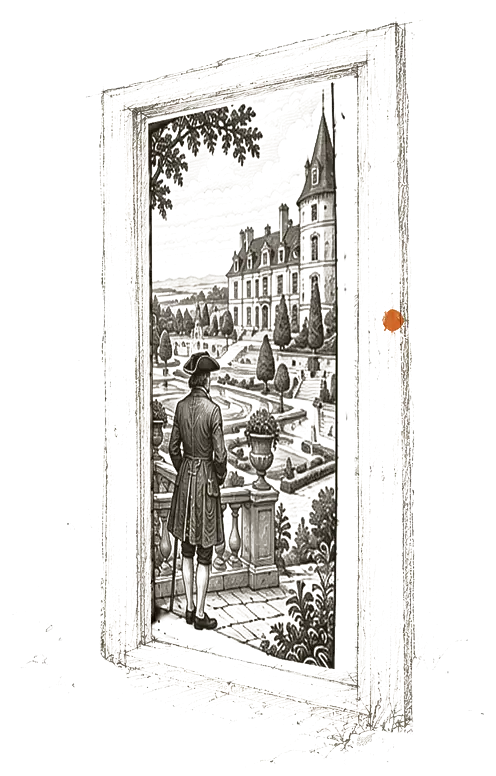
Candide grows up in Westphalia, in the castle of the Baron of Thunder-ten-tronckh, where the tutor Pangloss teaches that all is for the best in the best of all possible worlds. Caught kissing Cunégonde, the baron's daughter, he is driven from the castle, forcibly enlisted by the Bulgars and thrown into war, then reaches Lisbon on the day of the earthquake, before witnessing an auto-da-fé of the Inquisition.
Timeline
- 1100–1461Middle AgesChansons de geste, courtly romance, Villon. The language parts from Latin.
- 1532–1595RenaissanceRabelais, Montaigne, the Pléiade. The essay is invented and French is dared.
- 1636–1695ClassicismThe rule, the court, tragedy. Corneille, Racine, Molière, La Fontaine.
- 1715–1789EnlightenmentVoltaire, Rousseau, Diderot. Literature becomes a political weapon.
- 1820–1850RomanticismHugo, Lamartine, Nerval. The self, history, freedom of form.
- 1850–1890Realism and naturalismFlaubert, Balzac, Zola, Maupassant. The novel examines society.
- 1857–1900SymbolismBaudelaire, Verlaine, Rimbaud, Mallarmé. Poetry leaves narrative behind.
- 1913–1940ModernityProust, Gide, the surrealists. The novel turns back on itself.
- 1938–1960ExistentialismSartre, Camus, Beauvoir. Writing becomes a responsibility.
- 1950–1970Nouveau roman, New WaveNarrative is dismantled on one side, the camera on the other.
Reading keys
- The particle de does not necessarily indicate nobility and its literary use is a dated social sign, several authors having added it to themselves.
- The pseudonym is an institution, from Molière to Céline, and the civil name sometimes disappears from catalogues.
- Formal and familiar address organise every dialogue, and the shift from one to the other is an event that translations into English cannot render.
- The name of the lycée, of the grande école or of the competitive examination passed functions as a family belonging in twentieth-century narratives.
- The Algerian war, torture and the place of the harkis remain an open subject, and the vocabulary used, events or war, situates a text.
- Vichy, collaboration and the responsibility of the French administration in the deportations were officially acknowledged in 1995, after fifty years of a Gaullist narrative.
- Secularism, the veil and the place of Islam are an immediate political division, and a novel that approaches them is read as an intervention.
- Class relations are stated less directly than in England, often through the detour of taste, language and diplomas.
- Catholicism was the state religion until 1905, and the rupture of the separation still structures the institutions, the school and the calendar.
- Anticlericalism is a constituted literary tradition, from Voltaire to Zola, and conversion, in Claudel or Bernanos, is in return a major literary gesture.
- Minority Protestantism, the dragonnades and the revocation of 1685 form a memory of internal persecution that the texts of the Midi and the Cévennes carry.
- The local legendary stock, Mélusine, a popular Gargantua, procession dragons, exists and was reconstituted in the twentieth century against the idea of a France without mythology.
- The meal is a complete social form, with an order of courses and regulated conversation, and a novel uses it as a theatre scene.
- 14 July and 11 November are civic rites, and school commemoration is part of literary education.
- Religious rites persist without faith, baptism, communion, marriage in church, and contemporary texts note it.
- Mourning is marked by black, the cemetery visit of 1 November and a funeral at which the eulogy is delivered by a relative.
- The Song of Roland, around 1100, and La Fontaine's fables are the common school base, quoted from memory by whole generations.
- Perrault's tales, published in 1697, fixed Cinderella, Tom Thumb and Bluebeard in versions written by an author's hand.
- The Roman de Renart, written in branches in the twelfth and thirteenth centuries, provides the animal satire that Luxembourg and Flanders took up.
- The Revolution, the Commune, Verdun and 1968 are the landmarks that every text assumes are known, with their dates and their words.
- French literature is not the literature of France: a major part is written in Quebec, in West Africa, in the Maghreb, in the Antilles and in Belgium, and this catalogue shows it country by country.
- The school canon is not the readers' canon: authors central to the curricula are little read, and the reverse is true.
- Linguistic unity is recent and constructed: in the nineteenth century part of the country spoke Breton, Occitan, Alsatian or Corsican, and the school imposed French against those languages.
- Literary prizes are commercial instruments and not judgements of posterity, which the structure of the market explains.
- The catalogue mixes works in the public domain and films, and its halt around the nineteen eighties reflects rights, not production.
Tales and mythologies 2
- EpicThe Song of RolandLa Chanson de RolandAnonymous · 1100Betrayed by a vengeful baron, Roland and his men fall into an ambush as they cross the Pyrenees.LiteraturePublic domain
- TaleTales of Mother GooseHistoires ou contes du temps passéCharles Perrault · 1697Eight short tales, written for the salons from stories that were already in circulation, and followed by rhymed morals.Literature
A selection to begin with 10 / 202
- PoetryBallad of the Hanged MenBallade des pendusFrançois Villon · 1463Condemned men still hanging from the gibbet ask passers-by to pray for them rather than laugh.LiteraturePublic domain
- NovelJustine, or the Misfortunes of VirtueJustine ou les Malheurs de la VertuMarquis de Sade · 1791A young girl determined to remain virtuous reaps nothing but fresh misfortunes from each good deed.LiteraturePublic domain
- PoetryThe Flowers of EvilLes Fleurs du malCharles Baudelaire · 1857One hundred poems in which the poet moves from the ideal to spleen, from wine to revolt and to death.LiteraturePublic domain
- NovelMadame BovaryGustave Flaubert · 1857A provincial woman demands from life what her reading had promised her.LiteraturePublic domain
- NovelLes MisérablesVictor Hugo · 1862A former convict builds a new life under another name, and a policeman suspects him.LiteraturePublic domain
- NovelIn Search of Lost TimeÀ la recherche du temps perduMarcel Proust · 1913Seven volumes that follow a narrator from childhood to the age of writing, in which memory, jealousy and society life are examined under the same magnifying glass.LiteraturePublic domain
- NovelJourney to the End of the NightVoyage au bout de la nuitLouis-Ferdinand Céline · 1932A crossing of an era, from the war to Africa and from Detroit to the suburbs, by a man who believes in nothing, in a spoken language.Literature
- CinemaBreathlessÀ bout de souffleJean-Luc Godard · 1960A small-time crook on the run and an American student, a few days in Paris.Cinema
- CinemaLe TrouJacques Becker · 1960Five prisoners of the Santé dig beneath their cell to escape.Cinema
- CinemaLast Year at MarienbadL'Année dernière à MarienbadAlain Resnais · 1961A man tells a woman of a shared past of which she keeps no memory.Cinema