Germany
- works
- 92
- 69 books · 23 films
- period covered
- 830–1990
- language of writing
- German
The Grimm brothers had planned seven volumes and ten years of work. They began their dictionary of the German language in 1838, Wilhelm died in 1859 at the letter D, Jacob in 1863 while writing the article Frucht, and the thirty-second and last volume appeared in 1961, a hundred and twenty-three years after the first day. The last two decades of the undertaking were carried out on either side of a border, by an academy of the East and one of the West.
Read moreShow less
This country did indeed have a language and a literature before having a state. Luther's Bible fixed written German in the sixteenth century, the classical canon was made in small principalities around Weimar, and political unity came only in 1871, which explains the formula of a nation of culture that the Germans applied to themselves. After 1949, there were two states, two writers' unions, two school editions, and a visa was needed to read one's contemporaries.
The German form is the novel of formation and the novel of ideas, in which a character goes through an education that is also a thesis. The price is dated. On 10 May 1933, the books burn in the university squares, and the lists of titles to be withdrawn had been drawn up by a Berlin librarian. Exile follows: Anna Seghers writes her novel of flight in Marseille while she is fleeing, Thomas Mann writes in California. In the East, Christa Wolf publishes in 1963 a novel about a country cut in two, and Frank Beyer's film about a socialist building site is withdrawn from cinemas after three days in 1966. In the West, Heinrich Böll recounts in 1974 how a woman is destroyed by a newspaper.
What awaits the reader is a literature that takes ideas seriously to the point of making characters of them, and that has never finished settling its accounts with its century. The novel that opens this page, published in 1774, is made of the letters of a young man in love with a woman promised to another, and it became at once a European success: young men copied the hero's blue coat and yellow waistcoat.
A way to begin
The Sorrows of Young Werther
Johann Wolfgang von Goethe · 1774
A brief, incandescent novel that set all Europe ablaze: romantic passion in its purest form, in the public domain.
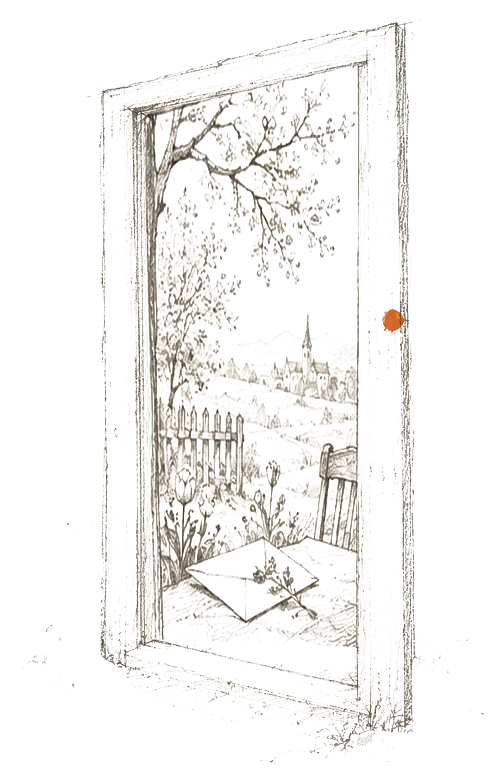
In the spring of 1771, a sensitive young man settles near a small town. At a ball he meets Charlotte, who has been raising her brothers and sisters since their mother's death; he loves her at once, though he knows she is promised to Albert, whose friend he becomes, then goes away to try to forget her. His letters to his friend Wilhelm tell, day after day, what he feels.
Timeline
- 830–1210Middle AgesHeroic songs and courtly epic, from the Hildebrandslied to Parzival.
- 1600–1720BaroqueThe Thirty Years' War runs through everything: a dark, dense prose born of disaster.
- 1720–1785Aufklärung, the EnlightenmentReason, tolerance, theatre as a platform. Lessing is its voice.
- 1765–1790Sturm und DrangFeeling revolts against rule. The young Goethe, the young Schiller.
- 1786–1805Weimar ClassicismGoethe and Schiller seek a finished form, between Antiquity and modernity.
- 1795–1848RomanticismThe tale, the night, the fragment, irony. A lasting invention of the imagination.
- 1910–1925ExpressionismThe scream, the city, distortion. The movement moves from page to screen.
- 1918–1933Weimar cinemaCaligari, Nosferatu, Metropolis: fifteen years that found a visual grammar.
- 1933–1945Exile and banCreation goes into exile or falls silent. A whole generation is torn away.
- 1947–1990Postwar and partitionWriting after the catastrophe, on both sides of the Wall.
- 1962–1982New German CinemaFassbinder, Herzog, Wenders: a young generation rebuilds cinema.
Reading keys
- The particle von indicates a real noble origin, and its use or its abandonment by an author is a dated social gesture.
- Formal address has remained alive and its abandonment in a dialogue marks a precise shift that French translation erases.
- University titles are part of the name in administrative usage, Herr Doktor, which immediately places a character.
- Many Jewish families of Germany had borne German names for generations, and the name therefore says nothing about belonging: it is a datum not to be inferred.
- The National Socialist past is treated by constant public and school work, and relativising the Shoah falls under criminal law.
- The memory of the GDR is disputed: a dictatorship for some, a confiscated social experiment for others, and a text situates itself by the vocabulary it uses.
- The bombing of the German cities and the expulsion of the Germans of the East can be approached but always second, after the crimes committed.
- Patriotism is little expressed and is read as a political position, which distinguishes this country from all its neighbours.
- The country has been divided since the sixteenth century between a Protestant north and east and a Catholic south and west, a division that still explains votes, festivals and public holidays.
- The Church is financed by a tax levied with income, and leaving the Church is an administrative step that characters carry out.
- The east is massively without religion, an effect of forty years of the GDR, which gives two distinct societies within one country.
- The creatures of the tales, mine dwarfs, Frau Holle, the pied piper of Hamelin, come from nineteenth-century collections and not from an intact tradition.
- The Christmas eve of 24 December, with the tree and the presents in the evening, is more important than the 25th, and the Christmas market opens the period.
- The Rhenish carnival, with its satirical speeches and its constituted bodies, is a regulated institution, distinct from the Bavarian festivals.
- Confirmation, or the secular Jugendweihe of the East, marks the passage to adolescence.
- Funerals are sober, cremation common, and the graves are leased for a limited period and then given back, a detail that contemporary narratives exploit.
- The Grimms' tales, collected from 1812, are the densest common reference, in versions reworked by an author's hand over the course of seven editions.
- Goethe's Faust provides the formulas quoted like proverbs, including by those who have not read it.
- The character of Werther, Döblin's Alexanderplatz and Günter Grass's drum are the novelistic landmarks that every German reader possesses.
- The wall, its construction in 1961 and its fall in 1989, organise the chronology of everything written since.
- German literature includes Austria and German-speaking Switzerland: the language extends far beyond the state, and the catalogue distinguishes them for convenience.
- The novel of formation is not a novel of sentimental apprenticeship: it presupposes a theory of education and is read as a disguised treatise.
- The GDR produced a real literature, with its own debates and its censorship, and not a mere corpus of propaganda.
- An important part of what is written in German is written by authors come from Turkey, Romania or Russia, and this begins as early as the nineteen seventies.
- The catalogue stops around 1990, which reflects the state of translations and not the country's production.
Tales and mythologies 3
- PoetryThe HildebrandsliedHildebrandsliedAnonymous · 830A heroic fragment in Old High German, copied around 830: a father and a son face to face, and only one of the two knows who the other is.LiteraturePublic domain
- PoetryMuspilliAnonymous · 870A vision of the end of time in Old High German, written down around 870 on the pages left blank in a royal book.LiteraturePublic domain
- TaleGrimm's Fairy TalesKinder- und HausmärchenJacob Grimm and Wilhelm Grimm · 1812Two hundred tales gathered at the beginning of the nineteenth century by two philologists who wanted to give their language a body of stories comparable to that of other languages.LiteraturePublic domain
A selection to begin with 10 / 92
- NovelBerlin AlexanderplatzAlfred Döblin · 1929Berlin at the end of the twenties, around a working-class square, where a man released from prison tries to stand upright in a city that speaks louder than he does.Literature
- CinemaTitanicHerbert Selpin · 1943The 1912 sinking told by Nazi cinema as the work of British greed, with a German officer as its hero.Cinema
- NovelTransitAnna Seghers · 1944Marseille under the Vichy regime: refugees waiting for visas and ships, and a man who has taken another man's name.Literature
- CinemaThe Great SacrificeOpfergangVeit Harlan · 1944A man torn between his wife and a neighbour condemned by illness, in a colour melodrama shot in Hamburg.Cinema
- CinemaUnder the BridgesUnter den BrückenHelmut Käutner · 1946Two bargemen on the Havel and the young woman they take in, in a film shot in and around Berlin in 1944.Cinema
- CinemaThe Murderers Are Among UsDie Mörder sind unter unsWolfgang Staudte · 1946Berlin in ruins, in the months following the capitulation: a surgeon back from the front finds alive the officer under whom he served.Cinema
- NovelThe Tin DrumDie BlechtrommelGünter Grass · 1959Danzig and then the Rhineland, from the beginning of the century to the fifties, told by a man who remained the size of a three-year-old child.Literature
- NovelThey Divided the SkyDer geteilte HimmelChrista Wolf · 1963Halle and Berlin in the months before the building of the Wall: a young couple put to the test by politics.Literature
- CinemaTrace of StonesSpur der SteineFrank Beyer · 1966A large construction site in the GDR at the end of the fifties: a rebellious team leader, a party secretary and a newly arrived engineer.Cinema
- NarrativeThe Lost Honour of Katharina BlumDie verlorene Ehre der Katharina BlumHeinrich Böll · 1974A Rhineland town during carnival: an ordinary woman handed over within a few days to the sensationalist press.Literature