Bosnia and Herzegovina
- works
- 13
- 11 books · 2 films
- period covered
- 1774–1993
- language of writing
- Bosnian
In 1774, an Italian abbot passing through published a lament he had heard in the Dalmatian hinterland, then the Ottoman province of Bosnia. A woman, blamed for not having come to the bedside of her wounded husband, is driven from her house and dies of leaving her children. Goethe translated it around 1775 and published it without signing it. Walter Scott in 1798, Nerval, Pushkin and Mickiewicz followed. When Mérimée fabricated a collection of twenty-eight false Balkan ballads in 1827, the only authentic one in the set was that one.
Read moreShow less
Bosnia is the country where four religions and three national narratives occupy the same ground, and where no one can therefore be told about alone. Andrić made a form out of it: the bridge, the inn, the market square, places of passage where people cross each other for centuries without understanding each other, and where the narrator takes nobody's side because there is no side to take that does not betray someone. Four Ottoman centuries, forty Austrian years, one Yugoslavia, one war: each layer left its vocabulary, and a paragraph may contain a Turkish word, a German word and a Slavic word without the author underlining it.
The deepest formal trait comes from the oral. Between 1933 and 1935, two Harvard scholars came to record the gusle players in Bosnia because the tradition was most alive there. They found illiterate singers able to sustain twelve thousand lines over several days, improvising from formulas, and this allowed them to understand how Homer could have composed without writing. The modern theory of orality was born there. That decasyllable and that way of taking up the same turns of phrase still irrigate Bosnian prose.
What awaits the reader is therefore a deliberate slowness, nested narratives, narrators who take three centuries to reach their subject. The novel that opens this page follows a bridge over the Drina at Višegrad through four centuries, and its author wrote it in Belgrade under German occupation.
A way to begin
The Bridge on the Drina
Ivo Andrić · 1945
The bridge at Višegrad and four centuries of Bosnian history, in the best-known work of the Nobel laureate Ivo Andrić.
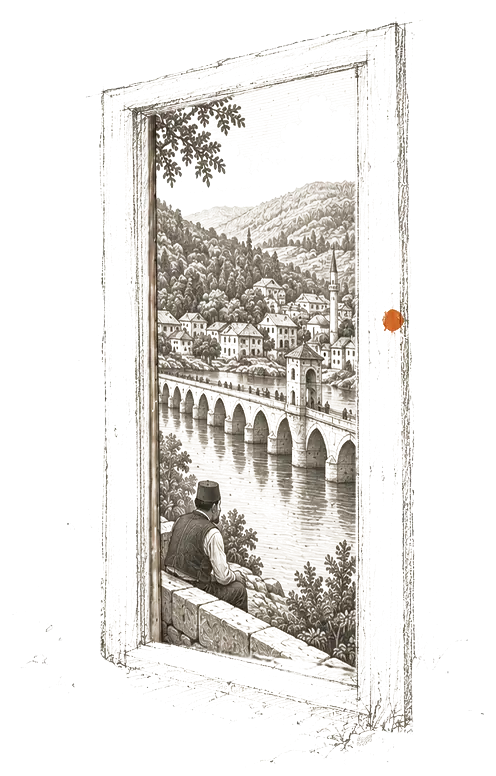
A Serbian boy from near Višegrad, taken from his mother by the Ottoman levy of Christian boys, becomes grand vizier and has a bridge built over the Drina where he was parted from her. The bridge becomes the heart of the town: Turks, Serbs, Sephardic Jews and Roma meet there and face the floods together, and four centuries pass over the bridge, up to the Austro-Hungarian occupation.
Timeline
- 1907–1929Before YugoslaviaAleksa Šantić, Šimić, Samokovlija. Mostar and Sarajevo write.
- 1945–1966Andrić and SelimovićThe Bridge on the Drina, then Death and the Dervish. Two summits.
- 1969–1971Poetry and cinemaMak Dizdar and his tombstones; Sidran, later Kusturica's screenwriter.
Reading keys
- The name alone almost always indicates the community: Mehmed or Meša for a Muslim, Ivo or Marko for a Catholic Croat, Aleksa or Petar for an Orthodox Serb. Authors know it and play on that legibility.
- The suffix -ica in a married woman's name means "wife of": Hasanaginica is the wife of Hasan-aga, it is not a first name.
- Ottoman titles survive in names and narratives: aga, beg, effendi, hodja. They mark a rank and not a religious function, except for the hodja.
- The komšija, the neighbour, is a moral category as much as a spatial one. Good conduct towards the komšija is a recurring theme.
- The war of 1992 to 1995 and the siege of Sarajevo saturate recent production, but Bosnian literature is not reducible to it and many authors refuse to be read through that single prism.
- One does not ask someone directly about their community. A narrative conveys that information through the name, the food, the festival mentioned, never through a declaration.
- Sevdah, the melancholy that gives its name to the sevdalinke songs, is a socially recognised state and not a weakness. A character who gives in to it is not ill.
- Irony and self-mockery are the default register, including for speaking of the worst.
- Four traditions coexist: Sunni Islam, Serbian Orthodoxy, Croatian Catholicism and an old Sephardic Jewish presence in Sarajevo. The four calendars cross in a single street.
- Bosnian Islam is marked by the Sufi brotherhoods, the tekke, and by the cult of saints' tombs. A visit to a turbe is not a marginal practice.
- The stećak, a medieval tombstone covered with enigmatic figures, is an object of national identification and the subject of Mak Dizdar's poetry.
- Beliefs in spirits and in the evil eye run through all four religions and are practised independently of them.
- Funeral rites differ according to community and the narrative distinguishes them: swift burial without a coffin among Muslims, a wake and calendar commemorations among the Orthodox.
- Coffee is drunk at the end of a visit and serving it marks the close of the conversation. Offering coffee too early dismisses the guest.
- Ramadan and Bajram organise the year for part of the population, Orthodox Easter and Christmas for the others, and neighbours visit one another for each other's festivals.
- The sevdalinka, a slow and painful song, is sung in company and not in solitude.
- Hasanaginica, the lament of Hasan-aga's wife, is the most famous text in the country, claimed also by Croats and Serbs. That dispute over attribution is part of its history.
- The cycle of Muslim heroic songs, with the brothers Mujo and Halil, protected by fairies, is the Bosnian counterpart of the Serbian Kosovo cycle.
- The vile and the zana, mountain fairies, circulate between the Slavic and Albanian traditions of the region.
- The stećci, tombstones of the Bosnian Middle Ages, serve as a poetic and identity reference.
- In French "Bosniaque" designates the inhabitants of the country, but the language distinguishes Bosanac, an inhabitant of Bosnia whatever the religion, from Bošnjak, a member of the Muslim community. The confusion carries weight.
- The Muslims of Bosnia are Slavs and speak the same language as their neighbours. Describing them as descendants of Turks repeats a nineteenth-century political thesis.
- Andrić is a Yugoslav Nobel laureate and a subject of debate in Bosnia, where some reproach his treatment of Islam. Reading him as a neutral voice of the country is inaccurate.
- The word "multicultural" applied to Sarajevo has become a tourist slogan. The works themselves describe a costly and fragile coexistence.
Tales and mythologies 1
- PoetryHasanaginicaAnonymous · 1774A ballad passed on by word of mouth in the Dalmatian hinterland is written down and printed by an Italian traveller.Literature
Available in English 3
The books from this country that can be read in English, in the original or in translation.
- NovelThe Bridge on the DrinaNa Drini ćuprijaIvo Andrić · 1945The book appeared in Belgrade five months after the liberation of the city, together with two other novels written during the occupation.Literature
- NovelDeath and the DervishDerviš i smrtMeša Selimović · 1966The novel was published in Sarajevo by Svjetlost, after four years of writing, under socialist Yugoslavia.Literature
- PoetryStone SleeperKameni spavačMak Dizdar · 1966After a series of collections, a poet from Sarajevo, long a journalist and editor, turns to the medieval tombs of his country.Literature
A selection to begin with 10 / 13
- PoetryPjesmeAleksa Šantić · 1908not translated into EnglishThe poet of Mostar, now in full command of his art, publishes a new collection a year after his debut at the National Theatre in Belgrade.Literature
- Short storiesOd proljeća do proljećaIsak Samokovlija · 1929not translated into EnglishThe book appears in Sarajevo, published by the Group of Sarajevo Writers (Grupa sarajevskih književnika), two years after the first short story published by this hospital doctor.Literature
- PoetryStojanka majka KnežopoljkaSkender Kulenović · 1942not translated into EnglishThe lament of a Bosnian peasant woman who has lost her sons in the war of 1942.Literature
- CinemaMajor BaukNikola Popović · 1951Six years after the war, the young Bosna Film studio produces its first major fiction film, an epic of the resistance.Cinema
- NovelDeath and the DervishDerviš i smrtMeša Selimović · 1966The novel was published in Sarajevo by Svjetlost, after four years of writing, under socialist Yugoslavia.Literature
- PoetryStone SleeperKameni spavačMak Dizdar · 1966After a series of collections, a poet from Sarajevo, long a journalist and editor, turns to the medieval tombs of his country.Literature
- NovelUgursuzNedžad Ibrišimović · 1968not translated into EnglishFour years after a first collection of short stories, a young writer from Sarajevo, a sculptor by training, publishes his first novel.Literature
- CinemaWalter Defends SarajevoValter brani SarajevoHajrudin Krvavac · 1972For the thirtieth anniversary of the revolution, the Bosna Film studio dedicates an action film to the heroism of the people of Sarajevo.Cinema
- NovelZemlja heretikaZaim Topčić · 1972not translated into EnglishA former partisan, who passed through the Jasenovac camp and became a novelist of the war, turns to the centuries of the bans of Bosnia.Literature
- PoetrySarajevski tabutAbdulah Sidran · 1993not translated into EnglishThe book appears in besieged Sarajevo, when the Bosnian war has been going on for more than a year.Literature