Poland
- works
- 75
- 57 books · 18 films
- period covered
- 1580–1990
- language of writing
- Polish
In February 2001, a German film-maker found under the paint, in a larder in Drohobych, the frescoes that Schulz had painted in 1942 for the children of the Gestapo officer who kept him as a slave. Three months later, envoys of the Yad Vashem memorial cut out five pieces of them and took them to Jerusalem. Poland and Ukraine spoke of theft, the memorial invoked the agreement of the local authorities, and an arrangement of 2008 left the fragments in Jerusalem.
Read moreShow less
That the affair should involve three countries says enough about the situation. Drohobych was Polish in 1942, it is Ukrainian today, and Schulz wrote there in Polish in a Yiddish-speaking town. Poland disappeared from the maps from 1795 to 1918, which made its literature a substitute institution, written in large part in Paris; its borders were moved westwards in 1945, and the three million Polish Jews murdered took an entire literature with them. Schulz was shot down in the street in November 1942, and the novel he was working on has never been found.
The Polish form is the detour: parody, allegory, the irony of exile. Gombrowicz writes before the war, then from Argentina, novels that mock maturity, Zbigniew Herbert invents a Mr Cogito in order to say sideways what cannot be written, Stanisław Lem places his moral questions on planets. The price is that of the twenty years that follow the war. Tadeusz Borowski publishes his Auschwitz narratives and then dies in 1951. Czesław Miłosz chooses exile the same year, publishes in 1953 his inquiry into the intellectuals under the regime and remains unpublished at home until 1980. After 1981, martial law sends publishing back into the cellars.
What awaits the reader is a literature that takes history sideways, through farce or metaphysics, and that mistrusts pathos. The novel that opens this page, serialised in 1895 and 1896, follows the first Christians of Rome under Nero; Polish readers read their own subjugation into it, and it contributed to its author's Nobel Prize.
A way to begin
Quo Vadis
Henryk Sienkiewicz · 1896
The most famous Polish novel outside Poland, free of rights: the first Christians of Rome under Nero.
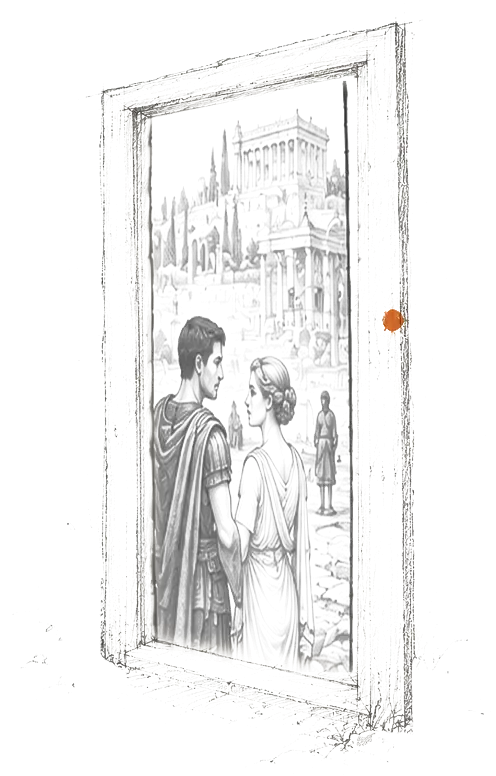
In Nero's Rome, the patrician Marcus Vinicius, an officer back from the wars, falls in love with Lygia, a young Christian raised in a Roman household. In searching for her he discovers the Christian community of Rome, its poverty, its simplicity and its faith, which contrast with the luxury and games of the imperial court, while fire and persecution smoulder.
Timeline
- 1543–1600Golden AgeKochanowski gives Polish its first great poetry.
- 1795–1918PartitionsPoland vanishes from the maps. Literature becomes the substitute homeland.
- 1822–1863RomanticismMickiewicz and Słowacki, writing from exile, become national prophets.
- 1939–1945Occupation and exterminationThe country is destroyed, and its culture with it. What is written afterwards bears the mark.
- 1956–1970Polish Film SchoolWajda, Munk, then Polanski. The war is filmed from below.
- 1976–1989SolidarnośćMiłosz receives the Nobel in 1980, the year of the Gdańsk strikes.
Reading keys
- Names decline and the family name takes a feminine form in -ska: Kowalski and Kowalska are husband and wife, and French catalogues wrongly make them uniform.
- The suffix in -ski originally indicates the possession of an estate, and it served as a mark of nobility, which explains its abundance among novel characters.
- First names follow the calendar of saints, and the name day counts more than the birthday, with visits and cake.
- The Jewish surnames of Poland often have a German or Yiddish form, and their Polonisation or their maintenance is a fact of family history, not a preference.
- The extermination of the Jews of Poland took place on Polish soil, and the division between the role of the occupiers, that of the rescuers and that of the denouncers is an active historiographical and political conflict, framed since 2018 by a law.
- The Katyn massacre of 1940, long attributed to the Germans by the Soviet Union, is a non-negotiable point of memory.
- The role of the Church, that of Solidarność and the legacy of the martial law of 1981 divide along lines that still structure political life.
- Abortion, the rights of sexual minorities and the place of Catholicism mean that a contemporary text is read immediately as a taking of position.
- Catholicism is in the majority, practised, and tied to national identity since the partitions: the Church held the role of a national institution when the state did not exist.
- The Marian cult, with the Black Madonna of Częstochowa proclaimed queen of Poland, is the country's devotional centre and a constant narrative device.
- The pre-Christian Slavic stock is known only through hostile Christian chroniclers, and the popular creatures, rusalki, spirits of the fields, have been maintained in the tales.
- Hasidism was born in these regions and left there its courts, its rabbis' tombs and its narratives, which Polish literature cites as a neighbouring and vanished world.
- The Christmas eve of 24 December includes twelve meatless dishes, a wafer shared among the guests and a place left for an unexpected visitor.
- On Easter Monday people sprinkle each other with water, and All Saints' Day fills the cemeteries with candles to the point of being visible from the roads.
- Weddings last two days, with the ceremony of the unveiling of the bride at midnight, and a novel uses it as a known setting.
- The black of mourning, the bread and salt offered at the entrance and the hand kissed to elderly women are codes still legible.
- The national poem of 1834, written in Paris by an exile and opening on the invocation of Lithuania, is learnt by heart and quoted like a proverb.
- The founding legends come from the medieval chronicles: Krak and the dragon of Wawel, king Popiel eaten by mice, princess Wanda.
- Gliński's collection of tales, in 1853, and Oskar Kolberg's ethnographic monument, region by region, are the reference corpora.
- The partitions, the insurrections of 1830 and of 1863, Warsaw destroyed in 1944 and Solidarność form the historical repertoire that every text assumes is known.
- Polish romanticism is not an aesthetic current but a political programme: the great poems were written in exile to stand in for a state.
- The extermination camps were German and situated in occupied Poland: the expression Polish camps is refused, and the reader must know the nuance.
- Part of the literature of this territory is written in Yiddish and in Hebrew, and the catalogue keeps a trace of it: language does not state belonging.
- The country has not always been homogeneous: before 1939 one inhabitant in three was neither Catholic nor of Polish language.
- Many major authors wrote outside the country, in Paris, in Buenos Aires or at Berkeley, and their absence from the official catalogues of the time measures nothing.
Tales and mythologies 1
- TaleKlechdy, starożytne podania i powieści ludu polskiego i RusiKazimierz Władysław Wójcicki · 1837not translated into EnglishA collection of legends, tales of heroes and fairy tales from the Polish and Ruthenian countryside.Literature
A selection to begin with 10 / 75
- Short storiesThe Street of CrocodilesSklepy cynamonoweBruno Schulz · 1934A collection of poetic prose pieces, between childhood memory and mythology, about a small Jewish town in Galicia before the Great War.LiteraturePublic domain
- NovelFerdydurkeWitold Gombrowicz · 1938A grown man, forced back onto the school benches, discovers how others impose a face on him.Literature
- Short storiesThis Way for the Gas, Ladies and GentlemenPożegnanie z MariąTadeusz Borowski · 1948Stories by a political prisoner of Auschwitz, who describe the camp from the inside, with no hero and no consoling moral.Literature
- EssayThe Captive MindZniewolony umysłCzesław Miłosz · 1953How intelligent men come to serve a doctrine, explained through four cases known to the author.Literature
- NovelSolarisStanisław Lem · 1961A philosophical science-fiction novel on the impossible encounter with an alien intelligence.Literature
- CinemaBirth CertificateŚwiadectwo urodzeniaStanisław Różewicz · 1961Three stories of war and occupation, seen at a child's height.Cinema
- CinemaKnife in the WaterNóż w wodzieRoman Polański · 1962A couple and a hitchhiker on a sailing boat: three characters and the rivalry of two men.Cinema
- CinemaThe Saragossa ManuscriptRękopis znaleziony w SaragossieWojciech Jerzy Has · 1965An officer lost in the Sierra Morena hears tales that nest one within another.Cinema
- PoetryMr. CogitoPan CogitoZbigniew Herbert · 1974A collection of poems built around an ironic double, on the dignity of man under constraint.Literature
- CinemaThe DecalogueDekalogKrzysztof Kieślowski · 1989The Decalogue transposed into ten stories about neighbours, in the Warsaw of the late eighties.Cinema