Democratic Republic of the Congo
- works
- 13
- 8 books · 5 films
- period covered
- 1900–1999
- language of writing
- French
From 1885 to 1908, an entire country was the personal property of one man. Leopold II, king of the Belgians, did not administer it in the name of Belgium: the Congo Free State belonged to him outright, like a private estate eighty times larger than his kingdom, and he extracted rubber from it at the cost of a system of forced labour whose mutilations ended by provoking the first international human rights campaign. Belgium took over that territory only in 1908, under pressure.
Read moreShow less
That starting point explains a good part of what follows: an immense country without a state, four hundred languages, a river that serves as a backbone, and a culture built through the city and through music more than through school. Kinshasa invented Congolese rumba, which became the music of a whole continent, and Lingala passed from a river language to the language of song for the whole of Central Africa. Popular painters told the history of the country on canvases sold in the street, and one of them drew from it a chronicle in a hundred and one images.
The literary form that came out of it is political grotesque. Sony Labou Tansi published in 1979 a novel in which a dictator cuts up the body of his opponent without managing to make it disappear, and the dead man goes on speaking. That way of making power absurd rather than denouncing it set a fashion throughout Africa. Cinema took the same course: in 1987, "La Vie est belle" follows a village musician come up to Kinshasa, and the musical comedy becomes a portrait of a city. The price was the exile of most of those authors, and a production written in Paris, in Brussels and in Kinshasa without meeting itself.
What awaits the reader is an avowed excess, in which humour and horror are not separated and the sentence overflows. The novel that opens this page begins with the execution of an opponent who refuses to die, and his ghost then haunts a dynasty of dictators.
A way to begin
Life Is Rosy
Dieudonné Mweze Ngangura and Benoît Lamy · 1987
A filmmaker from Bukavu and a Belgian director make Papa Wemba the hero of a musical comedy in Kinshasa.
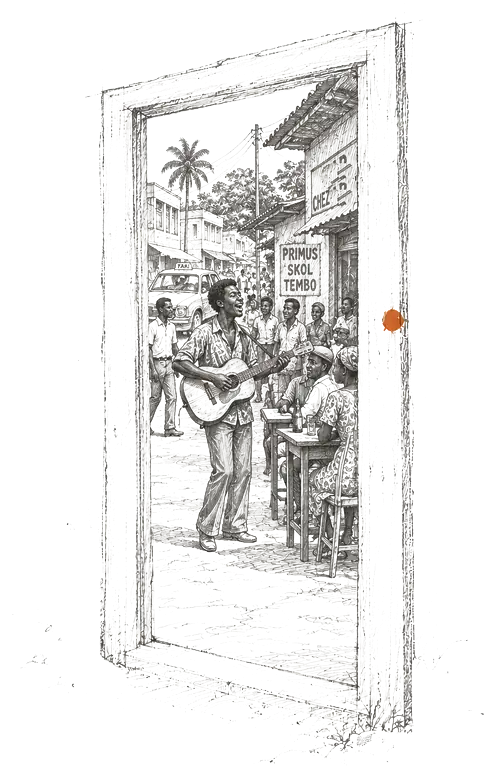
Kourou, a young village musician, travels up to Kinshasa on a truck, determined to live by his music, and loses his instrument on the way. In the city, no one believes he is a musician: Nvouandou, the rich owner of the orchestra he admires, takes him on as a servant. Now Nvouandou, who wants a son, has been advised by a sorcerer to take a second wife without consummating the marriage for a month, and Kourou falls in love with this young woman, Kabibi. Among odd jobs, orchestras and bars, the city lives to the rhythm of its music.
Timeline
- 1940–1976First writingsBolamba, Clémentine Nzuji, Mweya Tolande.
- 1979Life and a HalfSony Labou Tansi invents a language to say the African dictatorships.
- 1987–1999Congolese cinemaLa Vie est belle, Macadam tribu, and Mobutu filmed by Thierry Michel.
Reading keys
- Four large linguistic ensembles structure the country, with Lingala in the north-west and in Kinshasa, Swahili in the east, Kikongo in the south-west and Tshiluba in the centre. The name places the region.
- The authenticity policy of the nineteen seventies imposed the abandonment of Christian first names: characters change name in mid-narrative for that reason.
- The societies of the south-west are matrilineal, those of the east often patrilineal. The system determines who inherits and who decides.
- Classificatory kinship extends the terms brother and uncle, and the obligation to help a relative is real.
- The violence of the Congo Free State, the Katangese secession, Mobutu's dictatorship and the wars in the east since 1996 form a history that literature approaches through the grotesque and allegory.
- Criticism of power under Mobutu proceeded by the fable, and the habit has remained.
- Sorcery, kindoki, explains success as well as misfortune. Accusations against children called witches are a grave and contemporary social fact.
- Making do, the unwritten article fifteen that says "sort yourselves out", is a principle of life that the narratives assume is known.
- Catholicism and Protestantism are massively implanted, with an explosion of revival churches in the cities.
- Kimbanguism, a church founded by the prophet Simon Kimbangu, arrested in 1921 and dead in prison, has millions of faithful and constitutes a major religious fact.
- The cult of the ancestors and the nkisi, charged objects, belong to the Kongo and Luba stock.
- The nganga healer and the diviner are ordinary characters, distinct from the malevolent sorcerer.
- Mourning, matanga, includes a wake, songs and a deferred lifting of mourning, with considerable expenditure.
- The white of kaolin marks contact with the dead, and widowhood imposes public prohibitions on the woman.
- Rumba accompanies weddings as well as funerals, and the choice of pieces makes sense.
- La sape, the art of dressing in designer clothes, is a codified social practice and a literary subject.
- The kasala, a Luba heroic song performed by women to recall the ancestors of a dead person, is a recognised and published genre.
- The Kongo and Luba narratives about origins, with the myth of Mbombo who vomits the sun and the moon, form the cosmogonic stock.
- Simon Kimbangu and his church are a reference known to all.
- Rumba, its orchestras and its singers constitute a common heritage and a language shared with the other Congo.
- The Congo Free State was not a Belgian colony but the private property of a king, which is a legal fact and not an image.
- The two Congos are two distinct countries, and Sony Labou Tansi, born on the Belgian side and settled in Brazzaville, belongs to both literary histories.
- Lingala is not the language of the whole country: Swahili dominates the east and Tshiluba the centre.
- The grotesque of the novels is not a literary exoticism but a way of accounting for a power that behaved implausibly.
Tales and mythologies 1
- PoetryKasalaAnonymous · 1900not translated into EnglishThe genre was described as early as 1936 in a Belgian colonial journal, then published in a bilingual edition in 1969.Literature
Available in English 1
The books from this country that can be read in English, in the original or in translation.
- NovelBetween TidesEntre les eauxV. Y. Mudimbe · 1973An African priest torn between the Church and revolution, in the first novel of a great Congolese thinker.Literature
A selection to begin with 10 / 13
- NarrativeLes Aventures de Ngoy, héros légendaire des BangalaAntoine-Roger Bolamba · 1940not translated into EnglishAt the end of the thirties, a young clerk from Boma wins a literary competition organised in Léopoldville for Congolese authors.Literature
- NovelSans rancuneThomas Kanza · 1965not translated into EnglishThe first lay Congolese student in Europe, in a novel drawn for the most part from life.Literature
- NovelBetween TidesEntre les eauxV. Y. Mudimbe · 1973An African priest torn between the Church and revolution, in the first novel of a great Congolese thinker.Literature
- NovelBandokiZamenga Batukezanga · 1973not translated into EnglishA Kongo village ravaged by disease looks for sorcerers, in a popular novel from Kinshasa.Literature
- PoetryKasala, chant héroïque lubaClémentine Nzuji · 1974not translated into EnglishA Congolese poet and linguist transcribes and translates the praise songs of the Luba clans of Kasai.Literature
- NarrativeAhata, suivi du Récit de la DamnéeMweya Tol'ande · 1976not translated into EnglishA young journalist from Kinshasa gives voice to a woman abandoned by her fiancé, who has gone to study far away.Literature
- CinemaPerle noireJoseph Kumbela · 1994A Zairean actor based in Switzerland steps behind the camera with a dramatic comedy about a couple and money.Cinema
- CinemaThe Draughtsmen ClashLe Damier – Papa national oyé !Balufu Bakupa-Kanyinda · 1996A Congolese filmmaker turns a game of draughts between a president for life and a vagrant into a satire of power.Cinema
- CinemaAsphalt TribeMacadam tribuJosé Laplaine · 1996Unable to shoot in Kinshasa, a Zairean filmmaker films two brothers, their mother and their neighbourhood in Mali, in a nameless metropolis.Cinema
- CinemaMobutu, King of ZaireMobutu, roi du ZaïreThierry Michel · 1999After the fall of the Zairean dictator, a Belgian documentary maker reconstructs, archive by archive, his thirty-two years in power.Cinema