Romania
- works
- 51
- 45 books · 6 films
- period covered
- 1830–1985
- language of writing
- Romanian
Dada was born in Zurich in 1916 around two Romanians, one of them a young man born in Moinești under the name of Samuel Rosenstock and who signed himself Tristan Tzara. The theatre of the absurd was born in Paris from the pen of Eugène Ionesco. The most quoted of European pessimists is called Emil Cioran. The most widely read historian of religions of the century is Mircea Eliade. All Romanian, all gone, several having switched to French.
Read moreShow less
One could therefore read Romania as the country one leaves. That would be to miss what it has kept. Romanian is a Latin language encircled by Slavic languages, and that position is found everywhere: in a vocabulary in which a French speaker recognises one word in three, in a village that remains the measure of all things including for the authors who mock it, in a literature that never stops weighing departure and return. Rebreanu, Sadoveanu and Preda write the land and those who work it. Caragiale, as early as 1879, writes the petty notables of the town and their vain chatter, of whom he made types that ordinary speech still summons.
The price of that position was paid under censorship, and this shaped the forms. Lucian Pintilie's film The Reconstruction was released on 5 January 1970 without a preview, was withdrawn from the cinemas after a few weeks, discussed in February at the Party Secretariat, and did not return to Romanian screens until 1990. Twenty years of prohibition for a film in which the police reconstruct a brawl between young men and manufacture a death. Romanian authors learnt to say things without naming them, and the habit outlived the regime.
What awaits the viewer is therefore a deliberate slowness, dialogues that circle around the subject, a dry humour that does not announce itself and has to be caught in flight. The familiarity of the vocabulary is deceptive and is part of the journey. The poem that opens this page tells of a star in love with an emperor's daughter, who flies to the Creator to be released from his eternity.
A way to begin
Luceafărul
Mihai Eminescu · 1883
A star in love with an emperor's daughter asks the Creator to make him mortal: Eminescu's poem, on the school syllabus since 1906. Free of rights.
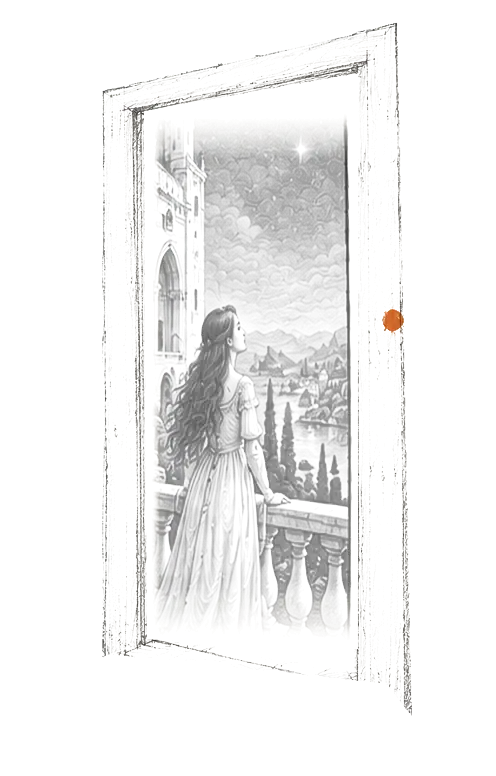
Every night an emperor's daughter looks out of her window at the evening star and calls to it. It descends a first time into the sea, during her dream, and returns in the guise of a young man who offers her the empire of the ocean; she refuses to follow him. He comes a second time, born of the sun and the night, and again she refuses. She then asks him to become mortal; he flies to the Creator, at the ends of the world, to be released from his eternity.
Timeline
- 1521–1750Chronicles and first writingsThe language is written little by little, between Church Slavonic and emerging Romanian.
- 1848The generation of 1848National awakening and militant Romanticism: they want a language, a literature, a country.
- 1880–1900The great classicsAround the Junimea circle and Titu Maiorescu: Eminescu, Creangă, Caragiale, Slavici.
- 1918–1940Between the warsThe great modern moment: the novel, poetry, and a generation that will scatter to France.
- 1947–1989Communist regimeImposed realism, then the art of saying things otherwise. Many write in exile.
- 1960–1975Romanian New WaveA generation of filmmakers takes shape, before censorship closes in again.
Reading keys
- The ending -escu means "son of": Popescu, Ionescu, Georgescu are extremely frequent surnames and indicate no kinship between them.
- Diminutives are systematic and can be disconcerting: Ion becomes Ionel or Nelu, Nicolae becomes Nicu, Maria becomes Mărioara. The same character changes name depending on who is speaking to him.
- Godparenthood, cumetrie, creates a kinship as binding as blood. A godfather arbitrates conflicts and his opinion weighs more than an uncle's.
- One celebrates the day of the saint whose name one bears, the ziua onomastică, often more than the birthday.
- Under Ceaușescu's regime, censorship produced an oblique language called Aesopian: the reader of the time knew that a novel about the Middle Ages was speaking of the present. Works after 1989 kept the taste for implication.
- Abortion, banned from 1966 to 1989, structures major works without always being named.
- The Roma question is almost always approached obliquely, and the word used in older works is no longer acceptable today.
- The formal address is doubled by an even more deferential form, dumneavoastră, and the shift from one to the other marks a change of relationship.
- Hospitality is obligatory and refusing it offends. One insists three times, and refusing three times is a normal choreography.
- Complaint is a courteous mode of conversation, not a call for help.
- Orthodoxy is in the majority and Easter counts there more than Christmas. Lent is long and breaking it gives rise to table scenes that are not decorative.
- The funeral ritual extends in time: wake, pomană meal, wheat cake, forty days, then anniversaries. A character who misses one of these stages commits a serious fault.
- The strigoi, the dead who return, belong to village belief and not to tourist folklore. The rites intended to prevent them from getting out are concrete.
- Transylvania adds Catholics, Hungarian Protestants and Saxon Lutherans, which makes the word "Romanian" more complex than it appears.
- Black is the colour of mourning, worn for a long time by widows, sometimes for life.
- The merry cemetery of Săpânța, where painted crosses recount in verse the death of each person, often with humour, shows that the relation to death is not uniformly sombre.
- On the first of March, the mărțișor, a red and white thread offered to women, opens the spring.
- The Christmas colinde and the căluș round dances belong to a living ritual tradition, not to a reconstruction.
- Miorița, a ballad every schoolchild learns: a shepherd warned by his ewe accepts his death and asks that his mother be told he has married a queen. A subject of national dispute as much as a common reference.
- Meșterul Manole, the builder forced to wall up his wife so that the monastery will stand. The motif circulates throughout the Balkans and is read in Romania as a national matter.
- Făt-Frumos and Ileana Cosânzeana are the prince and princess of the tales, quoted as one would quote Prince Charming.
- The shepherd, the village and the mountain function as a stock of images, including in the urban works that mock them.
- Dracula is not a Romanian reference. Vlad the Impaler is a local political figure, severe and respected, and Bram Stoker's vampire is a British invention that Romanians regard with irony or irritation.
- The fatalism attributed to Miorița is not the universal key to Romanian culture: it is an internal debate, and presenting it as an explanation of the country repeats a cliché that Romanians themselves contest.
- The slowness of contemporary cinema is not an aesthetic contemplation, it is a way of making administrative duration and attrition visible.
- The word dor, a mixture of nostalgia and lack, has no equivalent and all translations weaken it.
Tales and mythologies 1
- TaleThe Foundling Prince and Other TalesLegende sau basmele românilorPetre Ispirescu · 1872Romanian fairy tales, collected and rewritten by a Bucharest typographer.Literature
A selection to begin with 10 / 51
- TheatreO noapte furtunoasăIon Luca Caragiale · 1879not translated into EnglishA neighbourhood captain jealous of his honour, and a night of misunderstandings in a suburb of Bucharest.Literature
- NovelIonLiviu Rebreanu · 1920The hunger for land of a young Transylvanian peasant, ready to do anything to own some.LiteraturePublic domain
- NovelAncuta's InnHanul AncuțeiMihail Sadoveanu · 1928Nine travellers, an autumn of new wine, and stories of former times.Literature
- NovelBengal NightsMaitreyiMircea Eliade · 1933A young European lodged with a Bengali scholar, and a love the house cannot accept.Literature
- EssayOn the Heights of DespairPe culmile disperăriiEmil Cioran · 1934Short pages written during sleepless nights, by a young man making his debut.Literature
- CinemaO noapte de pominăIon Șahighian · 1939A minor Bucharest clerk, a lifetime's savings and a night in a cabaret.Cinema
- TheatreThe Bald SopranoLa Cantatrice chauveEugène Ionesco · 1950Two English couples, a mad clock and a fireman, in a conversation that goes round in circles.Literature
- NovelThe MorometesMoromețiiMarin Preda · 1955A family of Wallachian peasants, slowly undone by debts and grudges.Literature
- CinemaThe ReenactmentReconstituireaLucian Pintilie · 1970Two young brawlers forced to re-enact their fight for a cautionary film.Cinema