Kazakhstan
- works
- 38
- 27 books · 11 films
- period covered
- 1070–1998
- language of writing
- Kazakh
In the eighteen eighties, a man translated Pushkin and Goethe into Kazakh under a yurt. Abai Kunanbaiuly, the son of a clan chief trained in the Quranic school and a reader of the Russians, set about bringing into his language what he read in Russian, and composed in parallel texts in brief prose, his Words, in which he reproaches the Kazakhs for their laziness and their vanity with unusual severity. He became the founder of written Kazakh literature and a moralist whom the country still quotes against itself, including in official speeches.
Read moreShow less
That entry into writing took place on a considerable oral foundation. The zhyrau, court poets of the khanates, had been composing and reciting since the fifteenth century, and the aitys, an improvised verse contest between two singers before an audience that decides, is still practised and broadcast on television. The epic of Alpamys and that of Kobylandy were sung to the accompaniment of a two-stringed instrument. An entirely oral literature therefore existed before a single book was printed, with its professionals, its schools and its value judgements.
The price was catastrophic. Forced collectivisation and the famine from 1930 to 1933 killed about one Kazakh in three and destroyed nomadism in a few years, and the event remained unsayable for sixty years. The generation of writers trained in the nineteen twenties was shot in 1937 and 1938. Cinema developed afterwards in Soviet form, before a new wave appeared at the end of the nineteen eighties with dry films about abandoned villages and the youth of Almaty.
What awaits the reader is a literature of the steppe that does not idealise it, and a poetry in which moral judgement is explicit, addressed to an audience one speaks to familiarly. The book that opens this page gathers forty-five words in which a scholar of the steppe judges his people and calls on them to learn, and they circulated by word of mouth before being printed.
A way to begin
Book of Words
Abai Kunanbaiuly · 1898
Forty-five prose words in which a learned notable of the steppe judges his people and calls on them to learn. Free of rights.
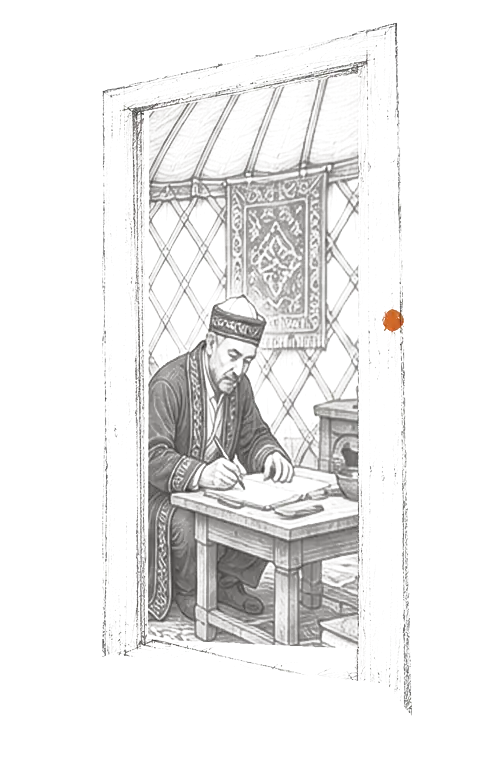
Forty-five prose texts written in the 1890s. In the first, the author says that at the end of a life of struggle, exhausted, nothing suits him any more, and he decides to amuse himself with paper and ink. Others attack the chiefs and judges who live off the people, corruption, flattery and feuds, or plead for schooling, girls included.
Timeline
- 1050–1500Zhyrau and epicsYusuf Khass Hajib, Asan Qaighy, the Alpamys. Poetry is spoken on horseback.
- 1850–1911AbaiThe Book of Words founds written Kazakh literature; Baitursynov follows.
- 1928–1943Soviet periodMukanov, Shukhov, Beck. Kazakh matter enters the Russian novel.
- 1961–1982ThawSuleimenov and Kekilbaev; Az i Ya causes a scandal in Moscow.
- 1988–1998Kazakh New WaveNugmanov, Aprimov, Omirbaev. A spare cinema, recognised in Europe.
Reading keys
- Names often end in -ov or -ova, a Russian inheritance, and many have taken up forms in -uly, "son of", and -qyzy, "daughter of".
- Belonging to the clan and to the horde, the zhuz, remains a social datum that is known and left unspoken.
- The rule of the seven ancestors forbids marriage between people sharing a forebear up to the seventh generation, and everyone is supposed to be able to recite them.
- Respect for elders imposes forms of address and an order of precedence in the yurt as at table.
- The famine from 1930 to 1933, which killed nearly a third of the Kazakhs, was unsayable until 1990 and remains a heavy subject.
- The nuclear tests at Semipalatinsk, the dried-up Aral Sea and the test range are subjects addressed since independence.
- The purges of 1937 and 1938 wiped out the first generation of Soviet Kazakh writers.
- Criticism of the authorities is risky, and restraint is valued in social relations.
- Hanafi Sunni Islam is in the majority, having arrived late and long mixed with earlier practices.
- Tengrism, the cult of the sky Tengri and of the earth Umay, survives in formulas, rites and place names.
- The shamanism of the baqsy, healers and diviners, coexisted with Islam and is found again in the narratives.
- The mausoleums of saints, including that of Ahmed Yasawi at Turkestan, are major places of pilgrimage.
- Mourning includes a wake, a burial, then commemorations on the seventh day, the fortieth and at one year, with meals at which an animal is slaughtered.
- The white of milk and of kumis, fermented mare's milk, has a ritual value, and one sprinkles milk to bless a departure.
- Nowruz on 21 March is the main festival, with the nauryz kozhe prepared from seven ingredients.
- The yurt, its assigned places and its orientated entrance are a social arrangement that the narratives assume is known.
- Alpamys and Kobylandy, heroic epics sung by the zhyrau, are the national narrative stock.
- Abai's Words, brief texts of morality and social criticism, are learnt at school and quoted as maxims.
- The samples of Turkic popular literature collected from 1866, with Kazakh in volume three, form the founding documented corpus.
- The Orkhon inscriptions, the oldest known Turkic texts, in which Tengri founds the legitimacy of the sovereign, are claimed as depth.
- Kazakhstan is not an exclusively Kazakh country: Russians form an important minority there and part of the literature is written in Russian.
- Nomadism did not disappear through modernisation but through administrative destruction, in three years, with a massive famine.
- Kazakh Islam is old but late and long superficial, which explains the persistence of Tengrist rites.
- The aitys is not a reconstituted folklore: it is a living competition, televised, with its professionals and its prizes.
Tales and mythologies 2
- EpicАлпамысAnonymous · 1500not translated into EnglishThe world of the Turkic nomads of Central Asia in their struggle against the Kalmyks, as the storytellers sing it.Literature
- EpicSpecimens of the Folk Literature of the Turkic TribesProben der Volkslitteratur der türkischen StämmeVasily Radlov · 1870The Kazakh steppes and the Altai between 1860 and 1880, where a philologist takes down at dictation what the reciters sing, as the Russian empire completes its conquest.Literature
Available in English 10
The books from this country that can be read in English, in the original or in translation.
- PoetryWisdom of Royal GloryQutadgʻu biligYusuf Khass Hajib · 1070The eleventh-century Karakhanid khanate, between Balasagun and Kashgar, where a court scholar writes a mirror for princes in Turkic.Literature
- EssayBook of WordsQara sözderAbai Kunanbaiuly · 1898The Kazakh steppe of the late nineteenth century, where a literate notable judges his own people and urges them to educate themselves.Literature
- PoetryMosquitoMasaAkhmet Baitursynov · 1911Orenburg in the early 1910s, where Kazakh men of letters found a press and a poetry of struggle in their own language.Literature
- NovelThorny PathТар жол, тайғақ кешуSaken Seifullin · 1927The account of the revolt, the civil war and the revolution in the steppe, by a man who took part in them and who writes ten years later.Literature
- PoetryKulagerҚұлагерIlyas Zhansugurov · 1936A Kazakh narrative poem about a racehorse and about what being first is worth on the steppe.Literature
- NovelAbaiАбай жолыMukhtar Auezov · 1942The Kazakh steppe under the Russian Empire, told through the life of the poet Abai Kunanbaev, from childhood to maturity.Literature
- NovelVolokolamsk HighwayВолоколамское шоссеAlexander Bek · 1943The battle of Moscow in the autumn of 1941, seen from a single infantry battalion and through its commander.Literature
- NovelBlood and SweatҚан мен терAbdizhamil Nurpeisov · 1961A trilogy about fishermen of the Aral Sea, caught up in war and revolution, written by a man from that shore.Literature
- NovelThe NomadsКөшпенділерIlyas Yesenberlin · 1969The great fictional fresco of Kazakh history, in three books, from the fifteenth century to the middle of the nineteenth.Literature
- EssayAz i YaOlzhas Suleimenov · 1975The Soviet Union of the mid-seventies, where the shared past of the Slavs and the nomads of the steppe remains a sensitive subject.Literature
A selection to begin with 10 / 38
- PoetryMosquitoMasaAkhmet Baitursynov · 1911Orenburg in the early 1910s, where Kazakh men of letters found a press and a poetry of struggle in their own language.Literature
- PoetryKulagerҚұлагерIlyas Zhansugurov · 1936A Kazakh narrative poem about a racehorse and about what being first is worth on the steppe.Literature
- NovelAbaiАбай жолыMukhtar Auezov · 1942The Kazakh steppe under the Russian Empire, told through the life of the poet Abai Kunanbaev, from childhood to maturity.Literature
- NovelVolokolamsk HighwayВолоколамское шоссеAlexander Bek · 1943The battle of Moscow in the autumn of 1941, seen from a single infantry battalion and through its commander.Literature
- NovelBlood and SweatҚан мен терAbdizhamil Nurpeisov · 1961A trilogy about fishermen of the Aral Sea, caught up in war and revolution, written by a man from that shore.Literature
- Feature filmQyz ZhibekSultan Khodzhikov · 1970The Kazakh steppe of the epics, where a given word binds entire clans and a wounded suitor can reignite a war.Cinema
- Feature filmThe NeedleIglaRashid Nugmanov · 1988Alma-Ata under perestroika, where young people listen to rock, take drugs and expect little from the country that raised them.Cinema
- Feature filmThe Last StopKonechnaya ostanovkaSerik Aprimov · 1990A Kazakh village in the late 1980s, seen by a young man made a stranger at home by two years in the army.Cinema
- Feature filmThe Fall of OtrarОтырардың күйреуіArdak Amirkulov · 1991A Kazakh fresco about the intrigues that preceded the destruction of Otrar by Genghis Khan's armies, filmed on the eve of the end of the Soviet Union.Cinema
- Feature filmSurzhekey: Angel of DeathСұржекей — өлім періштесіDamir Manabaev · 1991A Kazakh film about the great famine of the thirties, a subject that remained forbidden throughout the Soviet period.Cinema