Italy
- works
- 120
- 80 books · 40 films
- period covered
- 1270–1988
- language of writing
- Italian
On 27 October 1881, a children's newspaper in Rome published the fifteenth chapter of a serial: the wooden puppet is hanged there from an oak branch by the Cat and the Fox, he closes his eyes, lets his legs dangle and stiffens. Collodi thought he had finished. Readers and the editorial staff protested for three and a half months, publication resumed on 16 February 1882 under a new title, and the puppet became the best-known Italian character in the world after being executed.
Read moreShow less
That a book's fate should be settled in a newspaper says a good deal about this country. The Italian language had existed as a literature since Dante when it was given to a new state to share out: at the unification of 1861, a very small share of the population spoke it, the rest living in dialect. Manzoni had gone to rinse his novel in the waters of the Arno to give it an acceptable Florentine, and compulsory school and then the television of the nineteen fifties had to come before Italian became a spoken language from north to south.
The Italian form therefore oscillates between the common language and the dialects, from Basile's Neapolitan to the dialogues of neorealism. The price is read at the beginning and the end of the century: Dante writes his poem in exile, sentenced to be burnt alive if he returns to Florence; Gramsci writes his notebooks in prison; and Primo Levi's account of deportation, refused by the major publishers, appeared in 1947 with a small publisher in two thousand five hundred copies, part of which ended up remaindered, before becoming a school book ten years later.
What awaits the reader is a literature of the voice, of the village and of irony, and a cinema that filmed poverty with non-professional actors in the streets of Rome. The novel that opens this page was turned down by two major publishers and published in 1958, after the death of its author, a Palermo prince who led a retired life, and it won the Strega Prize the following year.
A way to begin
The Leopard
Giuseppe Tomasi di Lampedusa · 1958
A Sicilian prince watches his class come apart just as Italy comes together: the novel that was the first great bestseller of post-war Italy.
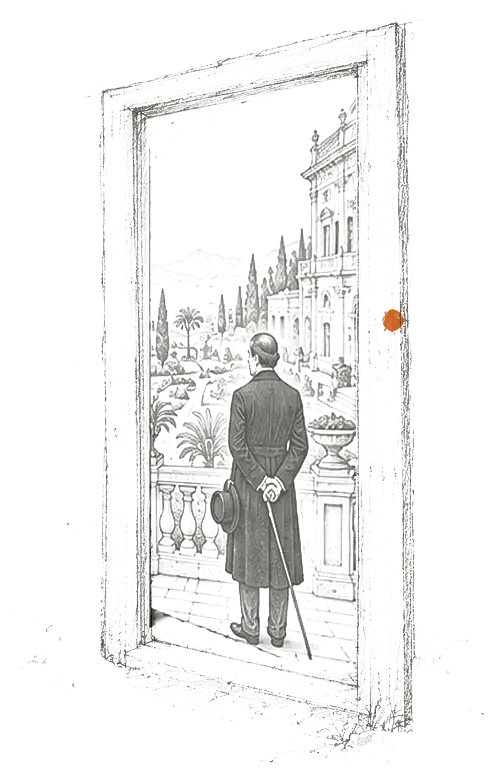
In May 1860 Garibaldi's Redshirts land in Sicily. Don Fabrizio, Prince of Salina, sees his class falter as Italian unity is forged. His favourite nephew, Tancredi, joins the revolutionaries, then falls in love with Angelica, daughter of an ambitious, newly rich bourgeois. Through the prince's family, the novel follows the decline of the aristocracy before the rise of the bourgeoisie.
Timeline
- 1300–1375TrecentoDante, Petrarch, Boccaccio. The Italian language is born of three men.
- 1450–1550RenaissanceAriosto, Machiavelli, Castiglione. Chivalric poem and modern politics.
- 1750–1830Enlightenment and RomanticismGoldoni reforms the theatre, Leopardi raises poetry to its peak.
- 1827–1870RisorgimentoManzoni gives the country a novel and a language just as it becomes a nation.
- 1880–1920VerismoVerga paints poor Sicily. Pirandello blows the theatre apart.
- 1943–1952NeorealismRossellini, De Sica, Visconti film in the street, with the people of the street.
- 1955–1980Great auteur cinemaFellini, Antonioni, Pasolini. Italy is at the centre of world cinema.
Reading keys
- The family name often follows the place of origin, with the particle di or da, and southern names are distinguished from northern ones by their endings.
- First names follow the patron saint of the town and the grandfather, and the name day counts as much as the birthday.
- The first belonging is the town, then the region, and a character presents himself by his bell tower before his nation, which the very language of the text may signal.
- The extended family, with godparenthood and alliances, is the social unit of reference, and the narrative treats it as an institution.
- Fascism, the Republic of Salò and the purge are a still active division, and the words used to name the Resistance or the civil war situate a text.
- The southern question, the gap between north and south and internal emigration are a permanent subject since 1861.
- The mafias, their assassinations of magistrates and the social silence that surrounds them are approached in a whole literature, with real risks for the authors.
- The place of the Church and of the Vatican, a state within the state, obliges every political text to situate itself.
- Catholicism is a total cultural framework, with its local saints, its processions and its votive offerings, and anticlericalism there is an internal position, not an external rejection.
- The cult of the dead and of the souls of purgatory is very present in the south, with practices that Neapolitan literature describes without translating them.
- Healers, the evil eye and the rites against spells are documented up to the present day, and Carlo Levi described them in 1945 as a coherent system.
- The regional legends, transmitted by Basile's collections in Neapolitan and Pitrè's in Sicilian, form a stock that Calvino rewrote in Italian in 1956.
- The patron saints' festivals, with their procession, their band and their illuminations, are the great local gathering and a constant narrative setting.
- The Sunday family meal is an institution with a fixed order of courses, and a text uses it as a regulated scene.
- Mourning is worn in black, for a long time, and the widows of the south sometimes keep it all their lives.
- 25 April, the feast of the Liberation, and 2 June, the feast of the Republic, are civic dates whose commemoration remains debated.
- Dante provides a stock of lines and figures quoted without reference, and his hell is a common topography.
- Pinocchio and Manzoni's novel about two betrothed of the seventeenth century are the two texts that school has made universal.
- Basile's Pentamerone, published in Neapolitan in 1634, contains the first written versions of Cinderella and Puss in Boots, before Perrault and Grimm.
- The commedia dell'arte, with its fixed types, Harlequin, Pantalone, Pulcinella, is a repertoire of characters that theatre and cinema take up.
- Italy is only a hundred and sixty years old as a state, and its literature is eight hundred: the nation came after the language, not the reverse.
- The dialects are not regional variants of Italian but distinct languages, and their use in a text is a political choice.
- Neorealism is not a miserabilist naturalism: it is a technical and moral answer to twenty years of studio cinema.
- The south is not an archaic setting: the southern question is an economic fact documented since unification.
- The catalogue mixes Latin and Italian authors, a convenience of classification that says nothing about a continuity.
Tales and mythologies 1
- TaleThe Tale of TalesLo cunto de li cuntiGiambattista Basile · 1636A curse cast by an old woman sets ten storytellers to work for five days.Literature
A selection to begin with 10 / 120
- PoetryThe Divine ComedyLa Divina CommediaDante Alighieri · 1321A poem in one hundred cantos in which a living man travels through Hell, Purgatory and Paradise, guided by Virgil and then by Beatrice.Literature
- NovelThe BetrothedI promessi sposiAlessandro Manzoni · 1840A historical novel in which two Lombard betrothed, separated by a lord, live through the misfortunes of their century.LiteraturePublic domain
- NovelThe Adventures of PinocchioLe avventure di PinocchioCarlo Collodi · 1883A puppet carved from a log comes to life, and refuses everything people want to make of it.Literature
- CinemaRome, Open CityRoma città apertaRoberto Rossellini · 1945In occupied Rome, a hunted resistance fighter, a parish priest and a neighbour shelter one another.Cinema
- NarrativeIf This Is a ManSe questo è un uomoPrimo Levi · 1947Testimony of a young Italian chemist deported to Auschwitz, written on his return in an analytical tone.Literature
- CinemaBicycle ThievesLadri di bicicletteVittorio De Sica · 1948In postwar Rome, a father loses the bicycle on which his new job depends.Cinema
- NovelThe Baron in the TreesIl barone rampanteItalo Calvino · 1957A boy climbs into an oak tree to escape a dinner, and spends the rest of his life there.Literature
- CinemaTeoremaPier Paolo Pasolini · 1968A nameless visitor settles in with a bourgeois Milanese family, and each of them gives himself to him.Cinema
- CinemaRomeo and JulietFranco Zeffirelli · 1968Two teenagers from feuding families, in Verona, fall in love and marry in secret.Cinema
- CinemaCome Have Coffee with UsVenga a prendere il caffè da noiAlberto Lattuada · 1970A methodical civil servant enters, through a calculated marriage, a house of three heiress sisters.Cinema