Fiji
- works
- 7
- 7 books
- period covered
- 1912–1993
- language of writing
- English
Between 1879 and 1916, more than sixty thousand Indians landed in Fiji under contract to cut sugar cane. The local word for that contract is girmit, formed on the English agreement. Most were supposed to leave again after five years and never did. Their descendants today make up nearly a third of the population, and the country has two literatures that do not always read each other.
Read moreShow less
That double belonging came with a regional function. The University of the South Pacific settled in Suva in 1968, and it was there that the literature of the anglophone Pacific began to exist: a review, a publishing house, workshops, and authors from Tonga, Samoa, the Solomons and Vanuatu publishing from Fiji for want of being able to do so at home. An archipelago of three hundred islands found itself the literary capital of an ocean, and many authors classified elsewhere began writing here.
From this comes a reversal of perspective which is the region's most lasting contribution. Epeli Hauʻofa, born in Papua to Tongan parents and settled in Suva, published in 1983 a satire of the micro-states of the Pacific, of their bureaucracies and of the development aid that maintains them. He would then argue that the Pacific is not a scattering of small isolated and poor islands, but an immense sea that its inhabitants have always crossed in every direction, and that the idea of isolation is an invention of colonial maps. Seeing the sea as a path and not as a barrier changes everything one reads afterwards, including the narratives of navigation, which are no longer feats but ordinary journeys.
What awaits the reader is therefore a precise irony, directed against the powerful and against good intentions with equal energy. The collection that opens this page follows, on an invented South Pacific island, the foreign development experts and those who learn to profit from them, and critics have seen in it sketches where affection mingles with satire.
A way to begin
Tales of the Tikongs
Epeli Hauʻofa · 1983
An invented island in the South Pacific, its foreign experts and those who live off development aid, seen with irony. Translated into French.
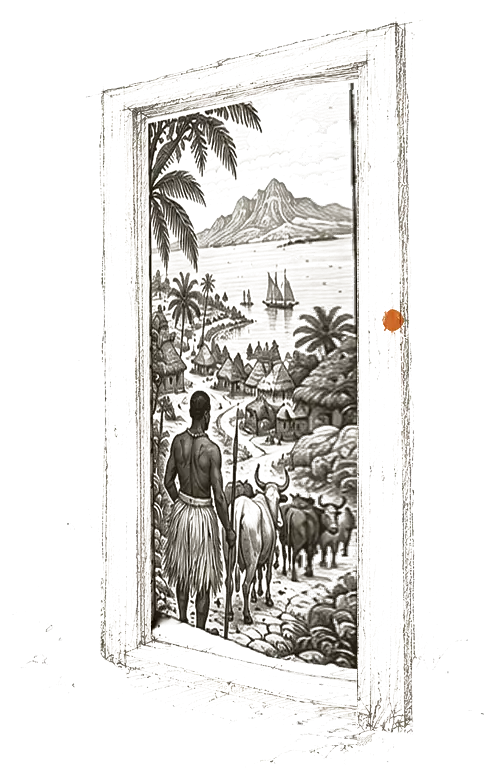
A sequence of linked stories set on Tiko, an invented island in the South Pacific. Foreign experts arrive to impose their model of development, and the inhabitants learn to put up with it or turn it to their advantage: Pulu struggles with the cattle donated by New Zealand, Ole Pasifikiwei runs into a diplomat charged with preserving local culture. Consultants, religious zealots, swindlers and officials pass through in turn.
Timeline
- 1800–1900MekeThe danced chants carry genealogies, wars and the history of the clans.
- 1879–1916Indian indentureThe arrival of indentured labourers creates a second tradition, in Fiji Hindi.
- 1968–1980University of the PacificThe University of the South Pacific, in Suva, becomes the centre of writing for the whole region.
- 1987–2010CoupsPoetry and the novel take on the coups, the land and the archipelago's double belonging.
Reading keys
- Two systems coexist. Indigenous Fijian names refer to the clan, the mataqali, and to the village of origin, which determine rights over land.
- Indo-Fijian names indicate the region of origin in India, the caste and the religion. A Singh, a Reddy and a Khan come neither from the same place nor from the same community.
- Among Fijians, the maternal uncle and the joking relation between cross-cousins structure relationships and authorise liberties of speech that come as a surprise.
- Chiefly titles, including Ratu for men and Adi for women, precede the name and are not decorative.
- The coups of 1987, 2000 and 2006, all linked to the sharing of power between the two communities, are the subject least addressed head-on.
- Relations between indigenous Fijians and Indo-Fijians are expressed by detour: a marriage, a neighbourhood, a market scene.
- Before a chief, one does not speak standing up and one does not pass in front of him. A ceremonial scene obeys rules of placement that the text assumes are known.
- Kava, yaqona, is drunk in a circle according to an order of precedence. A kava scene is a political scene.
- Methodist Christianity is in the majority among indigenous Fijians and has merged with custom, to the point where the Church is an institution of the village.
- Hinduism and Islam are practised by Indo-Fijians, with temples and mosques present throughout the country.
- Ancestral spirits, vu, and forbidden places continue to be respected alongside Christianity. Crossing a forbidden place has consequences in the narrative.
- The ceremonial presentation of the whale's tooth, tabua, opens and seals important relations.
- Fijian mourning unfolds over several days with presentations of mats, cloth and whales' teeth. The value of the gifts is counted and announced.
- Indo-Fijians follow cremation and Hindu rites or Muslim burial, which immediately distinguishes the scenes.
- Diwali is a national public holiday, as are the Christian feasts, which produces a shared calendar.
- The sulu, a piece of cloth worn by men, is an ordinary garment, including with a jacket and tie.
- The Fijian narrative stock, with Ndengei the serpent god who sleeps in a cave of the Nakauvadra, is known and cited.
- The girmit and the narratives of the sea crossing form the founding memory of the Indo-Fijians, with its songs and its registers of names.
- The Ramayana, brought by the indentured labourers, is performed and recited in Fiji as in Trinidad and Suriname.
- Maui, the Polynesian hero who fishes up islands, circulates throughout the region.
- Fiji is not a Polynesian country: the indigenous population is Melanesian with Polynesian contributions, and the country lies at the hinge of the two areas.
- The word "Indian" applied to Indo-Fijians erases a hundred and forty years of local history. They are not recent immigrants.
- Custom is not a folklore: the indigenous land regime covers most of the land and determines economic life.
- The postcard setting is precisely what Fijian literature writes against.
Tales and mythologies 1
- NarrativeTukutuku rarabaAnonymous · 1912not translated into EnglishThe memory of the Fijian clans, recorded under oath by the colonial administration to settle the ownership of land.Literature
A selection to begin with 5 / 7
- Short storiesThe CelebrationRaymond Pillai · 1980Fourteen stories of Indo-Fijian life, dealing with arranged marriages, the lot of wives and ancient beliefs.Literature
- Short storiesThe Fantasy EatersSubramani · 1988Ten short stories about the Indian community of Fiji, from the time of the plantations to that of the graduates.Literature
- NovelThe Wounded SeaSatendra Nandan · 1991An Indo-Fijian childhood in the village, between the memory of indenture and the figures of a vanished world.Literature
- PoetryTandavaSudesh Mishra · 1992A Fijian poet settled in Australia turns Yeats and Eliot against the colonial legacy.Literature
- TheatreLast Virgin in ParadiseVilsoni Hereniko and Teresia Teaiwa · 1993A young islander promised to a European, scrutinised by science and pushed to leave by a relative.Literature